ISO 27002:2022 explained. ISO 27002 controls list and absolutely everything you need to know about the ISO 27002:2022 changes.
Table of contents
- Absolutely everything you need to know about the ISO 27002:2022
- What is ISO 27002?
- What are the main changes to ISO 27002?
- ISO 27002 Controls List
- ISO 27002:2022 Organisational controls
- ISO 27002:2022 People controls
- ISO 27002:2022 Physical controls
- ISO 27002:2022 Technological controls
- ISO 27002:2022 FAQ
- ISO 27001 Controls: The 2022 Framework Update Summary
- ISO 27002:2022 Statement Of Applicability
- Source Material
Absolutely everything you need to know about the ISO 27002:2022
When you go for your ISO 27001 Certification you will choose a set of information security controls.
The list of controls that you will need comes from ISO 27002.
In the ISO 27001 standard it actually refers to it as ISO 27001 Annex A.
So the terms ISO 27002 and ISO 27001 Annex A are, for all intents and purposes, interchangeable. They mean the same thing.
ISO 27002 changed in 2022 and is now formally ISO 27002:2022.
This is everything you need to know about ISO 27002:2022.
What is ISO 27002?
Formally it is called ISO/IEC 27002:2022 Information security, cybersecurity and privacy protection — Information security controls.
It provides a reference set of generic information security controls including implementation guidance. It is designed to be used:
- within the context of an information security management system (ISMS) based on ISO/IEC27001;
- for implementing information security controls based on internationally recognised best practices;
- for developing organisation specific information security management guidelines.
What are the main changes to ISO 27002?
- They have removed the term ‘Code of Practice’
- The structure of the document has changed
- Some controls have been merged, some deleted and new controls have been introduced.
Structure
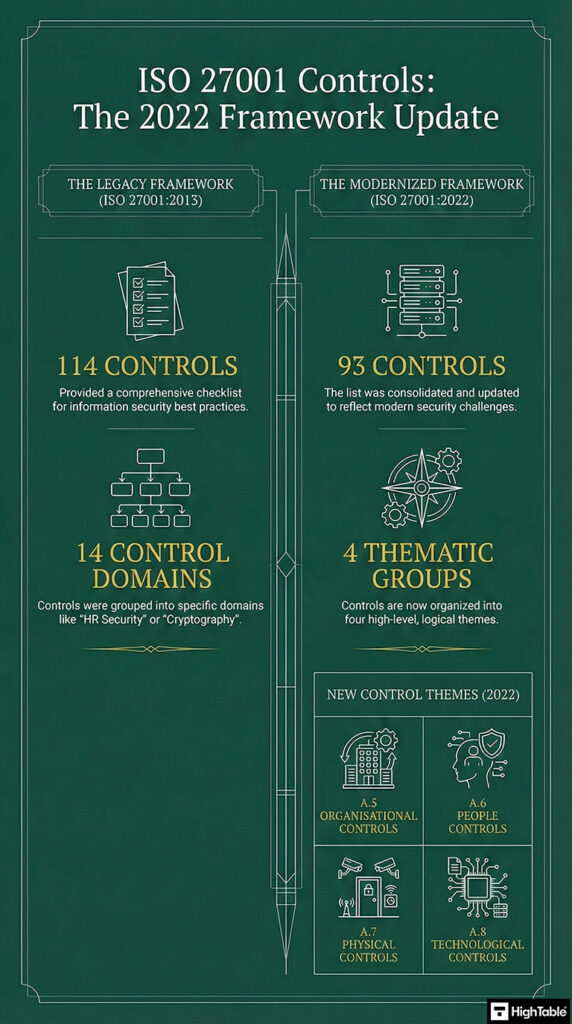
ISO 27002:2022 has 93 controls which have now been structured into 4 domains
- Organisational Controls
- People Controls
- Physical Controls
- Technological Controls
From the previous 14 sections, ISO 27002:2022 now has only four sections, along with two annexes.
New Controls
Here are the 11 controls that are new:
- ISO 27002:2022 control 5.7 Threat intelligence
- ISO 27002:2022 control 5.23 Information security for use of cloud services
- ISO 27002:2022 control 5.30 ICT readiness for business continuity
- ISO 27002:2022 control 7.4 Physical security monitoring
- ISO 27002:2022 control 8.9 Configuration management
- ISO 27002:2022 control 8.10 Information deletion
- ISO 27002:2022 control 8.11 Data masking
- ISO 27002:2022 control 8.12 Data leakage prevention
- ISO 27002:2022 control 8.16 Monitoring activities
- ISO 27002:2022 control 8.23 Web filtering
- ISO 27002:2022 control 8.28 Secure coding
ISO 27002 Controls List
In this section we list all of the ISO 27002: 2022 controls and compare it to the previous control set. We show if it is a new control or the control has changed.
ISO 27002:2022 Organisational controls
| Control | Title | Status | Purpose | Guide |
|---|---|---|---|---|
| 5.1 | Policies for information security | Existing | Ensure suitability, adequacy and effectiveness of managements direction and support for information security. | Read Guide |
| 5.2 | Information security roles and responsibilities | Existing | Ensure a defined, approved and understood structure is in place for the implementation and operation of the information security management system. | Read Guide |
| 5.3 | Segregation of duties | Existing | Reduce the risk of fraud, error and bypassing of information security controls. | Read Guide |
| 5.4 | Management responsibilities | Existing | Require all personnel to apply information security in accordance with the established policy. | Read Guide |
| 5.5 | Contact with authorities | Existing | Establish and maintain contact with relevant authorities. | Read Guide |
| 5.6 | Contact with special interest groups | Existing | Ensure appropriate flow of information takes place with respect to information security. | Read Guide |
| 5.7 | Threat intelligence | NEW | Provide awareness of the organisations threat environment so appropriate mitigation actions can be taken. | Read Guide |
| 5.8 | Information security in project management | Existing | Ensure information security risks related to projects are effectively addressed. | Read Guide |
| 5.9 | Inventory of information and other associated assets | Changed | Identify the organisations information and associated assets to preserve security. | Read Guide |
| 5.10 | Acceptable use of information and other associated assets | Changed | Rules for the acceptable use and procedures for handling information should be identified. | Read Guide |
| 5.11 | Return of assets | Existing | Protect the organisations assets during change or termination of employment. | Read Guide |
| 5.12 | Classification of information | Existing | Ensure identification and understanding of protection needs of information. | Read Guide |
| 5.13 | Labelling of information | Existing | Facilitate the communication of classification of information and support automation. | Read Guide |
| 5.14 | Information transfer | Existing | Maintain the security of information transferred within an organisation and with external parties. | Read Guide |
| 5.15 | Access control | Existing | Ensure authorised access and prevent unauthorised access to information. | Read Guide |
| 5.16 | Identity management | NEW | Allow for the unique identification of individuals and systems accessing information. | Read Guide |
| 5.17 | Authentication information | NEW | Ensure proper entity authentication and prevent failures of authentication processes. | Read Guide |
| 5.18 | Access rights | Changed | Ensure access to information is defined and authorised according to business requirements. | Read Guide |
| 5.19 | Information security in supplier relationships | Existing | Maintain an agreed level of information security in supplier relationships. | Read Guide |
| 5.20 | Addressing information security within supplier agreements | Existing | Maintain an agreed level of information security in supplier relationships. | Read Guide |
| 5.21 | Managing information security in the ICT supply chain | NEW | Maintain an agreed level of information security in supplier relationships. | Read Guide |
| 5.22 | Monitoring, review and change management of supplier services | Changed | Maintain an agreed level of information security and service delivery. | Read Guide |
| 5.23 | Information security for use of cloud services | NEW | Specify and manage information security for the use of cloud services. | Read Guide |
| 5.24 | Information security incident management planning and preparation | Changed | Ensure quick, effective, consistent and orderly response to information security incidents. | Read Guide |
| 5.25 | Assessment and decision on information security events | Existing | Ensure effective categorisation and prioritisation of information security events. | Read Guide |
| 5.26 | Response to information security incidents | Existing | Ensure efficient and effective response to information security incidents. | Read Guide |
| 5.27 | Learning from information security incidents | Existing | Reduce the likelihood or consequences of future incidents. | Read Guide |
| 5.28 | Collection of evidence | Existing | Ensure consistent and effective management of evidence related to information security incidents. | Read Guide |
| 5.29 | Information security during disruption | Changed | Protect information and other associated assets during disruption. | Read Guide |
| 5.30 | ICT readiness for business continuity | NEW | Ensure the availability of the organisations information and assets during disruption. | Read Guide |
| 5.31 | Legal, statutory, regulatory and contractual requirements | Existing | Ensure compliance with legal, statutory, regulatory and contractual requirements. | Read Guide |
| 5.32 | Intellectual property rights | Existing | Ensure compliance with requirements related to intellectual property rights. | Read Guide |
| 5.33 | Protection of records | Existing | Ensure compliance with requirements related to the protection and availability of records. | Read Guide |
| 5.34 | Privacy and protection of PII | Existing | Ensure compliance with requirements related to the protection of PII. | Read Guide |
| 5.35 | Independent review of information security | Existing | Ensure the continuing suitability, adequacy and effectiveness of the approach to managing information security. | Read Guide |
| 5.36 | Compliance with policies and standards | Existing | Ensure information security is implemented in accordance with policy and rules. | Read Guide |
| 5.37 | Documented operating procedures | Existing | Ensure the correct and secure operation of information processing facilities. | Read Guide |
ISO 27002:2022 People controls
| Control | Title | Status | Purpose | Guide |
|---|---|---|---|---|
| 6.1 | Screening | Existing | Ensure all personnel are eligible and suitable for the roles for which they are considered and remain eligible during employment. | Read Guide |
| 6.2 | Terms and conditions of employment | Existing | Ensure personnel understand their information security responsibilities for the roles for which they are considered. | Read Guide |
| 6.3 | Information security awareness, education and training | Existing | Ensure personnel and relevant interested parties are aware of and fulfil their information security responsibilities. | Read Guide |
| 6.4 | Disciplinary process | Existing | Ensure personnel understand the consequences of information security policy violation and deter such violations. | Read Guide |
| 6.5 | Responsibilities after termination or change of employment | Existing | Protect the organisations interests as part of the process of changing or terminating employment or contracts. | Read Guide |
| 6.6 | Confidentiality or non-disclosure agreements | Existing | Maintain confidentiality of information accessible by personnel or external parties. | Read Guide |
| 6.7 | Remote working | NEW | Ensure the security of information when personnel are working remotely. | Read Guide |
| 6.8 | Information security event reporting | Existing | Support timely, consistent and effective reporting of information security events identified by personnel. | Read Guide |
ISO 27002:2022 Physical controls
| Control | Title | Status | Purpose | Guide |
|---|---|---|---|---|
| 7.1 | Physical security perimeter | Existing | Ensure physical security is in place to stop unauthorised people from gaining physical access to property and assets. | Read Guide |
| 7.2 | Physical entry | Existing | Ensure only authorised physical access to the organisations information and other associated assets occurs. | Read Guide |
| 7.3 | Securing offices, rooms and facilities | Existing | Prevent unauthorised physical access, damage and interference to information and assets in offices. | Read Guide |
| 7.4 | Physical security monitoring | Existing | Ensure you detect and deter unauthorised physical access. | Read Guide |
| 7.5 | Protecting against physical and environmental threats | Existing | Prevent or reduce the consequences of events originating from physical and environmental threats. | Read Guide |
| 7.6 | Working in secure areas | Existing | Protect information and assets in secure areas from damage and unauthorised interference. | Read Guide |
| 7.7 | Clear desk and clear screen | Existing | Address risks of unauthorised access, loss of and damage to information on desks and screens. | Read Guide |
| 7.8 | Equipment siting and protection | Existing | Reduce the risks from physical and environmental threats, and from unauthorised access and damage. | Read Guide |
| 7.9 | Security of assets off-premises | Existing | Prevent loss, damage, theft or compromise of off-site devices and interruption to operations. | Read Guide |
| 7.10 | Storage media | NEW | Ensure only authorised disclosure, modification, removal or destruction of information on storage media. | Read Guide |
| 7.11 | Supporting utilities | Existing | Prevent loss, damage or compromise of information and assets due to failure of supporting utilities. | Read Guide |
| 7.12 | Cabling security | Existing | Prevent loss, damage, or compromise of information and interruption related to power and communications cabling. | Read Guide |
| 7.13 | Equipment maintenance | Existing | Prevent loss, damage, or interruption caused by lack of maintenance. | Read Guide |
| 7.14 | Secure disposal or re-use of equipment | Existing | Prevent leakage of information from equipment to be disposed or re-used. | Read Guide |
ISO 27002:2022 Technological controls
| Control | Title | Status | Purpose | Guide |
|---|---|---|---|---|
| 8.1 | User endpoint devices | NEW | Protect information against the risks introduced by using user endpoint devices. | Read Guide |
| 8.2 | Privileged access rights | Existing | Ensure only authorised users, software components and services are provided with privileged access rights. | Read Guide |
| 8.3 | Information access restriction | Existing | Ensure only authorised access and to prevent unauthorised access to information and other associated assets. | Read Guide |
| 8.4 | Access to source code | Existing | Prevent the introduction of unauthorised functionality and maintain the confidentiality of valuable intellectual property. | Read Guide |
| 8.5 | Secure authentication | Existing | Ensure a user or an entity is securely authenticated when access to systems is granted. | Read Guide |
| 8.6 | Capacity management | Existing | Ensure the required capacity of information processing facilities, human resources, offices and other facilities. | Read Guide |
| 8.7 | Protection against malware | Existing | Ensure information and other associated assets are protected against malware. | Read Guide |
| 8.8 | Management of technical vulnerabilities | Existing | Ensure information and other associated assets are protected from the exploitation of technical vulnerabilities. | Read Guide |
| 8.9 | Configuration management | Existing | Ensure hardware, software, services and networks function correctly with required security settings. | Read Guide |
| 8.10 | Information deletion | NEW | Prevent unnecessary exposure of sensitive information and comply with deletion requirements. | Read Guide |
| 8.11 | Data masking | NEW | Limit the exposure of sensitive data including PII and comply with legal and regulatory requirements. | Read Guide |
| 8.12 | Data leakage prevention | NEW | Detect and prevent the unauthorised disclosure and extraction of information by individuals or systems. | Read Guide |
| 8.13 | Information backup | Existing | Enable recovery from loss of data or systems. | Read Guide |
| 8.14 | Redundancy of information processing facilities | Existing | Ensure the continuous operation of information processing facilities. | Read Guide |
| 8.15 | Logging | Existing | Record events, generate evidence, ensure log integrity and support investigations. | Read Guide |
| 8.16 | Monitoring activities | Existing | Detect anomalous behaviour and potential information security incidents. | Read Guide |
| 8.17 | Clock synchronisation | Existing | Enable the correlation and analysis of security-related events and support investigations. | Read Guide |
| 8.18 | Use of privileged utility programs | Existing | Ensure the use of utility programs does not harm system and application controls. | Read Guide |
| 8.19 | Installation of software on operational systems | Existing | Ensure the integrity of operational systems and prevent exploitation of technical vulnerabilities. | Read Guide |
| 8.20 | Network security | Existing | Protect information in networks and supporting facilities from compromise via the network. | Read Guide |
| 8.21 | Security of network services | Existing | Ensure security in the use of network services. | Read Guide |
| 8.22 | Segregation of networks | Existing | Split the network in security boundaries and control traffic between them based on business needs. | Read Guide |
| 8.23 | Web filtering | NEW | Protect systems from being compromised by malware and prevent access to unauthorised web resources. | Read Guide |
| 8.24 | Use of cryptography | Existing | Ensure proper and effective use of cryptography to protect confidentiality, authenticity or integrity. | Read Guide |
| 8.25 | Secure development life cycle | Existing | Ensure information security is designed and implemented within the secure development life cycle. | Read Guide |
| 8.26 | Application security requirements | NEW | Ensure all information security requirements are identified and addressed when developing or acquiring. | Read Guide |
| 8.27 | Secure systems architecture and engineering principles | NEW | Ensure information systems are securely designed, implemented and operated within the development life cycle. | Read Guide |
| 8.28 | Secure coding | Existing | Ensure software is written securely reducing the number of potential vulnerabilities. | Read Guide |
| 8.29 | Security testing in development and acceptance | Existing | Validate if information security requirements are met when applications are deployed to production. | Read Guide |
| 8.30 | Outsourced development | Existing | Ensure information security measures required by the organisation are implemented in outsourced development. | Read Guide |
| 8.31 | Separation of development, test and production environments | Existing | Protect the production environment and data from compromise by development and test activities. | Read Guide |
| 8.32 | Change management | Existing | Preserve information security when executing changes. | Read Guide |
| 8.33 | Test information | Existing | Ensure relevance of testing and protection of operational information used for testing. | Read Guide |
| 8.34 | Protection of information systems during audit testing | NEW | Minimise the impact of audit and other assurance activities on operational systems and business processes. | Read Guide |
ISO 27002:2022 FAQ
What are the main changes in ISO 27002:2022?
The ISO/IEC 27002:2022 standard consolidates the previous 114 controls into 93, introduces 11 completely new controls, and restructures the 14 domains into 4 logical themes. While the number of controls has decreased due to merging 57 redundant items, the rigorousness of the standard remains high. The update focuses on modernising information security practices, specifically introducing concepts like Threat Intelligence and Cloud Security to address the current threat landscape.
What are the 4 themes of ISO 27002:2022?
ISO 27002:2022 abandons the previous 14-domain structure in favour of 4 distinct themes designed to simplify categorisation and ownership. These themes are:
- Organisational Controls (37 controls): Policies, rules, and structural frameworks found in Clause 5.
- People Controls (8 controls): Human resources, screening, and awareness measures found in Clause 6.
- Physical Controls (14 controls): Security perimeters, entry controls, and equipment protection found in Clause 7.
- Technological Controls (34 controls): Secure coding, network security, and cryptography found in Clause 8.
What are the 11 new controls in ISO 27002:2022?
To address evolving digital risks, the 2022 update introduces 11 brand-new controls that organisations must include in their Statement of Applicability (SoA) or justify excluding:
- 5.7 Threat intelligence
- 5.23 Information security for use of cloud services
- 5.30 ICT readiness for business continuity
- 7.4 Physical security monitoring
- 8.9 Configuration management
- 8.10 Information deletion
- 8.11 Data masking
- 8.12 Data leakage prevention
- 8.16 Monitoring activities
- 8.23 Web filtering
- 8.28 Secure coding
How does ISO 27002:2022 affect current ISO 27001 certification?
Organisations currently certified to ISO 27001:2013 generally have a 3-year transition period (ending October 2025) to align with the 2022 amendments. You do not need to recertify immediately; however, you must update your Statement of Applicability (SoA) to map your existing controls against the new 93 controls mandated by Annex A. Failure to transition by the deadline will result in a major non-conformity during your next surveillance or recertification audit.
What are attributes in ISO 27002:2022?
ISO 27002:2022 introduces “attributes,” which function like hashtags to help organisations create different views of their controls. Each control is tagged with five attribute types: Control Type (e.g., Preventive, Detective), Information Security Properties (Confidentiality, Integrity, Availability), Cybersecurity Concepts (Identify, Protect, Detect), Operational Capabilities, and Security Domains. This allows security managers to filter and report on controls more effectively for different stakeholders.
ISO 27001 Controls: The 2022 Framework Update Summary
ISO 27002:2022 Statement Of Applicability
You can download the new ISO 27002:2002 controls in the the Statement of Applicability.
As a bonus you get a copy of the 2013 version of the controls as well.
Allowing you to easily compare the two and assess the new requirements.
Source Material
This document is an opinion article based on the publicly available information provided here. It is noted the document is under preparation for final publication and is subject to changes.
About the author