

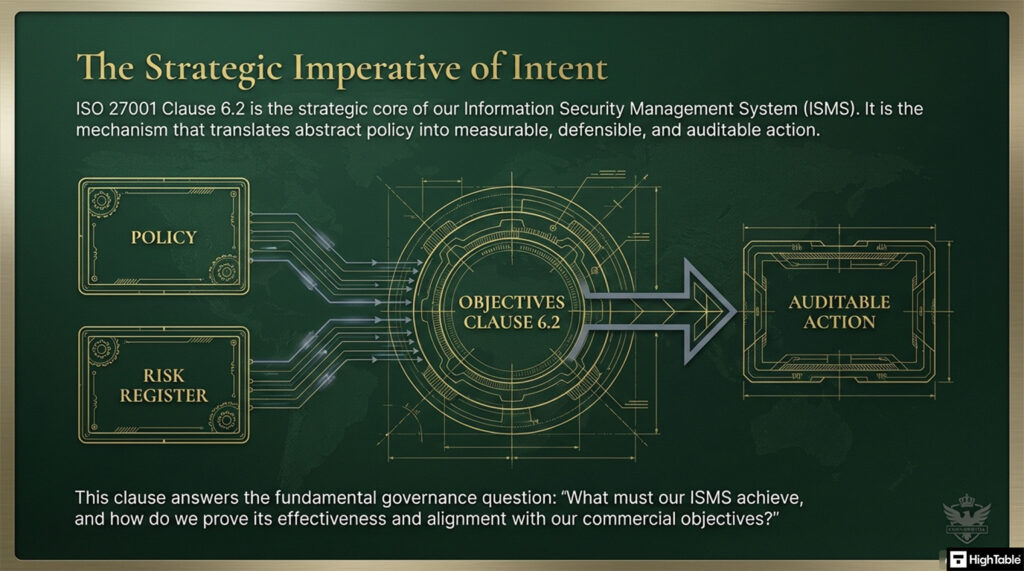
ISO 27001 Clause 6.2 is a security control that mandates organisations to establish measurable information security objectives at relevant functions. It satisfies the Primary Implementation Requirement of aligning security targets with overarching risk strategy, delivering the Business Benefit of a verifiable, results-driven security management system.
In this guide, I will show you exactly how to implement ISO 27001 Clause 6.2 and ensure you pass your audit. You will get a complete walkthrough of the control, practical implementation examples, and access to the ISO 27001 templates and toolkit that make compliance easy.
I am Stuart Barker, an ISO 27001 Lead Auditor with over 30 years of experience conducting hundreds of audits. I will cut through the jargon to show you exactly what changed in the 2022 update and provide you with plain-English advice to get you certified.
Table of contents
- ISO 27001 Information Security Objectives
- What is ISO 27001 Clause 6.2?
- ISO 27001 Clause 6.2 Video Tutorial
- How to implement ISO 27001 Clause 6.2
- ISO 27001 Clause 6.2 Implementaiton Checklist
- The Lifecycle of an Objective
- The ‘Practicable’ Nuance in Clause 6.2b
- Integration with Planning of Changes (Clause 6.3)
- Setting Security Objectives for AI & LLM Integrity
- ISO 27001 Templates
- How to audit ISO 27001 Clause 6.2
- ISO 27001 Clause 6.2 Audit Checklist
- How to pass an audit of ISO 27001 Clause 6.2
- What the auditor wants to see
- Dealing with Objective Failure: The Link to Clause 10.2
- ISO 27001 Clause 6.2 Applicability Across Different Business Models
- Fast track ISO 27001 Clause 6.2 compliance with the ISO 27001 Toolkit
- Common Objective “Hallucinations”: What to Avoid
- ISO 27001 Clause 6.2 Applicable Laws and Related Standards
- Mapping ISO 27001 Clause 6.2 to ISO 9001 (Quality Objectives)
- ISO 27001 Clause 6.2 FAQ
- Related ISO 27001 Controls
- Key Management Clauses Related to 6.2
- Further Reading
- ISO 27001 Clause 6.2 Executive Briefing Slides
Stop Guessing. Start Passing.
AI-generated policies are generic and fail audits. Our Lead-Auditor templates have a 100% success rate. Don’t risk your certification on a prompt

ISO 27001 Information Security Objectives
Information security needs to have objectives that set out what the information security management system hopes to achieve. This is the ‘why’ you have an information security management system.
What is ISO 27001 Clause 6.2?
ISO 27001 Clause 6.2 is an ISO 27001 control that requires you to establish information security objectives.
Those objectives should be established at relevant functions and levels in the organisation.
This ISO 27001 clause is all about information security objectives and planning to meet those objectives.
ISO 27001 Clause 6.2 Purpose
The purpose of ISO 27001 Clause 6.2 is to make sure that you know what you want your information security management system (ISMS) to achieve and how you will go about doing it.
The purpose here is to have an effective information security management system (ISMS) that meets the needs of the organisation.
ISO 27001 Clause 6.2 Definition
ISO 27001 defines ISO 27001 clause 6.2 as:
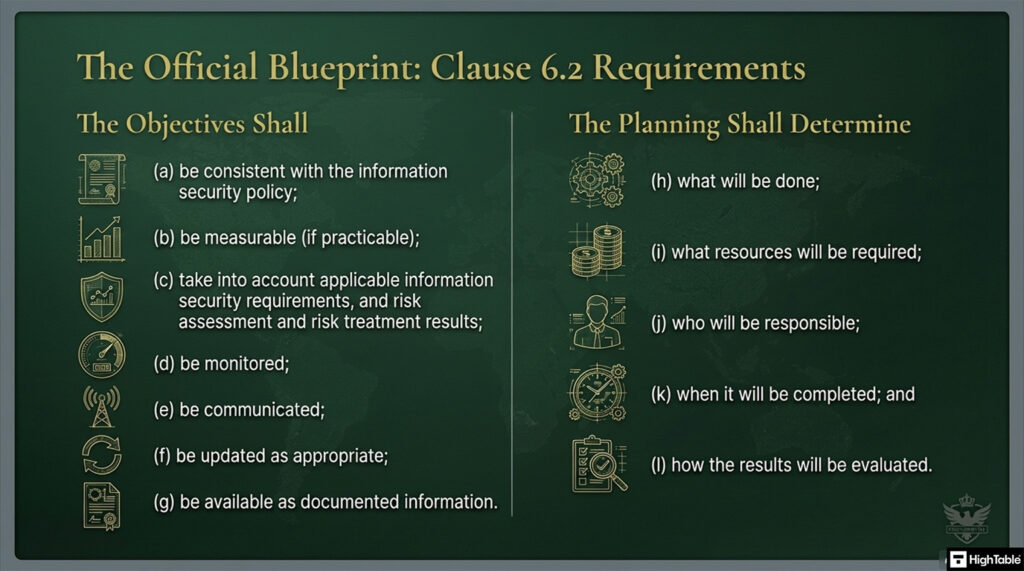
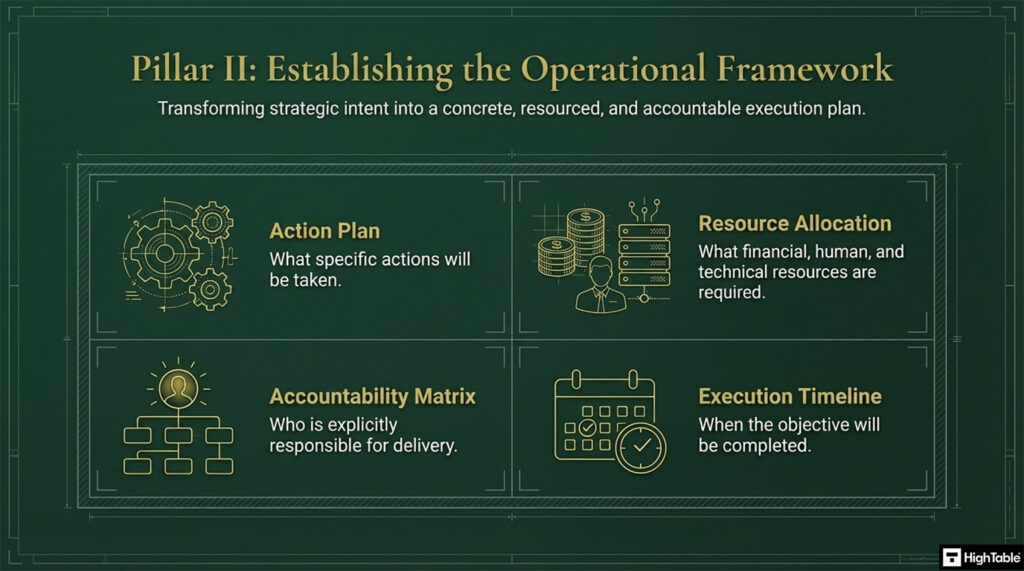
The organisation shall establish information security objectives at relevant functions and levels. The information security objectives shall: a) be consistent with the information security policy; b) be measurable (if practicable); c) take into account applicable information security requirements, and risk assessment and risk treatment results; d) be monitored e) be communicated f) be updated as appropriate. g) be available as documented information The organization shall retain documented information on the information security objectives. When planning how to achieve its information security objectives, the organisation shall determine; h ) what will be done; i) what resources will be required; j) who will be responsible; k) when it will be completed; and l) how the results will be evaluated.
ISO 27001:2022 Clause 6.2 Information Security Objectives and Planning to Achieve Them
What Changed in ISO 27001:2022 Clause 6.2?
ISO 27001 clause 6.2 had minor changes in the 2022 update with the changes being focussed on clarity.
The 2022 update to Clause 6.2 (Information security objectives and planning to achieve them) adds explicit requirements for monitoring and availability. While the 2013 version focused on setting and measuring goals, the 2022 version ensures those goals are actively tracked throughout the year.
| Feature | ISO 27001:2013 | ISO 27001:2022 |
|---|---|---|
| Monitoring Requirement | Objectives were required to be measurable, but active monitoring was not explicitly listed. | Clause 6.2 d) was added, explicitly requiring that objectives “be monitored.” |
| Documentation Availability | Required that documented information be “retained.” | Clause 6.2 g) now requires that objectives “be available as documented information.” |
| Structure | Followed the older Annex SL structure. | Updated to align with the new Harmonized Structure (HS) for easier integration with other ISO standards like 9001 or 14001. |
| Planning | Required defining what, who, when, and how. | Requirements remain the same but are more strictly enforced during audits to ensure “how the results will be evaluated” is clear. |
ISO 27001 Clause 6.2 Video Tutorial
For a complete visual guide to this process, check out our video tutorial: How to implement ISO 27001 Clause 6.2 Information Security Objectives
How to implement ISO 27001 Clause 6.2
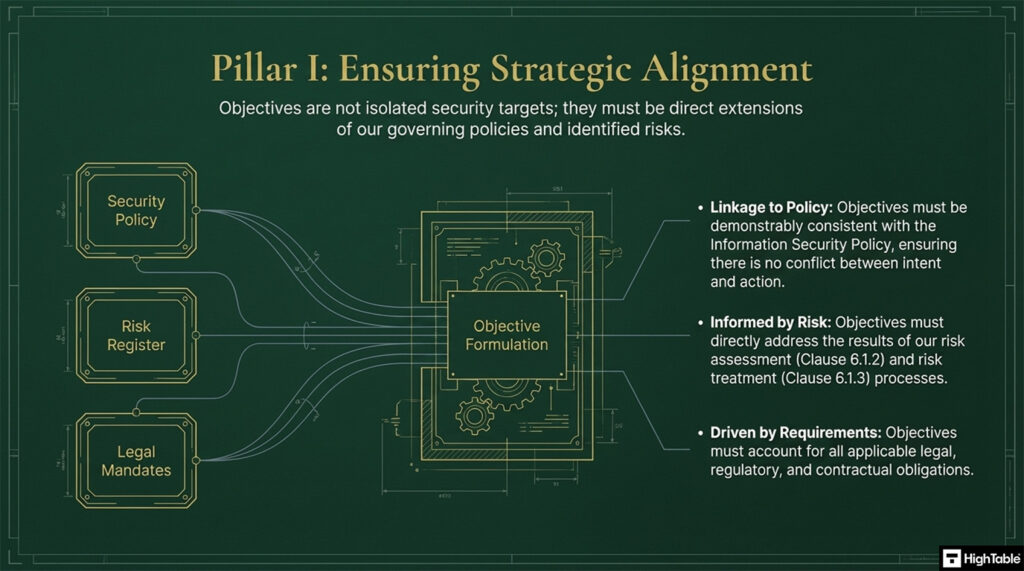
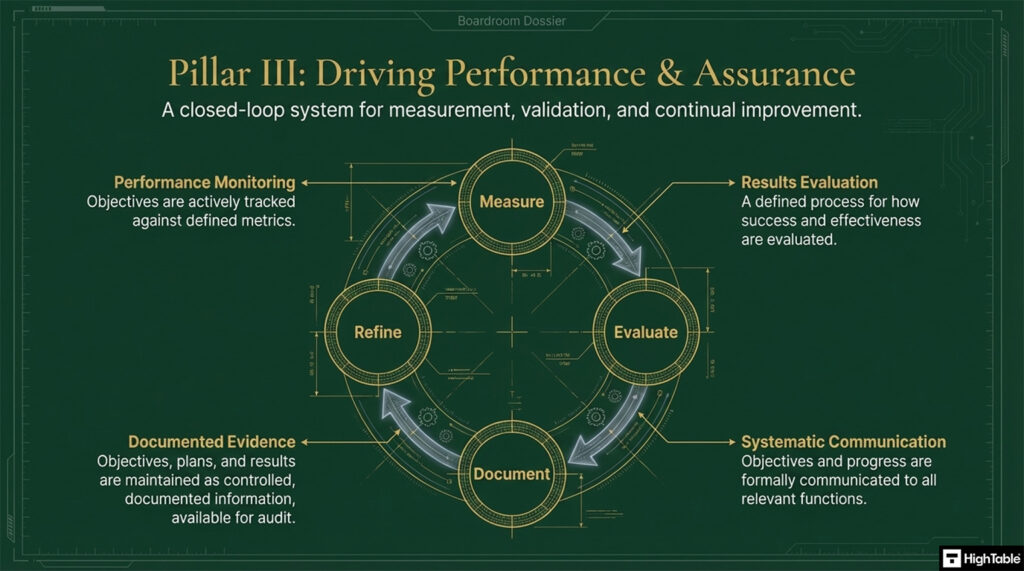
The implementation of ISO 27001 Clause 6.2 Objectives is based on three core pillars.
- Pillar 1 is ensuring strategic alignment.
- Pillar 2 is establishing the operational framework.
- Pillar 3 is driving performance and assurance.
To implement ISO 27001 Clause 6.2 effectively, you must move beyond simple documentation and focus on creating a living framework where security goals drive operational behaviour. This involves aligning technical controls, such as Identity and Access Management (IAM) and Asset Registers, with the strategic intent of the Information Security Management System (ISMS).
Implementing ISO 27001 Clause 6.2 ensures that your organisation’s security objectives are actionable, measurable, and aligned with your broader business strategy. Follow these ten steps to establish a high-performance framework for planning and achieving your information security goals, ensuring full alignment with the 2022 standard requirements.
1. Analyse Business Context and Stakeholder Requirements
- Provision a thorough review of internal and external issues identified in Clause 4.1.
- Formalise the requirements of interested parties to ensure objectives meet legal, regulatory, and contractual obligations.
- Result: A strategic foundation that ensures security goals support the wider business mission.
2. Map Objectives to the Risk Treatment Plan
- Review the outputs of your Clause 6.1 Risk Assessment to identify high-priority vulnerabilities.
- Provision specific objectives that directly mitigate risks documented in your Risk Treatment Plan (RTP).
- Result: Direct alignment between identified security threats and your strategic improvement goals.
3. Establish SMART Information Security Objectives
- Identify core security requirements based on your Risk Assessment and Information Security Policy.
- Provision objectives that are Specific, Measurable, Achievable, Relevant, and Time-bound (SMART).
- Formalise these goals to address the pillars of Confidentiality, Integrity, and Availability (CIA).
- Result: A documented set of objectives providing a clear baseline for ISMS performance.
4. Formalise the Information Security Objectives Register
- Document all objectives in a centralised register to meet the “documented information” requirement.
- Include metadata for each entry, such as the baseline date, target date, and current status.
- Result: A “single source of truth” for auditors to verify compliance with Clause 6.2.
5. Provision Resources and Technical Tooling
- Determine the financial, human, and technical resources required to meet each objective.
- Allocate necessary tooling, such as the ISO 27001 Toolkit, to support the implementation and tracking phase.
- Result: Operational feasibility and the technical capacity to deliver on security promises.
6. Assign Responsibilities and IAM Role Definitions
- Assign specific ownership to roles within the organisation, ensuring accountability via clear Job Descriptions.
- Provision appropriate permissions within your Identity and Access Management (IAM) systems to enable owners to execute tasks.
- Result: Clear accountability and the technical authority required for objective delivery.
7. Integrate Measurement and Monitoring Metrics
- Define Key Performance Indicators (KPIs) for every objective, such as MFA adoption rates or patching lead times.
- Utilise your Asset Register to identify technical touchpoints where automated monitoring can provide real-time data.
- Result: An evidence-based system that proves the effectiveness of security controls over time.
8. Formalise Communication and Awareness Programmes
- Communicate objectives to all relevant internal and external interested parties via a formal communication plan.
- Incorporate objectives into staff induction and ongoing security awareness training to ensure organisational alignment.
- Use Rules of Engagement (ROE) documents to update technical teams on their specific security responsibilities.
- Result: A security-conscious culture where every employee understands their contribution to the goals.
9. Audit and Review via Management Review Process
- Audit the progress of objectives at least annually or following significant organisational changes.
- Include progress reports in the formal Management Review (Clause 9.3) to ensure senior leadership oversight.
- Result: Executive visibility and validation of the ISMS performance against the strategic plan.
10. Revoke and Update for Continual Improvement
- Revoke or update objectives that are no longer relevant to the current risk landscape or business direction.
- Provision new objectives based on the results of internal audits and emerging threat intelligence.
- Result: A dynamic ISMS that adapts to new threats while maintaining compliance with Clause 6.2 requirements.
I’ve sat in the Auditor’s chair for 20 years. These are the exact tools I use to guarantee a pass.

ISO 27001 Clause 6.2 Implementaiton Checklist
To achieve compliance with ISO 27001 Clause 6.2, organisations must move beyond vague security goals and implement a structured framework that links objectives to risk treatment and operational performance. This checklist outlines the essential technical and administrative actions required to satisfy a Lead Auditor during a certification assessment.
| Step | Implementation Requirement | Audit Evidence / Example |
|---|---|---|
| 1 | Analyse Business Context & Stakeholder Requirements | Review of Clause 4.1/4.2 outputs to align goals with legal and contractual obligations. |
| 2 | Map Objectives to the Risk Treatment Plan (RTP) | Direct link between an objective (e.g. 100% MFA) and a high-priority risk in the RTP. |
| 3 | Establish SMART Security Objectives | A documented goal such as “Achieve 99.9% uptime for core services by Q4.” |
| 4 | Formalise the Information Security Objectives Register | A centralised ISO 27001 Toolkit document tracking all targets. |
| 5 | Provision Financial and Technical Resources | Budget approval for security tooling or dedicated personnel hours for implementation. |
| 6 | Assign Responsibility and Technical Ownership | Assigning “Patch Management Efficiency” to the Head of Infrastructure with clear KPIs. |
| 7 | Integrate Measurement and Monitoring Metrics | Utilising an Asset Register to pull automated logs for real-time KPI tracking. |
| 8 | Formalise Communication and Awareness | Inclusion of objectives in staff inductions and Rules of Engagement (ROE). |
| 9 | Conduct Formal Management Review (Clause 9.3) | Minutes from senior leadership meetings showing progress evaluation of security goals. |
| 10 | Revoke and Update via Continual Improvement | Documented updates to objectives following an internal audit or change in threat landscape. |
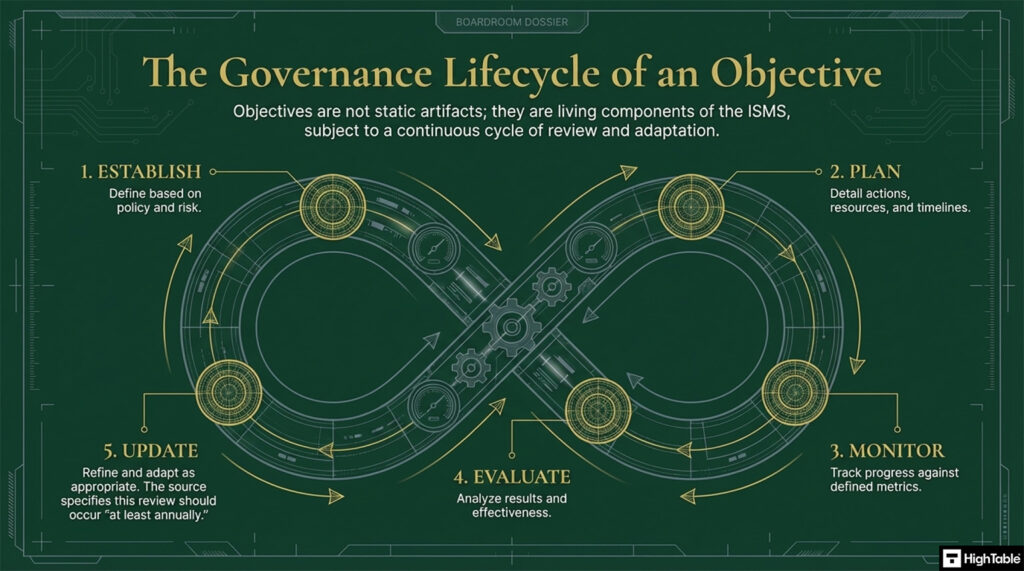
The Lifecycle of an Objective
The lifecycle of an objective is
| Stage | Audit Expectation & Activity |
|---|---|
| Establish | Define SMART security goals that align with the Information Security Policy and identified risks. |
| Plan | Determine resources, responsibilities, timeframes, and evaluation methodologies for each objective. |
| Monitor | Continuously track performance against KPIs to ensure the organisation remains on target. |
| Evaluate | Review results through the Management Review process to determine effectiveness. |
| Update | Refine and adapt objectives based on changes to the threat landscape, business pivot, or audit findings. |
The ‘Practicable’ Nuance in Clause 6.2b
ISO 27001 Clause 6.2b states that information security objectives shall “be measurable (if practicable)”. While the SMART framework encourages hard numbers, such as 99.9% uptime or 100% training completion, lead auditors recognise that some of the most vital security goals are qualitative and cannot be reduced to a simple percentage.
The term ‘practicable‘ provides the flexibility to include objectives that drive security culture and maturity, even if they lack a binary numerical metric.
Quantitative vs. Qualitative Objectives
Understanding the difference between these two types of objectives is key to building a balanced Information Security Management System (ISMS):
- Quantitative (Numerical): These are data-driven metrics. Example: “Achieve a mean time to recover (MTTR) of less than 4 hours for critical system outages.”
- Qualitative (Descriptive): These focus on the quality of an outcome or the maturity of a process where a hard number might be arbitrary. Example: “Ensure all high-level architectural changes undergo a peer-reviewed security impact assessment.”
How to Monitor Without Numbers
If an objective is not measurable in the traditional sense, Clause 6.2d still requires it to be monitored. In a real-world audit context, monitoring a qualitative objective involves management oversight and procedural evidence rather than a dashboard. You can demonstrate monitoring through:
- Peer Reviews: Documented sign-offs showing that the quality of work met a predefined security standard.
- Management Oversight: Minutes from ISMS board meetings where the progress and “health” of a qualitative goal were discussed and validated.
- Maturity Assessments: Using a 1-5 scale (like the CMMI model) to track the increasing sophistication of a process, even if the underlying tasks vary.
Audit Example: The Security Culture Objective
A common objective that falls under the ‘practicable’ clause is Improving Security Culture. It is notoriously difficult to put a single number on ‘culture,’ but you can prove you are monitoring it by providing the following evidence to your auditor:
- Planning: A defined strategy for culture change (Clause 6.2.2).
- Monitoring: Qualitative feedback from an annual staff security survey.
- Evaluation: A summary report presented to the board comparing this year’s survey sentiment to last year’s.
Lead Auditor Tip: Don’t force a metric where it doesn’t fit. I would much rather see a well-monitored qualitative objective that actually improves security than a made-up “95% success rate” on a metric that has no real-world value. If it isn’t practicable to measure it, focus your evidence on the integrity of the review process.
— Stuart Barker, ISO 27001 Lead Auditor
Integration with Planning of Changes (Clause 6.3)
A high-level gap that many practitioners miss is the critical dependency between ISO 27001 Clause 6.2 (Objectives) and ISO 27001 Clause 6.3 (Planning of Changes). ISO 27001 Clause 6.2f requires that objectives be updated as appropriate, but the standard is clear that any significant modification to the ISMS must be handled in a controlled and planned manner.
If your business pivots, adopts new technology like AI, or experiences a shift in risk appetite, your security goals will inevitably change. Simply changing a line in a spreadsheet is not enough; you must ensure the integrity of the ISMS remains intact during the transition.
Scenario: When Security Goals Shift Mid-Cycle
Imagine your organisation decides to migrate from on-premise servers to a full Cloud-SaaS model. Your original objective of “Physical Server Room Security” is now redundant, and a new objective regarding “Cloud Configuration Integrity” is required. To comply with ISO 27001 Clause 6.3, you must document:
- The Purpose of the Change: Why are the objectives being updated? (e.g., Digital transformation).
- Potential Consequences: Will removing an old objective leave a security gap elsewhere?
- The Integrity of the ISMS: How will you ensure that the ISMS continues to meet the standard while you transition?
- Allocation of Resources: Does the new objective require new tools, staff, or budget that wasn’t previously allocated?
How to Update Objectives via Clause 6.3
To demonstrate a “planned manner” of change to your auditor, follow this workflow:
- Formal Proposal: Document the proposed change to the security objective and its impact on the Risk Treatment Plan.
- Impact Assessment: Evaluate how the change affects internal and external requirements (ISO 27001 Clause 4.1 and ISO 27001 Clause 4.2).
- Approval: Ensure the change is reviewed and approved by the ISMS Board or Top Management.
- Update and Communicate: Once approved, update the documented information (Clause 6.2g) and communicate the change to relevant stakeholders (Clause 6.2e).
Lead Auditor Tip: During a Stage 2 audit, I look for “orphaned” objectives, goals that were changed on the fly without an impact assessment. If you pivot your security strategy, I want to see a Change Log or Management Review Minute that references ISO 27001 Clause 6.3. This proves that you are managing your security system, not just reacting to chaos.
— Stuart Barker, ISO 27001 Lead Auditor
Setting Security Objectives for AI & LLM Integrity
As organisations pivot toward Large Language Model (LLM) deployments, Clause 6.2 requires a shift from securing “data at rest” to securing “intelligence in inference.” If your ISMS scope includes AI, your information security objectives must reflect the technical nuances of the ISO/IEC 42001 (AI Management System) and the EU AI Act.
1. Objective: Model Integrity & Adversarial Robustness
Traditional uptime metrics are insufficient for AI. An AI model can be “online” but technically compromised via prompt injection or model evasion.
- Audit-Grade KPI: “Achieve a <1% success rate on internal ‘Red Teaming’ adversarial prompt injection tests against production LLMs.”
- Primary Control: ISO 27001 Annex A 8.8 (Management of technical vulnerabilities) expanded to include LLM-specific vulnerabilities (e.g., OWASP Top 10 for LLMs).
2. Objective: Data Provenance & Training Integrity
The “integrity” portion of the CIA triad takes on a new meaning with AI. You must ensure the data used to fine-tune your models hasn’t been tampered with (Data Poisoning).
- Audit-Grade KPI: “100% of datasets used for model fine-tuning must have a documented ‘Chain of Custody’ and hash-verified integrity check before ingestion.”
- Primary Control: ISO 27001 Annex A 5.31 (Legal and regulatory requirements) focusing on data rights and provenance.
3. Objective: Minimising “Hallucination Risk” as a Security Goal
In a 2026 audit, an auditor may argue that a “hallucinating” AI provides inaccurate information, which is a direct breach of the Integrity requirement of ISO 27001.
- Audit-Grade KPI: “Establish a baseline ‘Truthfulness Score’ for automated customer-facing outputs, ensuring a >98% accuracy rate verified by human-in-the-loop (HITL) sampling.”
- Primary Control: ISO 27001 Annex A 5.35 (Independent review of information security).
| AI Security Objective | Success Metric (KPI) | Resource Requirement | Evaluation Method |
| Prevent Model Leakage | Zero unauthorized downloads of model weights or system prompts. | Enhanced IAM & Data Loss Prevention (DLP) tools. | Quarterly “Crown Jewel” access log audit. |
| Ethical & Bias Alignment | 100% compliance with EU AI Act transparency requirements for high-risk systems. | Legal counsel & AI Ethics committee time. | External regulatory compliance audit. |
| Input Privacy | 0% PII (Personally Identifiable Information) leaked into training logs. | Automated PII masking/scrubbing tools. | Monthly automated scanning of LLM input logs. |
ISO 27001 Templates
ISO 27001 templates are a great way to fast track your implementation and leverage industry best practice.
These individual templates help meet the specific requirements of ISO 27001 clause 6.2

How to audit ISO 27001 Clause 6.2
Auditing ISO 27001 Clause 6.2 requires a systematic verification of how an organisation plans to achieve its security goals. This 10-step audit process ensures that objectives are SMART, appropriately resourced, and integrated into the technical fabric of the Information Security Management System (ISMS).
1. Verify Documentation of Security Objectives
Audit the existence of documented information regarding security objectives. Ensure that these goals are available at relevant levels and functions within the organisation.
- Confirm the objectives are documented as required by the 2022 update.
- Check that the objectives are consistent with the Information Security Policy.
- Verify that the objectives are available to stakeholders via a central ISMS portal or document store.
2. Validate SMART Criteria and Measurability
Examine the specific nature of each objective to ensure they are measurable. Vague objectives such as “protecting data” are insufficient without defined metrics.
- Inspect Key Performance Indicators (KPIs) associated with each objective.
- Cross-reference the “Achievable” and “Time-bound” elements against historical performance data.
- Confirm that quantitative or qualitative measurement methods are clearly defined.
3. Trace Alignment to the Risk Treatment Plan
Audit the link between Clause 6.1 risk outputs and Clause 6.2 objectives. A robust ISMS should use objectives to drive the mitigation of identified risks.
- Review the Risk Treatment Plan (RTP) to identify high-priority risks.
- Verify that objectives have been established to address these specific risks.
- Check for evidence that objectives are updated when new risks are identified in the Asset Register.
4. Inspect Resource Provisioning and Budgetary Support
Audit whether the organisation has determined and provided the resources needed to achieve its security goals. Objectives without resources are often flagged as non-conformities.
- Review budget approvals for technical security tools or the ISO 27001 Toolkit.
- Verify that personnel have been allocated sufficient time to execute the plan.
- Inspect evidence of hardware or cloud infrastructure provisioned for security projects.
5. Confirm Technical Ownership and IAM Roles
Formalise the verification of accountability by checking assigned responsibilities. Every objective must have a named owner with the authority to act.
- Check the Information Security Objectives Register for assigned owners.
- Validate that owners have the necessary Identity and Access Management (IAM) roles to monitor their respective areas.
- Verify that responsibility is reflected in Job Descriptions or individual performance goals.
6. Review Communication and Awareness Evidence
Audit how objectives are communicated across the organisation. Personnel must be aware of the objectives and how they contribute to achieving them.
- Inspect training records for security awareness sessions that include ISMS objectives.
- Review internal memos, newsletters, or Rules of Engagement (ROE) documents.
- Interview staff to confirm their understanding of how their role impacts security targets.
7. Analyse Monitoring and Measurement Data
Audit the actual monitoring activities. You need to see evidence that the organisation is tracking its progress against the baseline.
- Examine monitoring logs and performance reports derived from technical assets.
- Verify the frequency of measurement matches the defined reporting cadence.
- Inspect dashboards or tracking spreadsheets for real-time or periodic data entries.
8. Evaluate Management Review and Oversight
Review the involvement of senior management in the oversight of objectives. Clause 9.3 requires that progress on objectives is a mandatory input for management review.
- Inspect Management Review meeting minutes for discussions on objective performance.
- Verify that senior leadership has provided direction where objectives are not being met.
- Check for evidence of executive-level sign-off on objective updates.
9. Audit Integration with Operational Processes
Provision a check to ensure that security objectives are integrated into the organisation’s standard business processes, rather than existing in a vacuum.
- Verify that technical objectives (e.g. MFA rollout) are integrated into change management.
- Check if security objectives are considered during the procurement of new tools or services.
- Confirm that objectives are reflected in operational project plans.
10. Verify Continual Improvement and Updates
Audit the process for updating and refining objectives. An effective ISMS must react to changes in the threat landscape or business environment.
- Check for evidence of objectives being updated following an internal audit or security incident.
- Revoke the status of “compliant” if objectives remain static despite significant business changes.
- Confirm that completed objectives are replaced with new targets to drive continual improvement.
The Tools We Use.
100% Audit Success. Zero AI Guesswork.

ISO 27001 Clause 6.2 Audit Checklist
As a Lead Auditor, I look for evidence that security objectives are integrated into the business rather than existing as a static document. This checklist ensures you have the necessary proof for each requirement of Clause 6.2, from SMART criteria validation to the verification of resource provisioning.
| Check | Audit Requirement | Evidence Example | GRC Tooling Check |
|---|---|---|---|
| 1 | Documentation of Objectives | Information Security Objectives Register. | Is the register stored in the ISO 27001 Toolkit? |
| 2 | Consistency with Policy | Mapping document showing objective-to-policy alignment. | Does the tool link goals to the high-level Policy? |
| 3 | SMART Criteria Validation | KPIs with specific deadlines (e.g. 100% MFA by June). | Are tracking fields automated or manual? |
| 4 | Risk Treatment Alignment | Cross-reference with the Risk Treatment Plan (RTP). | Is there a direct link between a Risk and an Objective? |
| 5 | Resource Provisioning | Budget approvals or personnel time-allocation logs. | Are resources documented within the project module? |
| 6 | Ownership Accountability | IAM roles and Job Descriptions for objective owners. | Is the “Owner” field populated in the GRC platform? |
| 7 | Communication Evidence | Memos or Rules of Engagement (ROE). | Is there a distribution log for the Objectives? |
| 8 | Measurement & Monitoring | Performance dashboards or technical log extracts. | Does the tool generate real-time KPI reports? |
| 9 | Management Review | Minutes from Clause 9.3 meetings regarding progress. | Are review actions logged in the GRC task manager? |
| 10 | Continual Improvement | Version history of objectives following audits. | Does the platform track historical goal performance? |
How to pass an audit of ISO 27001 Clause 6.2
To pass an audit of ISO 27001 Clause 6.2 you are going to:
- Understand the requirements of your information security management system (ISMS)
- Write objectives that meet those requirements
- Write a plan that shows how you meet and assess those objectives
- Document your objectives
- Communicate the objectives
- Monitor your progress against the objectives
- Review and update objectives as required
What the auditor wants to see
When a Lead Auditor reviews ISO 27001 Clause 6.2, they aren’t just looking for a list of goals; they are looking for evidence of a functioning management process. They want to see that your objectives are grounded in reality, supported by resources, and actually tracked.
The following table breaks down exactly what an auditor will ask for, the specific evidence required, and real-world examples of “Audit-Grade” responses.
| What the Auditor Wants to See | Required Evidence / Artifacts | Example of an Audit-Grade Response |
|---|---|---|
| Documented Objectives (6.2g) | Information Security Objectives Register or ISMS Dashboard. | A signed PDF or version-controlled spreadsheet listing 5 core objectives for the current financial year. |
| SMART Alignment (6.2b) | Documented KPIs and specific target dates. | “Objective: Improve incident response. KPI: Mean Time to Respond (MTTR) under 2 hours. Target Date: Dec 2026.” |
| Policy Consistency (6.2a) | Mapping between Objectives and the InfoSec Policy statements. | Showing that an objective to “Encrypt all Data at Rest” directly supports the Policy statement of “Protecting Confidentiality.” |
| Resource Allocation (6.2i) | Budget approvals, head-count allocation, or tool procurement records. | An approved PO for an automated patching tool used to meet the “48-hour patching” objective. |
| Evidence of Communication (6.2e) | Email logs, intranet screenshots, or training attendance records. | A screenshot of the CEO’s monthly “All-Hands” slides highlighting the year’s security goals to the whole company. |
| Evaluation of Results (6.2l) | Quarterly performance reports or Management Review minutes. | Minutes from a Q3 Board meeting showing that a missed uptime target was discussed and a corrective action plan approved. |
| Risk Treatment Link (6.2c) | A direct link between the Risk Treatment Plan (RTP) and the objectives. | An objective to “Implement MFA” that was created specifically to treat a “High” risk of credential harvesting identified in the Risk Register. |
Auditor’s “Red Flag” Checklist
If you present any of the following, expect a Non-Conformity (NC):
- Vague Goals: Objectives like “We want to be more secure” are not measurable and will fail the audit.
- The “Wall-of-Green”: Dashboards showing 100% success on everything without any underlying data to prove it.
- Missing Owners: Objectives that don’t have a named individual responsible for the outcome (Clause 6.2j).
- Stale Data: Objectives that haven’t been reviewed or updated in over 12 months (Clause 6.2f).
Dealing with Objective Failure: The Link to Clause 10.2
One of the biggest mistakes organisations make during an ISO 27001 audit is trying to present a “perfect” dashboard. If every single Key Performance Indicator (KPI) for your security objectives is green, 100% of the time, an experienced auditor will suspect your objectives are either too easy or your monitoring is ineffective.
Auditors do not look for perfection; they look for integrity. This is where the critical link between Clause 6.2 (Objectives) and ISO 27001 Clause 10.2 (Non-conformity and Corrective Action) comes into play.
Why Failed Objectives are Audit Evidence
When a measurement shows that you are missing a security target, for example, your patch management success rate drops to 80% against a 95% objective, this is technically a non-conformity with your own ISMS requirements.
A failed objective is not an “automatic fail” for your certification. In fact, a failure that has been identified, documented, and acted upon is gold-standard evidence that your ISMS is actually working. It proves that:
- Monitoring is effective: You are actually watching the metrics and reporting honestly.
- Management is transparent: You are not hiding failures from senior leadership.
- The system is self-correcting: You are using data to drive real-world improvement.
The Corrective Action Workflow for Clause 6.2
If you miss an objective, you must follow the formal corrective action process defined in ISO 27001 Clause 10.2 to maintain compliance:
- React to the Non-conformity: Acknowledge the failure in your ISMS management tool or objective tracker.
- Evaluate the Need for Action: Determine why the objective was missed. Was it a lack of resources, a technical failure, or an unrealistic timeline?
- Identify the Root Cause: Use a “5 Whys” analysis or a Fishbone diagram to get to the source of the problem.
- Implement Correction: Fix the immediate issue and put measures in place to prevent recurrence.
- Review Effectiveness: Re-measure the objective in the next cycle to ensure the fix actually worked.
Documenting the Failure for your Auditor
To pass your audit when objectives are failing, ensure you have the following “paper trail” ready for the Lead Auditor:
- The Performance Report: Data showing the specific metric that was missed.
- The Non-conformity Report (NCR): A formal log referencing SO 27001 Clause 10.2 that records the failure.
- Management Review Minutes: Evidence that top management was informed of the failure and approved the resources for the corrective plan.
Lead Auditor Tip: I have certified companies that missed 40% of their initial objectives but had world-class Corrective Action records. I have also issued major non-conformities to companies with 100% “green” dashboards who could not prove the data was real. The value is in the response to the failure, not the success itself.
— Stuart Barker, ISO 27001 Lead Auditor
ISO 27001 Clause 6.2 Applicability Across Different Business Models
ISO 27001 Clause 6.2 requires organisations to establish measurable information security objectives that are consistent with their security policy and risk treatment results. This table outlines how different organisational types, ranging from small businesses to AI driven enterprises, should implement these objectives to satisfy both compliance requirements and strategic business goals.
| Organisation Type | Applicability | Why It Is Important | Clause 6.2.1 Objective Examples |
|---|---|---|---|
| Small Business | High. Essential for establishing a baseline security culture with limited resources. | Demonstrates security maturity to larger clients and reduces the likelihood of business-ending data breaches. | Achieve 100% staff completion of security awareness training within the first 30 days of employment. |
| Tech Startups | Vital. Often a mandatory requirement for venture capital due diligence and enterprise sales cycles. | Minimises technical debt by embedding security requirements into the DevOps and scaling processes early. | Maintain 99.9% availability for the production SaaS environment and implement MFA on all internal systems by Q3. |
| AI Companies | Critical. Addresses specific risks regarding model integrity, training data provenance, and intellectual property. | Mitigates the legal and ethical risks associated with processing massive datasets and protects proprietary algorithms. | Ensure 100% of training data sources are audited for compliance and implement strict IAM roles for access to model weights. |
Fast track ISO 27001 Clause 6.2 compliance with the ISO 27001 Toolkit
When addressing ISO 27001 Clause 6.2, auditors look for documented evidence that security objectives are integrated into the “business as usual” fabric of your organisation. While SaaS GRC platforms often promise automation, they frequently create a “compliance silo” that detaches these objectives from your actual operations.
The ISO 27001 Toolkit ensures that your planning is portable, familiar, and permanently owned, allowing for seamless integration into existing management workflows.
Choosing the right framework for managing ISO 27001 Clause 6.2 objectives is a critical decision for any Information Security Manager. While SaaS GRC platforms offer automated workflows, they often introduce significant vendor lock-in and recurring costs; conversely, a document-led toolkit provides permanent data ownership and seamless integration with existing business processes. This table evaluates the technical and financial implications of both approaches to help you maintain a sustainable ISMS.
| Argument | ISO 27001 Toolkit (HighTable) | Online SaaS GRC Platforms |
|---|---|---|
| Data Ownership | Permanent ownership of all documentation. You keep your files forever on your local or cloud drive. | Access is “rented”. If you stop paying the subscription, you lose access to your historical compliance data. |
| Simplicity & UI | Uses familiar Microsoft Word and Excel formats. No learning curve for staff or leadership. | Requires training on proprietary software interfaces, often leading to low internal adoption. |
| Total Cost | A single, one-off fee for the entire toolkit. No hidden costs or tiered pricing. | Expensive monthly or annual recurring fees that increase as your organisation scales. |
| Vendor Freedom | Zero vendor lock-in. Your ISMS remains portable and can be managed by any consultant or employee. | High vendor lock-in. Migrating your Clause 6.2 data and history out of a SaaS platform is technically difficult. |
| Clause 6.2 Planning | Easily link Excel-based objectives to existing business KPIs and resource spreadsheets. | Objectives are often trapped within the platform, making them harder to share with non-users. |
Key Takeaways for Senior Leadership
- Asset Portability: Clause 6.2 requires “documented information”. By using the Toolkit, your documentation remains a tangible business asset rather than a line item in a software vendor’s database.
- Operational Readiness: Because the toolkit uses standard office software, your team can begin defining objectives immediately without the delay of “platform onboarding.”
Common Objective “Hallucinations”: What to Avoid
In my 30+ years of auditing, I’ve seen hundreds of organisations fail Clause 6.2 not because they didn’t have goals, but because their goals were “hallucinations”, statements that look like objectives but lack the substance to survive a Stage 2 assessment.
1. The “Zero Risk” Hallucination
- The Mistake: “Our objective is to have zero security incidents this year.”
- Why Auditors Reject It: Security is about risk management, not risk elimination. A “zero incident” goal is unrealistic and encourages staff to hide minor breaches to avoid “breaking the streak.”
- The Gold Standard Fix: “Maintain an average Incident Response time of under 4 hours for P1 incidents, with 100% of ‘Lessons Learned’ reviews completed within 5 days.”
2. The “Busy-ness” Hallucination
- The Mistake: “We will hold regular security meetings.”
- Why Auditors Reject It: This is an activity, not an outcome. It doesn’t meet the Clause 6.2 requirement to define “how the results will be evaluated.” Meeting for the sake of meeting doesn’t prove the ISMS is effective.
- The Gold Standard Fix: “Ensure the ISMS Board achieves a 90% attendance rate and closes 100% of ‘High’ priority action items within their defined target dates.”
3. The “Binary” Hallucination
- The Mistake: “Implement a new firewall by June.”
- Why Auditors Reject It: While time-bound, it lacks a quality metric. You could plug in a firewall and misconfigure it, and technically “meet” the goal while actually decreasing security.
- The Gold Standard Fix: “Commission the new Next-Gen Firewall by June 30th, ensuring 100% of rules are peer-reviewed against the ‘Zero Trust’ architecture policy before go-live.”
ISO 27001 Clause 6.2 Applicable Laws and Related Standards
As a Lead Auditor, I view ISO 27001 Clause 6.2 not just as a compliance checkbox, but as the strategic bridge between your risk assessment and your operational reality. When you set measurable Information Security Objectives, you are simultaneously generating the exact audit evidence required by global regulators. This exhaustive mapping table illustrates how establishing SMART security targets under Clause 6.2 directly satisfies the governance and accountability mandates of international laws, frameworks, and industry standards.
| Regulatory Framework / Standard | Applicability & Focus Area | How ISO 27001 Clause 6.2 Satisfies the Requirement |
|---|---|---|
| NIST Cybersecurity Framework (CSF 2.0) | Global Cybersecurity Governance | Maps directly to the Govern (GV) function, specifically GV.PO-01 and GV.RM. Clause 6.2 provides the documented evidence that leadership has established strategic cybersecurity objectives, allocated resources, and implemented a monitoring cadence to oversee risk management strategies. |
| NIS2 Directive (EU) | Critical Infrastructure & Supply Chain Resilience | Article 20 mandates that management bodies approve cybersecurity risk-management measures and oversee their implementation. By setting measurable objectives and tracking them via Management Review, Clause 6.2 provides the auditable proof of executive oversight required to avoid severe NIS2 penalties. |
| DORA (Digital Operational Resilience Act – EU) | Financial Sector ICT Resilience | Article 5 demands that the management body defines, approves, and oversees the ICT risk management framework. Clause 6.2 satisfies this by translating high-level ICT resilience goals into granular, resourced, and measurable objectives for third-party risk and system availability. |
| SOC 2 (Trust Services Criteria) | Service Organisation Security & Availability | Directly addresses Common Criteria CC1.3, which requires management to establish objectives to enable the identification and assessment of risks relating to objectives. Your Clause 6.2 Objectives Register is the exact artefact a CPA will request to verify this criteria. |
| EU AI Act & Global AI Laws | Artificial Intelligence Governance | Article 17 requires a Quality Management System (QMS) for high-risk AI systems. Clause 6.2 allows organisations to set specific, measurable objectives regarding data poisoning prevention, model integrity, and algorithmic bias tracking, ensuring AI governance is quantified. |
| ISO/IEC 42001 (AI Management System) | AI Management Standard | Clause 6.2 of ISO 42001 is structurally identical to ISO 27001. By establishing information security objectives, you create the foundational blueprint for setting AI-specific objectives, ensuring harmonised governance across both data security and artificial intelligence operations. |
| GDPR (EU & UK) | Data Protection & Privacy | Article 24 (Responsibility of the controller) and Article 32 (Security of processing) demand technical and organisational measures. Clause 6.2 provides the framework to set measurable targets for data protection, such as “achieve 100% encryption of personal data at rest by Q2”, proving proactive compliance. |
| UK Data (Use and Access) Act 2025 | UK Evolved Data Protection | While reducing administrative burdens, this Act maintains strict accountability requirements. Clause 6.2 demonstrates practical security outcomes over mere paperwork, allowing UK businesses to prove they are actively measuring and improving their data safeguards. |
| Cyber Security and Resilience Bill (UK) | UK Critical Infrastructure & MSPs | Expanding on NIS2 principles, this bill mandates proactive resilience. Clause 6.2 allows Managed Service Providers (MSPs) to set and track specific objectives for incident response times and supply chain audits, ensuring readiness for expanded mandatory reporting. |
| CIRCIA (USA) | Cyber Incident Reporting for Critical Infrastructure | Mandates 72-hour reporting for critical sectors. Clause 6.2 supports this by allowing organisations to set strict, measurable objectives around incident detection and triage times, ensuring the technical resources and capabilities are in place to meet these aggressive reporting windows. |
| EU Product Liability Directive (PLD) Update | Software Provider Liability | The PLD update extends strict liability to software providers for cybersecurity flaws. By utilising Clause 6.2 to set rigorous “Secure by Design” objectives and vulnerability patching KPIs, software vendors can demonstrate a documented standard of care to defend against liability claims. |
| ECCF (European Cybersecurity Certification Framework) | EU Harmonised Security Labels | Achieving ECCF labels (Basic, Substantial, High) requires a verifiable security baseline. Clause 6.2 provides the planning and measurement framework necessary to prove to assessment bodies that security controls are not only implemented but continuously monitored against predefined targets. |
| HIPAA (Security Rule – USA) | Healthcare Data Protection | Under the Administrative Safeguards (45 CFR 164.308), covered entities must implement security management processes. Clause 6.2 acts as the mechanism to set measurable goals for safeguarding Electronic Protected Health Information (ePHI), such as audit log review frequencies. |
| California Data Laws (CCPA / CPRA) | Consumer Privacy Rights | Requires businesses to implement “reasonable security procedures and practices”. Setting SMART objectives under Clause 6.2 provides the documented evidence that a business is continually measuring and improving its security posture to protect Californian consumer data. |
Mapping ISO 27001 Clause 6.2 to ISO 9001 (Quality Objectives)
Many organisations operate an Integrated Management System (IMS) where ISO 27001 (Information Security) and ISO 9001 (Quality Management) coexist. Because both standards share the Annex SL high-level structure, Clause 6.2 is functionally identical in its requirements. However, the true “pro” move is knowing how to align them without doubling your administrative burden.
In this section, I will show you how to satisfy both standards by aligning objectives where they overlap, specifically in areas like service availability, process integrity, and customer trust.
Strategic Alignment: The Unified Objective Approach
Rather than maintaining two separate, siloed spreadsheets, a Lead Auditor looks for a unified management framework. ISO 9001 focuses on customer satisfaction and product quality, while ISO 27001 focuses on protecting information assets. When you maintain a high-performance system, those two things are often the same thing.
| Feature | ISO 27001 (Information Security) | ISO 9001 (Quality Management) | IMS Integration Strategy |
|---|---|---|---|
| Primary Focus | Confidentiality, Integrity, and Availability of data. | Conformity of products and customer satisfaction. | Focus on Service Reliability. High uptime satisfies both Security (Availability) and Quality (Customer Trust). |
| Input Source | Risk Assessments (6.1) and Security Policy. | Quality Policy and Organisational Strategy. | Use a single Strategic Management Review to set both sets of goals simultaneously. |
| Measurability | Security KPIs (e.g. MTTR, Patching rates). | Quality KPIs (e.g. Defect rates, Net Promoter Score). | Use a shared Objectives Register with a column to tag which standard the goal supports. |
| Communication | Staff and external partners. | Relevant interested parties and staff. | Include both Quality and Security goals in a single Staff Awareness Programme. |
Practical Example: The Unified IMS Objective
To avoid paperwork bloat, implement objectives that serve two masters. Here is how that looks in practice:
- The Quality Objective: “Ensure 99.9% uptime for the Client Portal to maintain customer satisfaction levels.”
- The Security Objective: “Maintain 99.9% availability of the Client Portal by mitigating DDoS risks and hardware failure.”
- The IMS Result: A single technical measurement (Uptime %) that provides audit evidence for both ISO 9001 and ISO 27001 Clause 6.2.
Lead Auditor Tip: When I audit an IMS, I check for “Objective Conflict.” For example, a Quality objective to “Simplify user login for speed” might conflict with a Security objective to “Implement mandatory MFA.” If you have an IMS, your Management Review (9.3) minutes must show that you have balanced these competing requirements. This is where the real maturity shows.
Stuart Barker, ISO 27001 Lead Auditor
Why This Matters for Your Audit
- Efficiency: You reduce the number of meetings and reports required by at least 30%.
- Clarity: Staff are not confused by competing sets of “priorities” from different departments.
- Compliance: It demonstrates to the auditor that security is not a “bolt-on” but is integrated into the business operations.
ISO 27001 Clause 6.2 FAQ
What is ISO 27001 Clause 6.2.1?
ISO 27001 Clause 6.2.1 mandates that an organisation establishes documented information security objectives at relevant functions and levels. Bottom line: these objectives must be consistent with the security policy, be measurable, account for risk assessment results, and be effectively communicated and updated to maintain ISMS compliance.
How do you create measurable security objectives?
Measurable objectives are created by applying the SMART framework (Specific, Measurable, Achievable, Relevant, and Time-bound). Lead auditors look for specific KPIs; for example, achieving 100% encryption on all portable assets or ensuring 99.99% uptime for critical infrastructure, rather than vague statements like “improve security.”
What planning is required for Clause 6.2.2?
To comply with Clause 6.2.2, you must document five specific planning elements: what will be done, what resources are required, who is responsible, when it will be completed, and how the results will be evaluated. This ensures that objectives move from theoretical goals to operational realities within the ISMS.
Who is responsible for setting security objectives?
Top management holds ultimate responsibility for ensuring security objectives are established and aligned with the organisation’s strategic direction. While the CISO or Information Security Manager typically drafts the technical details, 100% of these objectives must be approved and signed off by senior leadership to pass a Stage 2 audit.
Related ISO 27001 Controls
The following list identifies the critical 2022 controls that act as the delivery mechanism for your information security objectives:
Control to Objective Mapping with KPI Examples
| Security Objective (The Goal) | KPI / Measurement (The Success Metric) | Target Date | Primary Annex A Control (The Tool) | Responsible Owner |
| Ensure all critical systems are resilient. | Achieve 99.9% uptime for the production SaaS environment. | Ongoing / Monthly Review | ISO 27001 Annex A 8.14 (Redundancy of info. processing facilities) | CTO / Head of Infrastructure |
| Reduce the risk of “human error” breaches. | 100% of staff pass the quarterly phishing simulation with <3% click rate. | Q4 2026 | ISO 27001 Annex A 6.3 (Info. security awareness and training) | HR / InfoSec Manager |
| Minimise the “Window of Vulnerability”. | Patch all ‘Critical’ severity vulnerabilities within 48 hours of release. | Monthly Audit | ISO 27001 Annex A 8.8 (Management of technical vulnerabilities) | IT Security Lead |
| Strengthen Logical Access Security. | Zero “Critical” findings during quarterly access right reviews. | Quarterly | ISO 27001 Annex A 5.18 (Access rights) | IAM Administrator |
| Maintain Legal & Regulatory Compliance. | 100% compliance with GDPR/UK Data Protection Act 2018 audit. | Annual Review | ISO 27001 Annex A 5.31 (Legal and regulatory requirements) | DPO / Legal Counsel |
Key Management Clauses Related to 6.2
Outside of ISO 27001 Annex A, ISO 27001 Clause 6.2 is also connected with these core management requirements:
- ISO 27001 Clause 6.1.2 (Risk Assessment): Your objectives should be designed to treat the risks identified here.
- ISO 27001 Clause Clause 9.1 (Monitoring and Measurement): This is where you actually perform the evaluation defined in your 6.2.2 planning.
- ISO 27001 Clause Clause 9.3 (Management Review): This is the formal forum where you tell senior leadership whether you actually met your objectives.
Further Reading
- ISO 27001 Objectives | Beginner’s Guide
- Business Continuity Objectives and Strategy Template
- ISO 27001 Clause 6 Planning – Ultimate Certification Guide
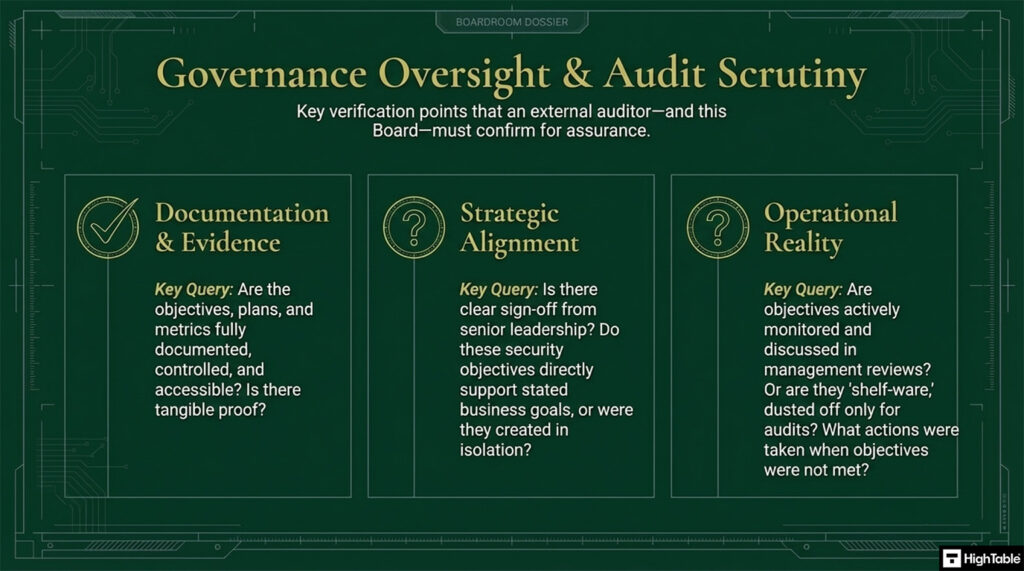
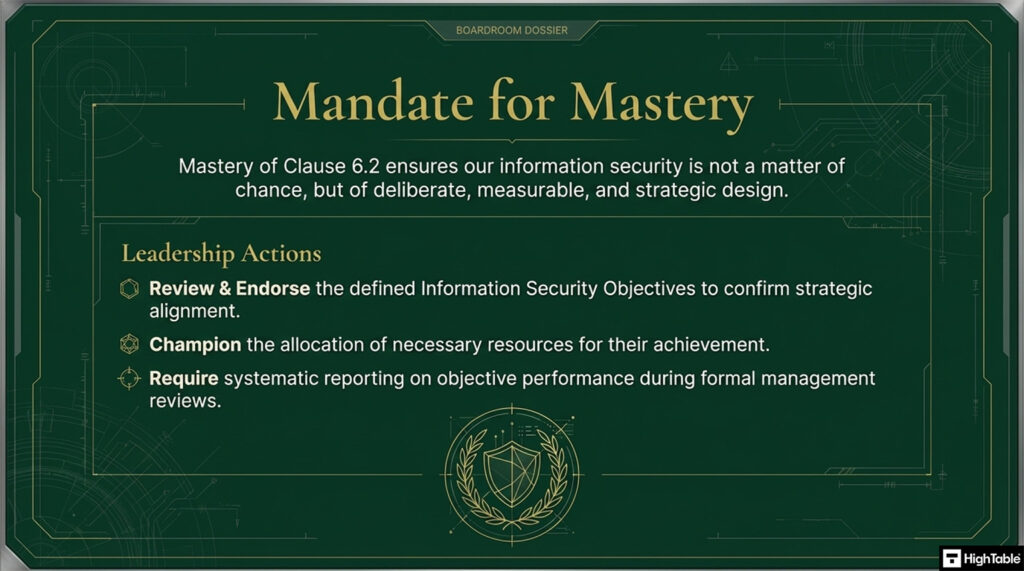
ISO 27001 Clause 6.2 Executive Briefing Slides
About the author
