

In this guide, you will learn what an ISO 27001 Data Retention Policy is, how to write it yourself and I give you a template you can download and use right away.
Table of contents
- ISO 27001 Data Retention Policy Explained
- ISO 27001 Data Retention Policy Template
- ISO 27001 Data Retention Policy Example
- How to write an ISO 27001 Data Retention Policy
- What you need to know
- How to Implement it
- How to audit it
- How it applies to Small Business, Tech Startups, and AI Companies
- ISO 27001 Data Retention Policy FAQ
ISO 27001 Data Retention Policy Explained
The ISO 27001 Data Retention Policy sets out how you long you keep different categories of data for. It is a legal and regulatory requirement.
It is one of the ISO 27001 policies required by the ISO 27001 standard for ISO 27001 certification.

ISO 27001 Starter Kit
Instant download of mandatory ISMS core policies and documentation. Verified by Lead Auditors and used by 5,000+ businesses worldwide to pass Stage 1 certification first time.
ISO 27001 Data Retention Policy Template
The ISO 27001 Data Retention Policy Template is designed to fast track your implementation and give you an exclusive, industry best practice policy template that is pre written and ready to go. It is included in the ISO 27001 toolkit.

ISO 27001 Data Retention Policy Example
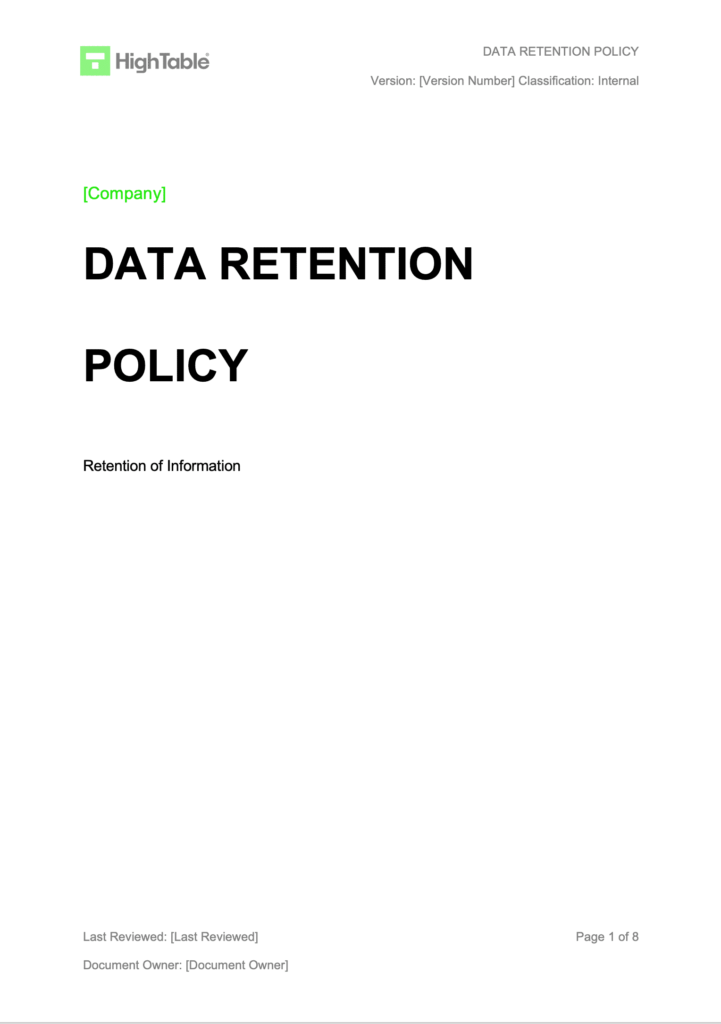
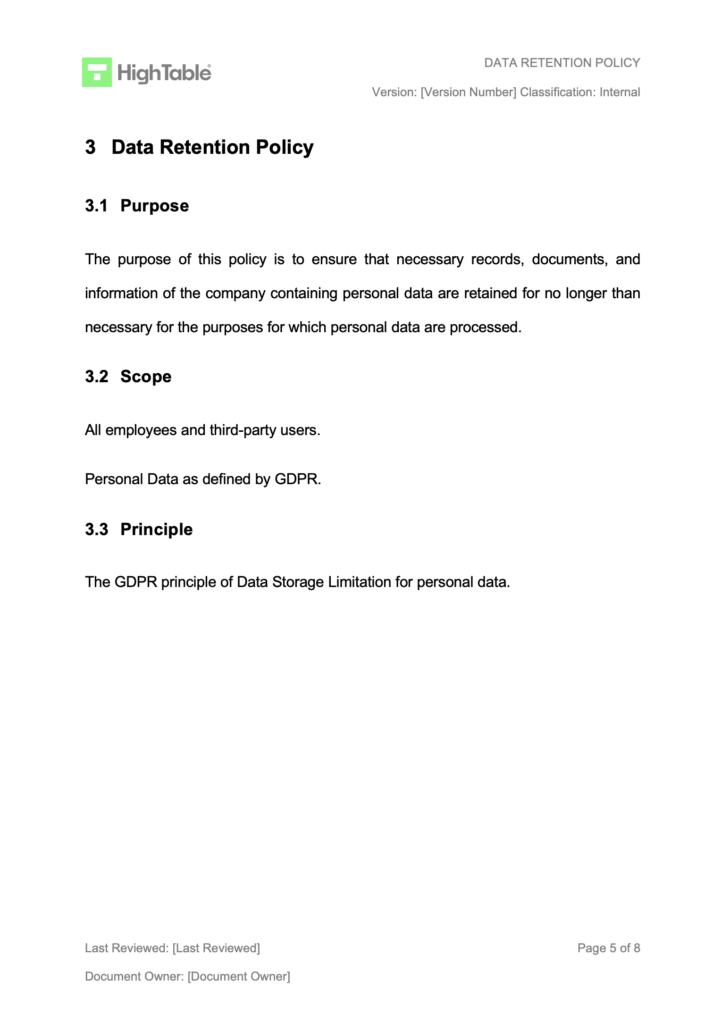
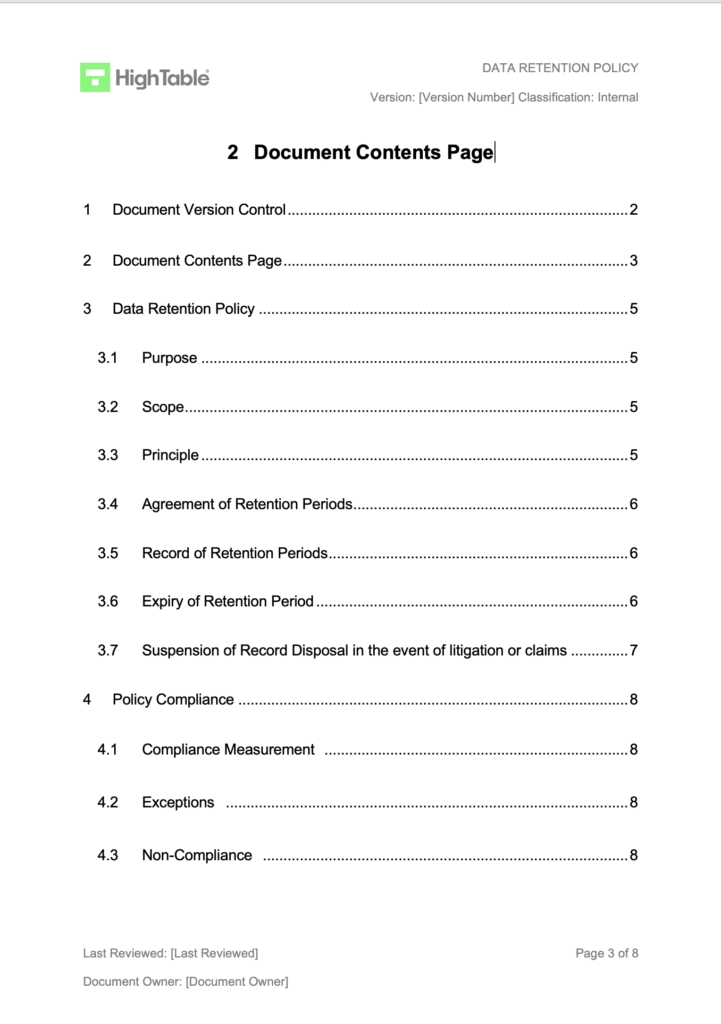
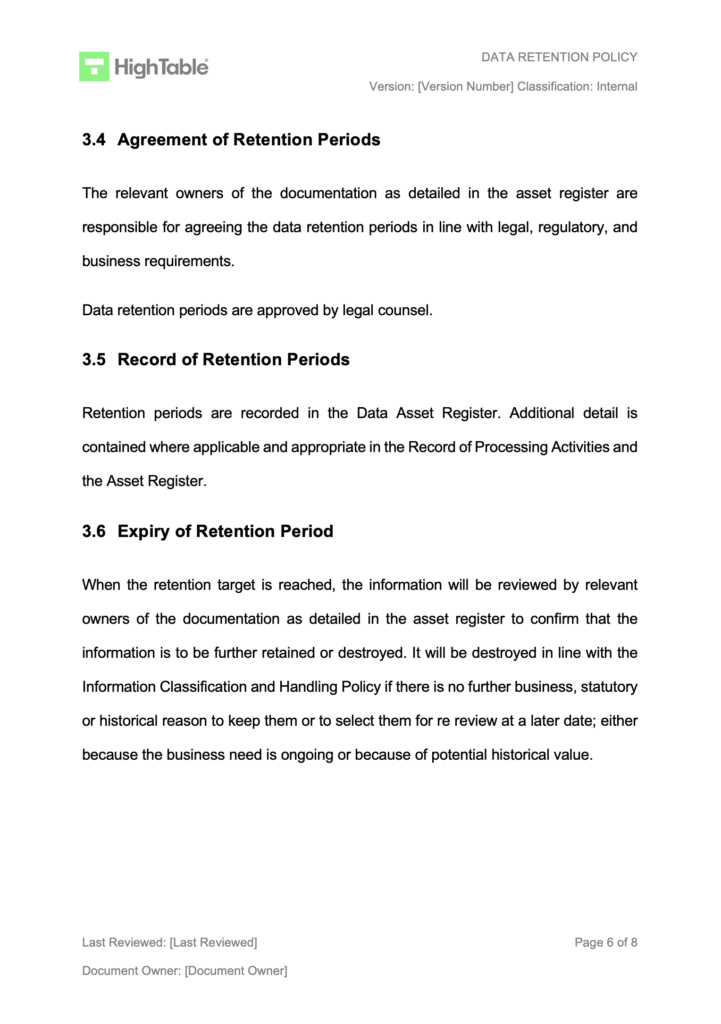
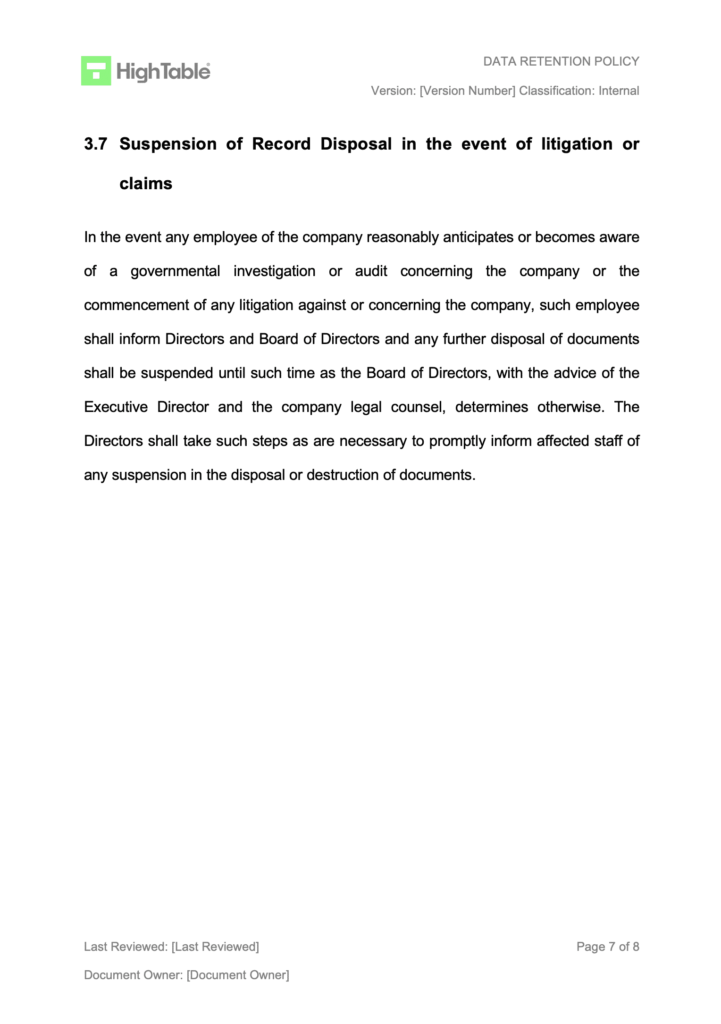
An example ISO 27001 Data Retention Policy:

How to write an ISO 27001 Data Retention Policy
Start by looking at what kind of data you have and how you store it. Then write down how long you need to keep it. Decide how you’ll securely delete or destroy data when the time is up. This could be by shredding paper or securely wiping a hard drive.
- Create your version control and document mark-up
- Write the ISO 27001 Data Retention Policy contents page
- Write the ISO 27001 Data Retention Policy purpose
- Write the ISO 27001 Data Retention Policy principle
- Write the ISO 27001 Data Retention Policy scope
- Define the approach to agreeing retention periods
- Explain the record of retention periods
- Set out what happens at the expiry of retention periods
- Explain the suspension of record disposal in the event of litigation or claims
What you need to know
Why You Need an ISO 27001 Data Retention Policy
You need a data retention policy for several important reasons. Firstly, it helps you reduce your risk. The more data you have, the bigger the target you are for cyberattacks. It’s like having fewer valuables in your house, so there’s less for a burglar to steal. Secondly, it helps you save money. Storing data costs money, and having less of it means lower costs. Lastly, it helps you stay compliant with laws like GDPR. Having a policy shows that you’re serious about protecting personal data and following the rules.
When You Need an ISO 27001 Data Retention Policy
You need a data retention policy as soon as you start handling any kind of data, especially if it’s personal information about people. If you’re a new business, you might think you can put this off, but it’s much easier to set up a policy from the beginning than to clean up a mess later. It’s a key part of getting your ISO 27001 certification.
Who Needs an ISO 27001 Data Retention Policy?
Everyone who handles data needs this policy! This includes all types of organisations, from a small bakery to a huge tech company. However, it’s particularly important for businesses that handle a lot of sensitive information, such as financial details, health records, or personal data.
Where You Need ISO 27001 Data Retention Policy
This policy applies to all the places where you store information. This means your computers, servers, cloud storage (like Google Drive or Dropbox), and even physical documents in a filing cabinet. The policy should cover all your data, no matter where it lives.
How to Implement it
Putting the policy into action is key.
Implementing a robust ISO 27001 Data Retention Policy ensures that your organisation mitigates the risks of data bloat and regulatory non-compliance. Follow these ten technical steps to establish a secure data lifecycle that satisfies Lead Auditors, aligns with the UK Data Protection Act, and protects your interested parties.
1. Categorise Information Assets via the Asset Register
- Provision a thorough review of your information assets to identify categories of personal, sensitive, and business-critical data.
- Result: A clear classification baseline that determines the appropriate retention level for every data set.
2. Identify Legal and Regulatory Mandates
- Formalise a list of statutory requirements, such as GDPR and the UK Data Protection Act 2018, that dictate minimum and maximum storage periods.
- Result: Legal alignment that prevents fines and ensures the organisation meets its “lawful basis” for processing.
3. Map Contractual Obligations for Interested Parties
- Identify specific retention clauses within client and vendor contracts to ensure business-specific requirements are met.
- Result: Contractual compliance that maintains stakeholder trust and prevents breach of service level agreements.
4. Formalise the Data Retention Schedule
- Document a centralised schedule listing each data category, the required retention duration, and the justification for the period.
- Result: A “single source of truth” document that provides definitive evidence for ISO 27001 auditors.
5. Provision Secure Storage and Encryption Controls
- Implement technical safeguards, such as AES-256 encryption at rest, for all data retained in archives or backups.
- Result: Technical assurance that data remains protected against unauthorised access throughout its entire lifecycle.
6. Assign IAM Roles and Disposal Responsibilities
- Define specific Identity and Access Management roles to ensure only authorised personnel have the permissions to delete or archive data.
- Result: Reduced risk of accidental or malicious data loss through granular technical accountability.
7. Integrate Automated Deletion Workflows
- Utilise technical scripts or cloud-native lifecycle management tools to trigger the automatic removal of data once thresholds are met.
- Result: Operational efficiency that removes the “human error” factor from the data disposal process.
8. Establish Secure Destruction Rules of Engagement
- Formalise Rules of Engagement for the physical and logical destruction of media, ensuring that data is rendered unrecoverable.
- Result: Verification that disposed data cannot be reconstructed by adversaries or unauthorised third parties.
9. Audit Disposal Evidence and Destruction Logs
- Collect system logs and certificates of destruction to maintain a definitive audit trail for every disposal action.
- Result: High-density evidence that proves the effectiveness of the policy during certification assessments.
10. Revoke Access and Update Policy Performance
- Conduct annual management reviews to update retention periods based on emerging threats, new laws, or changes in business strategy.
- Result: A dynamic, living policy that adapts to the evolving risk landscape of the organisation.
Check Your Work?
You built it yourself. Maybe with AI. But will it pass the audit?
Don’t gamble – let an ISO 27001 Lead Auditor check your work.
ISO 27001 Data Retention Policy Implementation Checklist
| Step | Implementation Requirement | Audit Evidence / Example |
|---|---|---|
| 1 | Data Discovery & Inventory | A populated Asset Register identifying PII and business-critical data sets. |
| 2 | Legal & Regulatory Mapping | Documentation of statutory retention mandates (e.g. GDPR Article 5, UK Data Protection Act 2018). |
| 3 | Define Retention Thresholds | A defined schedule (e.g. HMRC records kept for 6 years plus current) linked to a “Lawful Basis”. |
| 4 | Create Data Retention Schedule | A version-controlled “Data Retention Schedule” approved by Top Management as documented information. |
| 5 | Technical Storage Controls | Evidence of AES-256 encryption at rest and IAM role-based access for archived data. |
| 6 | Automated Disposal Workflows | Configuration of cloud lifecycle policies (e.g. AWS S3 Lifecycle) or scripts for automated deletion. |
| 7 | Secure Destruction Protocols | Rules of Engagement (ROE) for cryptographic erasure or physical shredding of storage media. |
| 8 | Maintain Disposal Logs | A secure “Disposal Log” recording what was deleted, when, by whom, and the method used. |
| 9 | Staff Awareness Training | Training records showing that staff understand their disposal responsibilities under Annex A 6.3. |
| 10 | Management Review & Monitoring | Minutes from a Clause 9.3 Management Review evaluating policy effectiveness. |
DO IT YOURSELF ISO27001
Stop Spanking £10,000’s on Consultants and Platforms

How to audit it
As an ISO 27001 Lead Auditor, I have conducted hundreds of assessments where the Data Retention Policy was the primary point of failure. Auditing this control is not about checking if a document exists, it is about verifying that your data lifecycle is technically enforced and legally defensible. Follow these ten audit steps to ensure your organisation meets the rigorous requirements of the ISO 27001: 2022 standard and global privacy mandates.
1. Inspect the Documented Data Retention Schedule
- Verify that a formal schedule exists and covers all information assets identified in your Asset Register.
- Result: Confirmation that the organisation has a defined baseline for storage limitation across all data categories.
2. Validate Legal and Regulatory Justification
- Cross-reference defined retention periods against statutory requirements like HMRC, GDPR, and the UK Data Protection Act 2025.
- Result: Assurance that retention thresholds are based on “Lawful Basis” rather than arbitrary internal preferences.
3. Sample Data Sets for Policy Alignment
- Select a random sample of database records or physical files to check if their age exceeds the defined retention limit.
- Result: Technical evidence that the policy is being operationalised rather than existing as “shelf-ware.”
4. Review Technical Disposal Workflows
- Audit the configuration of automated deletion scripts, cloud lifecycle policies, or manual disposal procedures.
- Result: Verification that the organisation has the technical capability to execute Annex A 8.10 requirements.
5. Examine Secure Destruction Evidence
- Inspect disposal logs and certificates of destruction to confirm that media has been rendered unrecoverable.
- Result: Proof that the organisation prevents data leakage during the final stage of the information lifecycle.
6. Audit Backup and Archive Retention
- Verify that retention rules are applied to backup snapshots and off-site archives, not just production environments.
- Result: Elimination of “shadow data” risks where legacy information persists indefinitely in secondary storage.
7. Confirm IAM Role-Based Accountability
- Review Identity and Access Management (IAM) permissions to ensure only authorised roles can modify or delete retained data.
- Result: Assurance that data integrity is maintained and that disposal actions are performed by accountable personnel.
8. Evaluate Rules of Engagement for Physical Data
- Audit the secure bins, shredding schedules, and physical transit logs for paper-based records and removable media.
- Result: Confirmation that the policy extends beyond digital assets to cover the entire physical threat landscape.
9. Interview Key Process Owners
- Question Data Custodians and IT leads on their understanding of the disposal process and their specific responsibilities.
- Result: Assessment of the “Human Element” and whether security awareness training has successfully embedded the policy.
10. Review Management Oversight and Policy Updates
- Examine Management Review minutes to ensure retention effectiveness is monitored and the policy is updated for freshness.
- Result: Evidence of “Continual Improvement” as required by ISO 27001 Clause 10.2 and Clause 9.3.
How it applies to Small Business, Tech Startups, and AI Companies
This policy is super important for different types of businesses, but for slightly different reasons.
| Business Type | Why It Is Important | Practical Example |
|---|---|---|
| Small Businesses | Even a small customer list needs to be managed properly. A policy helps you protect your customers’ trust and avoid fines. | A local flower shop collects customer names and phone numbers for delivery. The policy says to delete this information 30 days after the delivery is complete, unless the customer signs up for a newsletter. |
| Tech Startups | You are probably moving fast and handling a lot of user data. A policy helps you manage this growth without letting data pile up and become a security risk. | A new social media app collects user profiles and messages. The policy states that user profiles are kept as long as the account is active, but messages are deleted after one year. |
| AI Companies | You deal with massive amounts of data to train your models. A data retention policy is crucial for managing this data, ensuring you are not keeping training data longer than you should and that you are complying with privacy laws. | An AI company uses photos to train a facial recognition model. The policy requires that all photos are deleted from the training servers three months after the model is trained and deployed. |
ISO 27001 Data Retention Policy FAQ
An ISO 27001 Data Retention Policy is a formal document that defines how long an organisation keeps specific categories of information and how it securely disposes of them. It ensures compliance with ISO 27001 Annex A 5.31 and ISO 27001 Annex A 8.10 by preventing “data bloat” and reducing regulatory liability through structured storage limitation.
Retention is a legal and business requirement for how long active data is kept, while backup is a technical recovery safeguard. Data retention defines the lifespan of the “source” data to meet compliance; data backup saves copies of that data to protect against system failure or loss.
No, you should not keep data indefinitely. Keeping data longer than is necessary for its original purpose creates a significant security risk and directly violates privacy laws like GDPR, which mandate “Storage Limitation.” A Lead Auditor will flag indefinite retention as a major non-conformity.
Data retention directly satisfies the GDPR “Storage Limitation” principle (Article 5(1)(e)), which mandates that personal data is kept for no longer than necessary. Under ISO 27001, your retention schedule provides the auditable evidence required to prove you are not holding PII indefinitely, thereby avoiding fines of up to €20 million or 4% of global turnover.
Without a policy, you face severe consequences including regulatory fines, loss of customer trust, and increased vulnerability to cyberattacks. In the event of a breach, the lack of a policy proves “negligence by design,” making legal defence significantly more difficult and increasing potential settlement costs.
You should review your Data Retention Policy at least once a year. However, trigger-based reviews are required if there are significant changes to the legal landscape (e.g., a new Data Protection Act), a shift in business model, or following an internal audit finding.
No, the ISO 27001 Data Retention Policy applies to all information regardless of medium. This includes physical paper documents, hard drives, removable media, and even handwritten notebooks that contain sensitive business information or personal data.
Retention durations are determined by legal, statutory, and contractual requirements rather than arbitrary choice. Typical UK benchmarks include:
Financial and Tax Records: 6 years plus the current financial year (HMRC requirement).
Employment Records: 6 years after employment ceases to cover breach of contract claims.
Health and Safety Records: 40 years for records relating to hazardous substance exposure.
ISO 27001 Audit Logs: Typically 1 to 3 years depending on the risk assessment and incident response needs.
Your policy must include a formal process for handling “Subject Access Requests” and “Rights to Erasure.” If a customer requests deletion, you must verify if you have a competing legal requirement to keep it (e.g., tax records); otherwise, you must execute secure deletion immediately.
While you can draft the policy using the ISO 27001 Toolkit, having legal counsel review the specific retention periods for your jurisdiction is highly recommended. The auditor wants to see that your periods are based on “informed legal or regulatory requirements,” not just guesses.
The first step is to perform a data discovery exercise to create an Information Asset Register. You cannot apply retention rules to data if you do not know what data you have, where it lives, or who is responsible for it.
You must research the specific laws that apply to your industry and location (e.g., HMRC in the UK, HIPAA in the US). Using a professional ISO 27001 Toolkit helps by providing common baselines, but you must validate these against your specific business activities.
A disposal log is an audit record of all information that has been securely deleted. It should include the data category, the date of deletion, the method used (e.g., cryptographic erase), and the name of the individual who authorised the disposal. This is essential audit evidence for ISO 27001 Annex A 8.10.
If you have a documented policy and can prove you were following your disposal schedule, your legal liability may be reduced. However, if a hacker steals data that should have been deleted three years ago, you will face much harsher penalties for failing to implement “Storage Limitation” controls.
Secure deletion means using methods that ensure the data is technically unrecoverable. This includes using data wiping software that overwrites the drive sectors or physically shredding hard drives and paper documents. Simply moving a file to the “Recycle Bin” is NOT secure deletion.
Yes, it is a mandatory requirement. You cannot achieve ISO 27001 certification without demonstrating that you have a planned approach to data retention (ISO 27001 Annex A 5.31) and secure information deletion (ISO 27001 Annex A 8.10).
The biggest mistake is having a “paper-only” policy that isn’t followed in practice. Auditors will cross-reference your policy dates with your actual database records; if the policy says “delete after 1 year” but the database has 5-year-old records, you will receive a Major Non-Conformity.
Stuart Barker
ISO 27001 Ninja
Stuart Barker is a veteran practitioner with over 30 years of experience in systems security and risk management. Holding an MSc in Software and Systems Security, he combines academic rigour with extensive operational experience, including a decade leading Data Governance for General Electric (GE).
As a qualified ISO 27001 Lead Auditor, Stuart possesses distinct insight into the specific evidence standards required by certification bodies. His toolkits represent an auditor-verified methodology designed to minimise operational friction while guaranteeing compliance.
- MSc Security
- ISO 27001 Lead Auditor
- 30+ Years Exp
- Ex-GE Leader