

ISO 27001 Access Control Policy
In this guide, you will learn what an ISO 27001 Access Control Policy is, how to write it yourself and I give you a template you can download and use right away.
Key Takeaways
- Confidentiality Protection: Implementing access control is the most critical measure for safeguarding the confidentiality of organisational information assets.
- Compliance Alignment: Access control frameworks must be strictly aligned with legal, regulatory, and contractual obligations, as well as internal information classification policies.
- Technical and Educational Hybrid: Effective access security is achieved through a robust combination of technical system controls and comprehensive user education.
Table of contents
- ISO 27001 Access Control Policy
- Key Takeaways
- What is an ISO 27001 Access Control Policy?
- Access Control Principles
- Access Control Methods
- Access Control Considerations
- Access Management Lifecycle
- ISO 27001 Access Control Policy Example
- How to write an ISO 27001 Access Control Policy
- ISO 27001 Access Control Policy Walkthrough Video
- ISO 27001 Access Control Policy Template
- Why is the ISO 27001 Access Control Policy Important?
- Benefits of implementing an ISO 27001 Access Control Policy
- Access Control in Practice
- How the ISO 27001 toolkit can help
- Applicability of an ISO 27001 Access Control Policy to Small Businesses, Tech Startups, and AI Companies
- Information security standards that need an ISO 27001 Access Control Policy
- List of relevant ISO 27001:2022 controls
- ISO 27001 Access Control Policy FAQ
What is an ISO 27001 Access Control Policy?
The ISO 27001 access control policy outlines how to manage and control access to organisational resources including data and systems. The policy covers the entire user access lifecycle and it ensures the correct access to the correct information and resources by the correct people. The objective is to limit access to information and systems based on need, the principle of least privilege and need to know.
Access Control Principles
Access control is based on 4 simple principles:
| Principle | Description |
|---|---|
| Need to Know | Users are only provided access to the information and systems they require to perform their tasks and role. |
| Least Privilege | The level of access provided to users is the minimum they need to perform their tasks, minimising the impact of a compromised account. |
| Segregation of Duty | Processes and functions are divided among different individuals to prevent unchecked access and ensure critical tasks cannot be compromised without detection. |
| Role Based Access (RBAC) | System access is restricted based on individual roles, simplifying management and enforcing security protocols across the organisation. |
Access Control Methods
There are 3 primary methods to control access. They are
| Method | Description and Examples |
|---|---|
| 1. Authentication | Granting access based on identity verification via something a person is, knows, or possesses. Multi-Factor Authentication (MFA) combines these, using biometrics, passwords, or security tokens. |
| 2. Authorisation | The formal process where a system or information owner grants specific access rights based on an individual’s verified identity and organisational role. |
| 3. Physical Access Control | Security measures and physical barriers designed to restrict or prevent unauthorised access to sensitive locations and systems, such as locks, gates, fences, and walls. |
Access Control Considerations
When defining the policy and processes of access control the following considerations should be taken into account:
| Consideration | Requirement and Implementation Details |
|---|---|
| Business Requirements | Access control must remain strictly in line with the specific requirements of the organisation and its defined information security objectives. |
| Compliance | Policies must ensure that access control fully meets all relevant legal, regulatory, and customer contractual requirements. |
| Information Classification | Access control implementation should be directly mapped to the organisation’s Information Classification Policy to ensure appropriate protection levels. |
| Remote Access | The policy must define secure methods for remote access, including the use of Virtual Private Networks (VPNs), multi-factor authentication (MFA), and secure remote desktop protocols, while specifying approved devices. |
| Cloud and Third Party Services | Security controls must extend to cover third-party services, cloud platforms, and outsourced systems, ensuring contractual agreements reflect organisational security standards. |
Access Management Lifecycle
The lifecycle of user access is
| Stage | Description and Technical Requirements |
|---|---|
| 1. Requesting Access | Identification of access requirements for systems or data by an individual or a manager on behalf of their team. |
| 2. Approving Access | Formal approval by the system or data owner. Implementation of segregation of duty ensures the requester cannot approve their own access. |
| 3. Implementing Access | Technical provisioning by IT professionals. Focuses on Role-Based Access Control (RBAC) rather than cloning existing users to prevent unauthorised privilege creep. |
| 4. Managing Changes | Revision of access rights necessitated by role changes or internal transfers, triggering a new request and approval cycle. |
| 5. Reviewing Access | Regular audits (typically monthly) conducted by system owners to evidence that access remains relevant and catching instances of “stale” accounts. |
| 6. Logging and Monitoring | Continuous recording of successful and failed access attempts. Logs must be reviewed monthly with incidents escalated via the formal incident management process. |
| 7. Revoking Access | Prompt removal of access rights upon role change or termination of employment, documented through a formal approval and action trail for audit purposes. |
ISO 27001 Access Control Policy Example
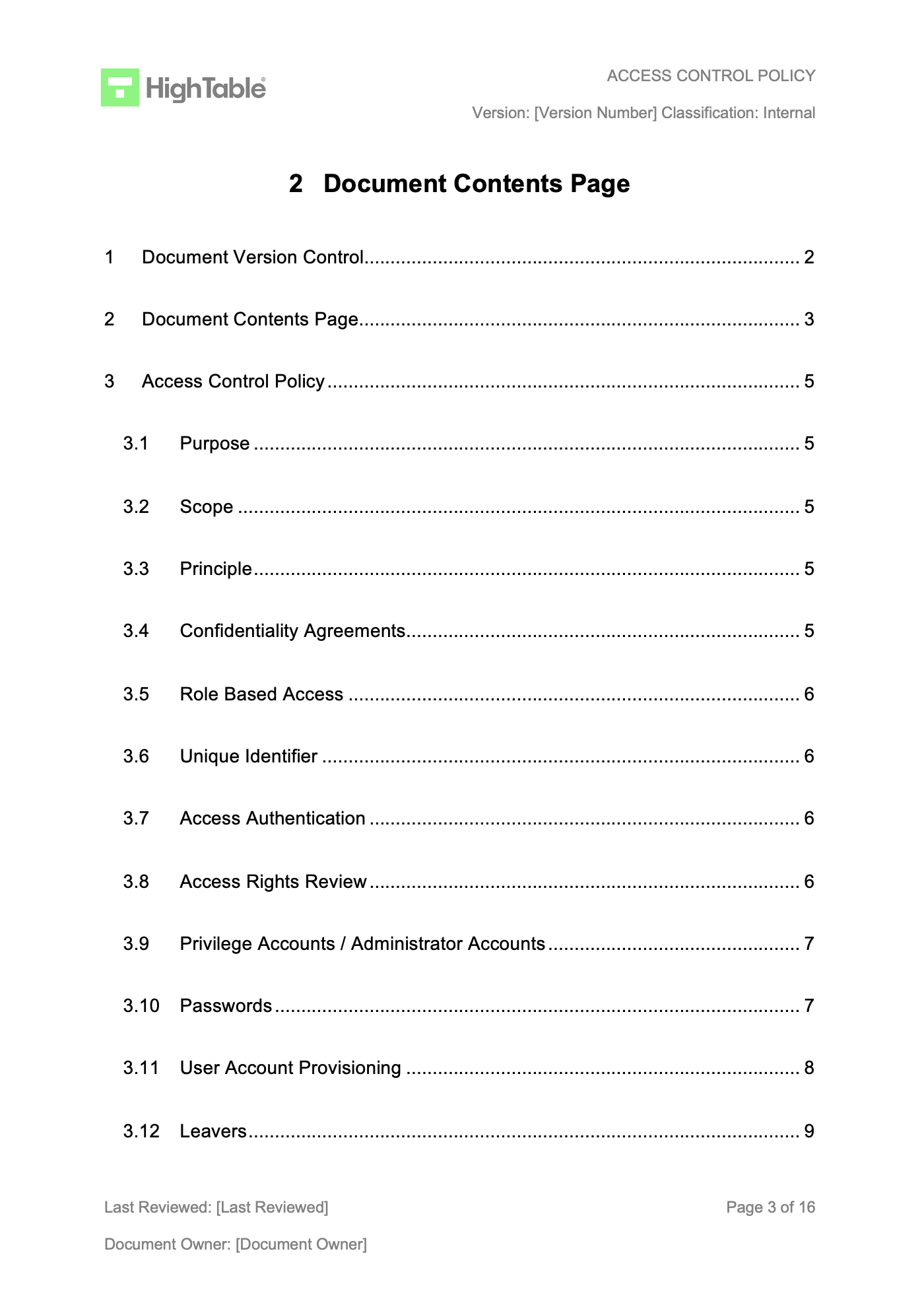
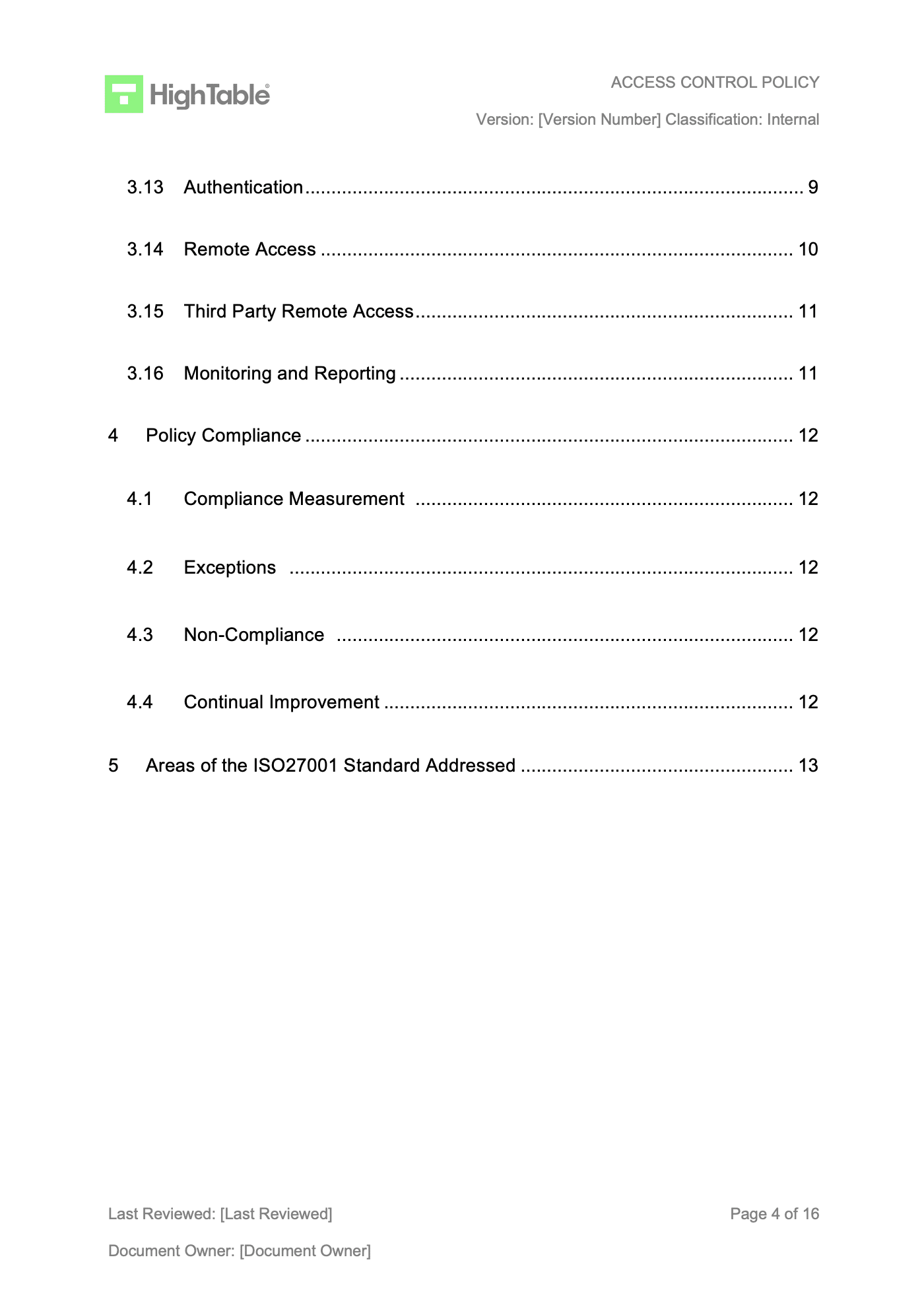
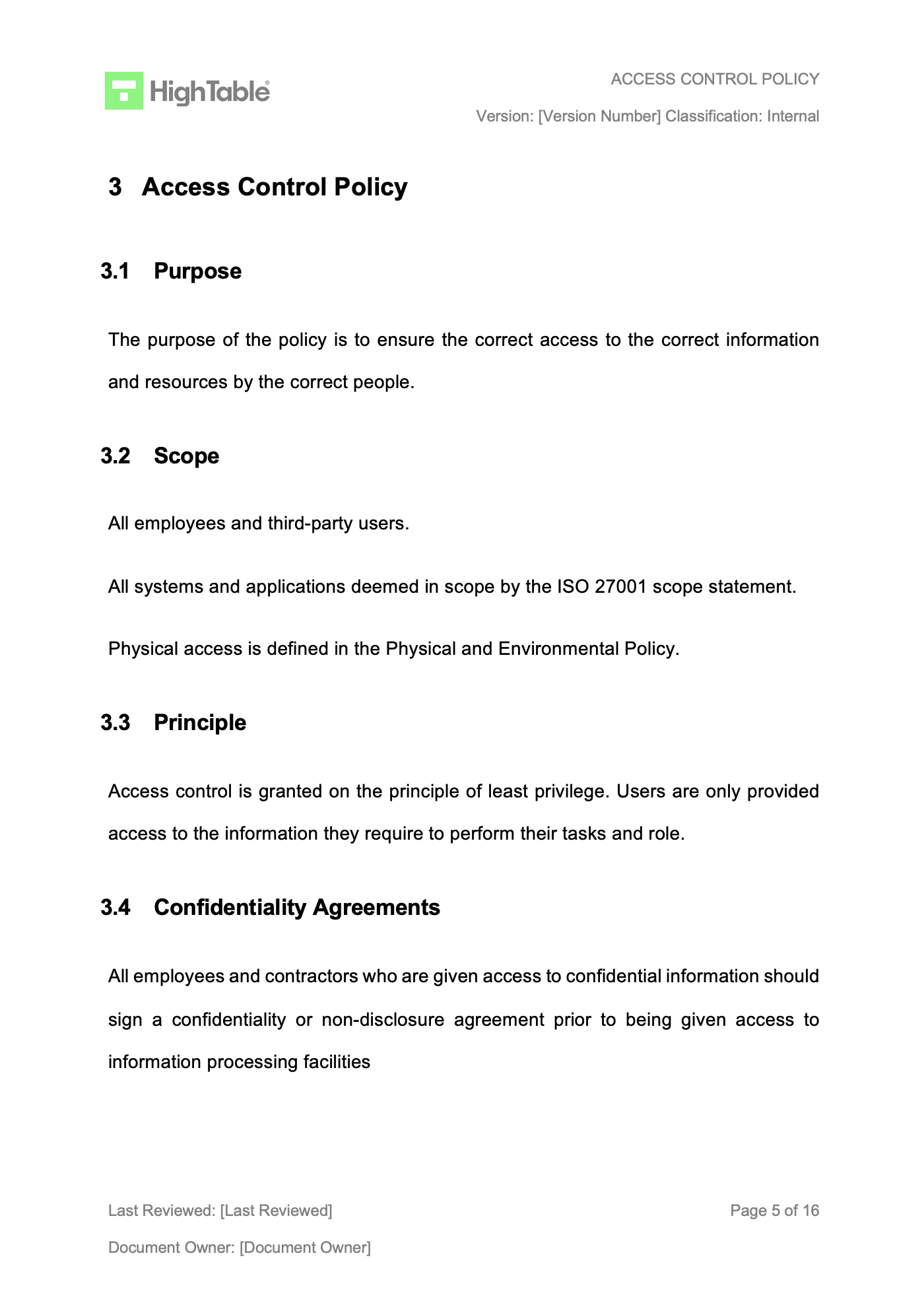
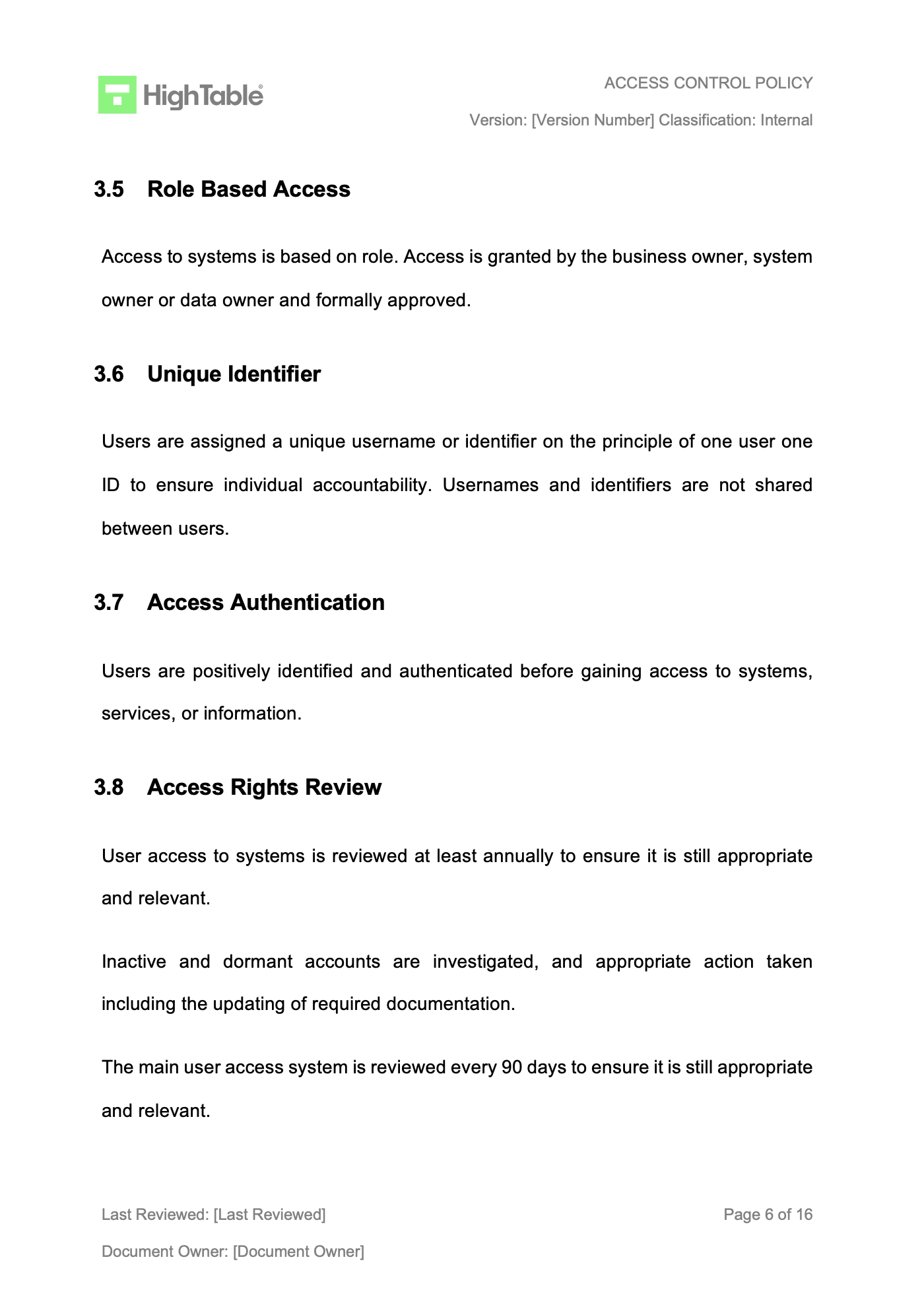
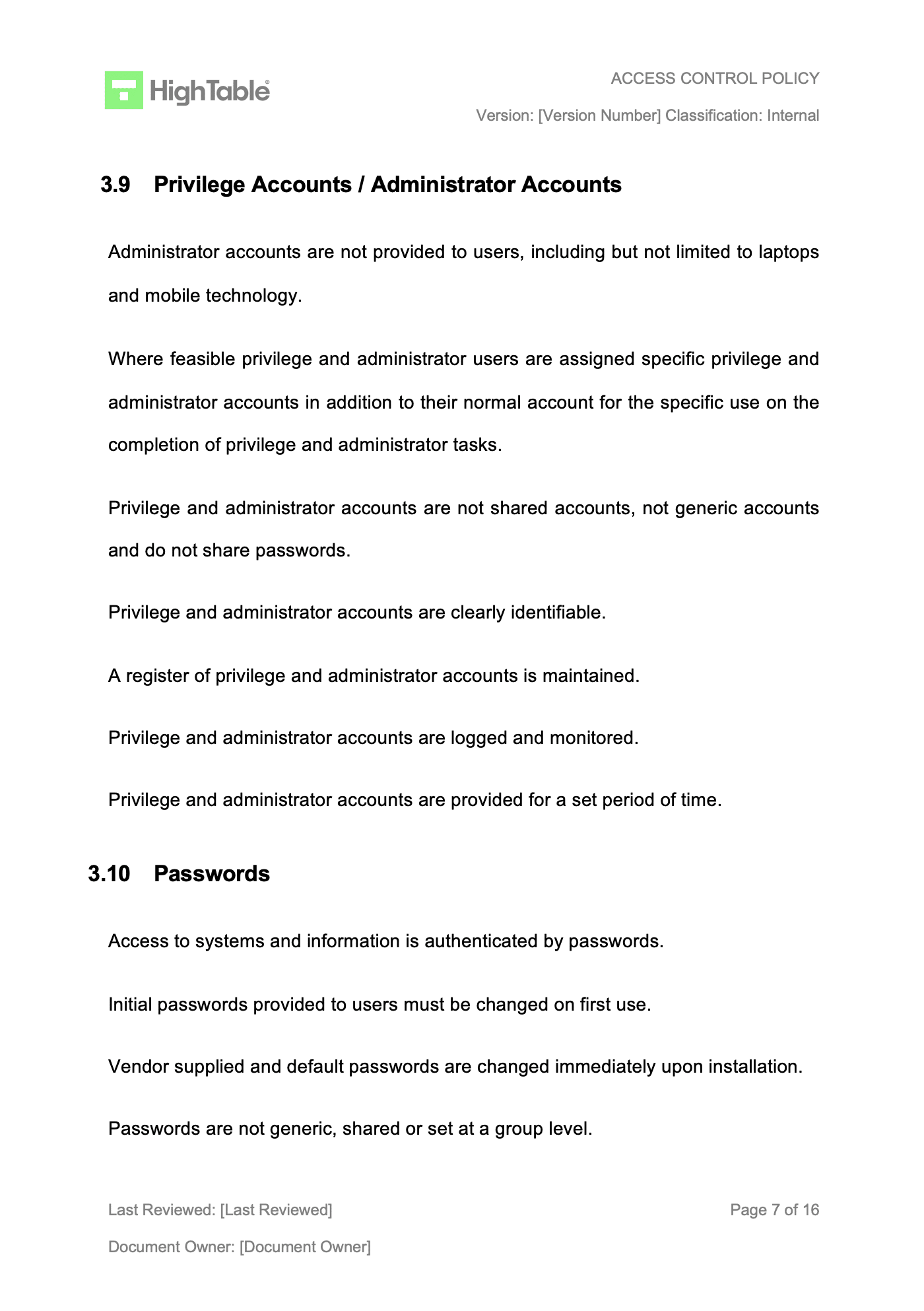
This is an example ISO 27001 Access Control Policy:
How to write an ISO 27001 Access Control Policy
The ISO 27001 Access Control Policy is required to be presented in a certain way. What we mean by that is that the policy is expected to have certain document markup. Document mark up is just a fancy words for having certain information on the policy. It will need version control, a version number, an owner, an information security classification.
To implement an ISO 27001 Access Control Policy, you must define clear access requirements based on business needs, formalise a “least privilege” framework, and implement robust identity management including MFA. This ensures only authorised users access specific data, satisfying Annex A security controls and reducing the risk of data breaches.1. Define Business Access Requirements
Identify and document all information assets, systems, and network services that require protection. Determine the specific access needs for different job roles within the organisation to ensure operational efficiency without compromising security.
- Conduct a risk assessment to identify sensitive data silos.
- Define the Rules of Engagement for internal and external resource access.
- Document the business justification for access to specific applications.
2. Formalise the Access Control Policy
Create a comprehensive document that outlines the principles of “Need to Know” and “Least Privilege”. This policy must be approved by management and communicated to all employees and relevant external parties.
- Align policy statements with ISO 27001 Annex A 5.15, 5.16, and 5.18.
- Specify the requirements for segregation of duties to prevent fraud.
- Establish clear guidelines for mobile computing and teleworking security.
3. Provision and Manage User Identities
Implement a formal user registration and de-registration process to enable the assignment of access rights. Ensure every user is assigned a unique identifier (ID) to maintain accountability for all actions performed on the system.
- Utilise Identity and Access Management (IAM) systems for centralised control.
- Verify user identities before issuing credentials or access tokens.
- Link every system ID to a specific, identifiable individual.
4. Configure Strong Authentication and MFA
Deploy robust authentication techniques to verify user identity before granting access. Use Multi-Factor Authentication (MFA) for all remote access and administrative connections to mitigate the risk of password-based attacks.
- Enforce complex password requirements and regular rotation.
- Implement MFA using hardware tokens, biometrics, or authenticator apps.
- Securely manage and store secret authentication information.
5. Control and Restrict Privileged Access Rights
Limit the allocation and use of privileged access rights, such as administrative or root accounts. Restrict these rights to a minimal number of users and ensure they are only used when performing specific administrative tasks.
- Develop a separate authorisation process for elevated privileges.
- Use Just-In-Time (JIT) access to grant temporary admin rights.
- Audit all actions performed using privileged accounts via log files.
6. Audit Access Rights and Revoke Promptly
Conduct regular reviews of user access rights to ensure they remain appropriate for the user’s current role. Immediately revoke access for any individual who leaves the organisation or changes roles to a position where access is no longer required.
- Perform quarterly access reviews for all critical systems.
- Automate the account termination process during employee offboarding.
- Update access rights immediately upon changes in employment status.
ISO 27001 Access Control Policy Walkthrough Video
ISO 27001 Access Control Policy Template
The ISO 27001 Access Control Policy template is pre written and ready to go. It is one of the required ISO 27001 policies that sets out the organisations approach to access control.

Why is the ISO 27001 Access Control Policy Important?
A cornerstone of information security is confidentiality and providing the right access to the right people at the right time. We want to ensure that people have access to do their job but no more. We want to protect the information and data that we have.
People will talk about preventing unauthorised access which is a fancy way of saying getting access to data they should not have. By protecting the access to the data we can reduce the risk of information security incidents and data breaches.
The ISO 27001 Access Control Policy is important as it sets out clearly and in written form what you expect to happen. If you don’t tell people what you expect of them then how can you expect them to do it? Communicating what is expected is a key step in any HR disciplinary process with many not being enforceable or actionable if you have not told people what to do and got them to accept that they understand what is being asked.
The ISO 27001 standard wants you to have the access control policy in place, communicated, and accepted by staff as part of your ISO 27001 certification. It actually forms part of a wider set of required information security policies that are all included in the ISO 27001 toolkit.
Benefits of implementing an ISO 27001 Access Control Policy
The main benefit is that it allows you to mitigate the risk of access to systems and data. Access poses unique challenges as it is the primary way people gain entry to systems and data to perform their role so the risks need to be assessed and appropriate controls implemented. The benefits of implementing an ISO 27001 Access Control Policy include:
- Regulatory Compliance: Formal access controls ensure the organisation meets stringent legal and regulatory requirements concerning data protection and information security.
- Confidential Information Protection: Robust policy frameworks safeguard sensitive information assets by enforcing strict “Need to Know” and “Least Privilege” principles.
- Stakeholder Trust: Implementing transparent and secure access management builds confidence with employees, clients, and third-party partners.
- Reputation Protection: Effective controls reduce the likelihood of security incidents, minimising potential fines and protecting the brand’s public image during an event.
Access Control in Practice
The ISO 27001 Access Control Policy is all about access to systems and data. When looking at access we are looking at the different types of access. We differentiate between normal users and administrators.
First things first we want to ensure that we have confidentiality agreements in place and being required to access systems. This may form part of employment contracts. It makes sense to grant access to systems based on roles where the role defines the level of access that is allowed. We want to ensure that we can track actions back to individuals so the concept of one user and one ID is introduced. If we have shared accounts it can be nearly impossible to track back who exactly did what. This can become critical if incidents occur and we need to conduct investigations. Users of systems are responsible for their actions.
System access is not a one time deal. We will have a start, leaver, mover process that covers the provision of access, the changes to access as roles change and the removal of access when someone leaves. To ensure that all is working as planned we are going to conduct regular access reviews. An access review is as simple as seeing who has access to systems, what level of access they have and confirming that they still need it. If they don’t, or they have changed role, or they have left and the normal processes hasn’t caught it then we handle it at that point.
Our most powerful users are administrators. They hold the keys to the kingdom. There are special considerations when it comes these administrative accounts. How they are allocated, when they are allocated, how they are used, how they are monitored is addressed.
We all use passwords and the rules for passwords are set. How passwords are created, how complex do they need to be, how often if at all are they changed, how are they communicated to users. Passwords are the keys to the doors of our systems and data so we are clear on their management and use.
Often times we rely on third parties or suppliers to help support and run our systems. We want to grant them the access that they need, when they need it to help us. We set out the policy and rules for their access. We also address remote access of all users.
How the ISO 27001 toolkit can help
An ISO 27001 toolkit is like a toolbox full of pre-made documents and guides. It gives you a head start on creating your policy and other important security documents, saving you a ton of time and effort. It’s a great way to make sure you don’t miss anything.
| Feature | ISO 27001 Toolkit (Templates) | Online SaaS Platforms |
|---|---|---|
| Ownership | Lifetime Ownership: You keep your policy files forever on your own infrastructure. You don’t rent your compliance. | Temporary Access: Your documentation lives on their servers. If you stop paying, you lose access to your data. |
| Simplicity | No Learning Curve: Uses familiar Microsoft Word and Excel formats. No need to train your team on complex new software. | High Complexity: Requires significant time for staff onboarding, technical training, and software configuration. |
| Cost | One-Off Fee: A single, transparent payment with no recurring costs or hidden “per-user” charges. | Ongoing Subscription: Expensive monthly or annual fees that increase as your organisation grows. |
| Freedom | No Vendor Lock-in: Complete control over your documentation. Easily portable and fully customisable to your needs. | Proprietary Lock-in: Extremely difficult to migrate your data out of the platform once you are embedded. |
Applicability of an ISO 27001 Access Control Policy to Small Businesses, Tech Startups, and AI Companies
| Business Type | Strategic Value | Practical Implementation Examples |
|---|---|---|
| Small Business | Protects critical customer data (contact info, payment details) to prevent business-ending data breaches. |
|
| Tech Startups | Safeguards intellectual property and “secret sauce” (source code) from internal and external unauthorised access. |
|
| AI Companies | Manages risks associated with massive, sensitive datasets used for training and inference. |
|
Information security standards that need an ISO 27001 Access Control Policy
This access control policy is a key part of ISO 27001, which is an international standard for managing information security. Other standards that need it include:
| Standard / Regulation | Relevance to Access Control |
|---|---|
| ISO 27001 | The primary international standard requiring a formal policy to manage and audit user access rights. |
| GDPR | Mandates strict controls over who can access personal data to ensure privacy and prevent unauthorised processing. |
| CCPA | Requires businesses to implement reasonable security procedures, including access restrictions, to protect consumer data. |
| DORA | Demands digital operational resilience in the financial sector through robust identity and access management (IAM). |
| NIS2 | Focuses on the security of network and information systems, necessitating strict access protocols for critical infrastructure. |
| SOC 2 | A framework for service organisations where ‘Access Control’ is a core Trust Services Criterion (TSC). |
| NIST | The Cybersecurity Framework (CSF) emphasizes ‘Identify’ and ‘Protect’ functions through granular access management. |
| HIPAA | Requires technical safeguards to ensure only authorised personnel access Protected Health Information (PHI). |
List of relevant ISO 27001:2022 controls
The ISO 27001:2022 standard has specific controls that relate to access control. Some of the most important ones include:
| Control Reference | Control Name and Implementation Context |
|---|---|
| Annex A 5.15 | Access Control: Establishes the rules for granting access to information and other associated assets based on business and security requirements. |
| Annex A 5.16 | Identity Management: Managing the full lifecycle of digital identities to ensure users are uniquely identified and accountable. |
| Annex A 5.17 | Authentication Information: Ensuring that authentication information (passwords, tokens, biometrics) is managed securely through a formal process. |
| Annex A 5.18 | Access Rights: Provisioning, reviewing, modifying, and revoking access rights to ensure they remain appropriate and authorised. |
| Annex A 8.4 | Access to Source Code: Restricting access to program source code and associated items to prevent unauthorised modification or disclosure. |
| Annex A 8.5 | Secure Authentication: Implementing strong authentication controls, such as MFA, based on the classification of information and risk assessment. |
| Annex A 8.11 | Data Masking: Using techniques like pseudonymisation or anonymisation to restrict the visibility of sensitive data to unauthorised users. |
ISO 27001 Access Control Policy FAQ
Where can I get an ISO 27001 Access Control Policy?
The ISO 27001 Access Control Policy can be downloaded at High Table: The ISO 27001 Company. This professional template is designed to meet all audit requirements for 2026 compliance standards.
What is the Purpose of the ISO 27001 Access Control Policy?
The purpose of the ISO 27001 Access Control Policy is to ensure the correct access to the correct information and resources by the correct people. It establishes a formal framework to prevent unauthorised access and ensure data integrity across the organisation.
What is the ISO 27001 Access Control Policy Principle?
Access control is granted on the principle of least privilege. Users are only provided access to the information they require to perform their tasks and role. This minimises the potential damage from accidental or malicious insider threats.
What are the access control steps?
The standard access control lifecycle consists of six critical stages to maintain security. These steps ensure every account is tracked from creation to deletion:
- 1. Requesting Access
- 2. Approving Access Requests
- 3. Implementing Access
- 4. Managing Changes to Access
- 5. Monitoring Access
- 6. Revoking Access
Who is responsible for the ISO 27001 Access Control Policy?
Access is the responsibility of the data and system owners. The ISO 27001 Access Control Policy is the responsibility of the senior leadership team. This can also be the senior operational leadership team, ensuring that security objectives are aligned with business operations.
What clauses of ISO 27001 apply to the access control policy?
The following mandatory clauses from the main body of the ISO 27001 standard apply to the access control policy:
- ISO 27001 Clause 5 Leadership
- ISO 27001 Clause 5.1 Leadership and commitment
- ISO 27001 Clause 5.2 Policy
- ISO 27001 Clause 6.2 Information security objectives and planning to achieve them
- ISO 27001 Clause 7.5.3 Control of documented information
- ISO 27001 Clause 7.3 Awareness
What classes of ISO 27001 Annex A apply to the access control policy?
The specific technical and organisational controls found in ISO 27001:2022 Annex A that apply to this policy include:
- ISO 27001 Annex A 5.15 Access Control
- ISO 27001 Annex A 5.16 Identity Management
- ISO 27001 Annex A 5.17 Authentication Information
- ISO 27001 Annex A 5.18 Access Rights
What are examples of a violation of the ISO 27001 Access Control Policy?
Common violations that can lead to security incidents include unauthorised access to data without approval, unauthorised disclosure of data to prying eyes, sharing passwords with colleagues, and the unauthorised destruction or modification of sensitive data without permission.
What are the consequences of violating the ISO 27001 Access Control Policy?
Not managing access to systems can have severe consequences, including legal and regulatory fines, loss of data, loss of revenue, and in the most extreme cases, risk to life and organisation closure. Effective access control is a simple, effective protection against cyber attack and data breach.
How do you monitor the effectiveness of the ISO 27001 Access Control Policy?
Monitoring effectiveness ensures the policy is actually working. Approaches include monthly access reviews by system and data owners, internal and external audits of the access control process, and the continuous review of system logs and alerts for operational anomalies.
Where does Access Control fit within the ISO 27001 framework?
Access control is primarily addressed in Annex A.9 (Access Control) of ISO 27001. This section contains a set of specific controls related to managing access to information and information processing facilities, ensuring a risk-based approach to data protection.
Is an Access Control Policy mandatory for ISO 27001 certification?
Yes, it is essential. ISO 27001 requires organisations to establish and implement an Access Control Policy as part of their Information Security Management System (ISMS) to meet the requirements of ISO 27001:2022 Annex A 5.15 Access Control.
What key elements should an ISO 27001 Access Control Policy include?
It should include principles for access control, user access management, system and application access control, mobile device access, remote access, privileged access management, and segregation of duties. These elements create a comprehensive “defence in depth” strategy.
What role do strong authentication mechanisms play?
Strong authentication, such as multi-factor authentication (MFA), is crucial for verifying user identities. It is a key requirement of an ISO 27001 Access Control Policy as it adds a necessary layer of security beyond simple passwords.
What is the importance of logging and monitoring access attempts?
Logging and monitoring access attempts (both successful and failed) are vital for detecting unauthorised activity, investigating security incidents, and providing an audit trail. Without logs, it is impossible to determine the “who, when, and where” of a data breach.
How does the Access Control Policy support incident response?
A robust Access Control Policy contributes to effective incident response by ensuring that unauthorised access is minimised. In the event of a breach, access logs provide crucial information for investigation, containment, and recovery efforts.
