
What is ISO 27001 Clause 4.3?

Home / ISO 27001 / What is ISO 27001 Clause 4.3?

Last updated Dec 18, 2025

Author: Stuart Barker | ISO 27001 Lead Auditor

ISO 27001 Clause 4.3 is the requirement to define the scope of the information security management system.

What is ISO 27001 Clause 4.3?

ISO 27001 Clause 4.3 (Determining The Scope Of The Information Security Management System) requires you to determine what is covered and protected by your Information Security Management System (ISMS).

In plain English, with limited resources you cannot protect everything as if it was confidential. You must identify what is most important to you, what you want to get certified for and explicitly document.

To satisfy this clause, you must document:

  1. What is in scope
  2. What is out of scope
  3. Your ISO 27001 Scope Statement

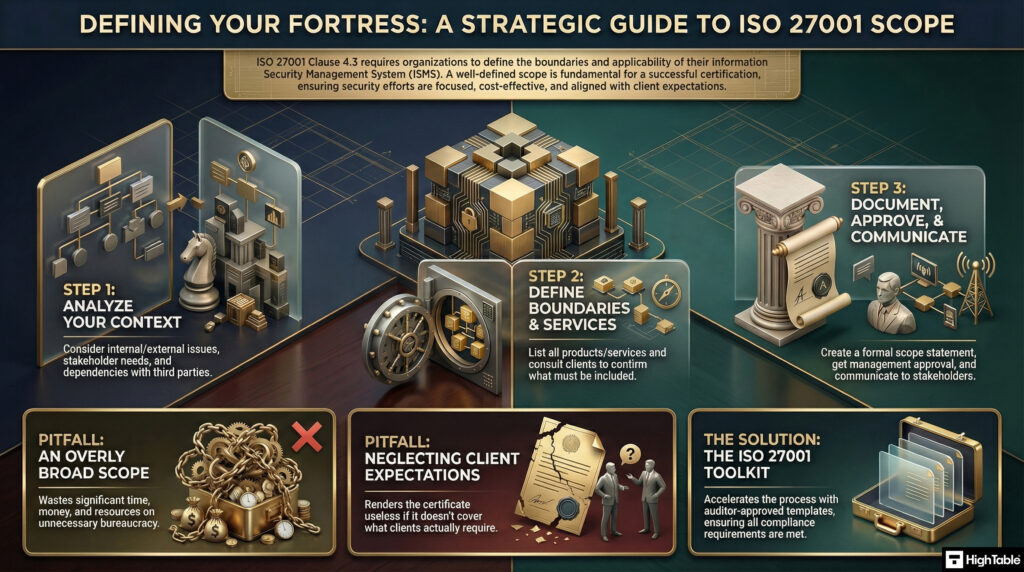
ISO 27001 Clause 4.3 Infographic
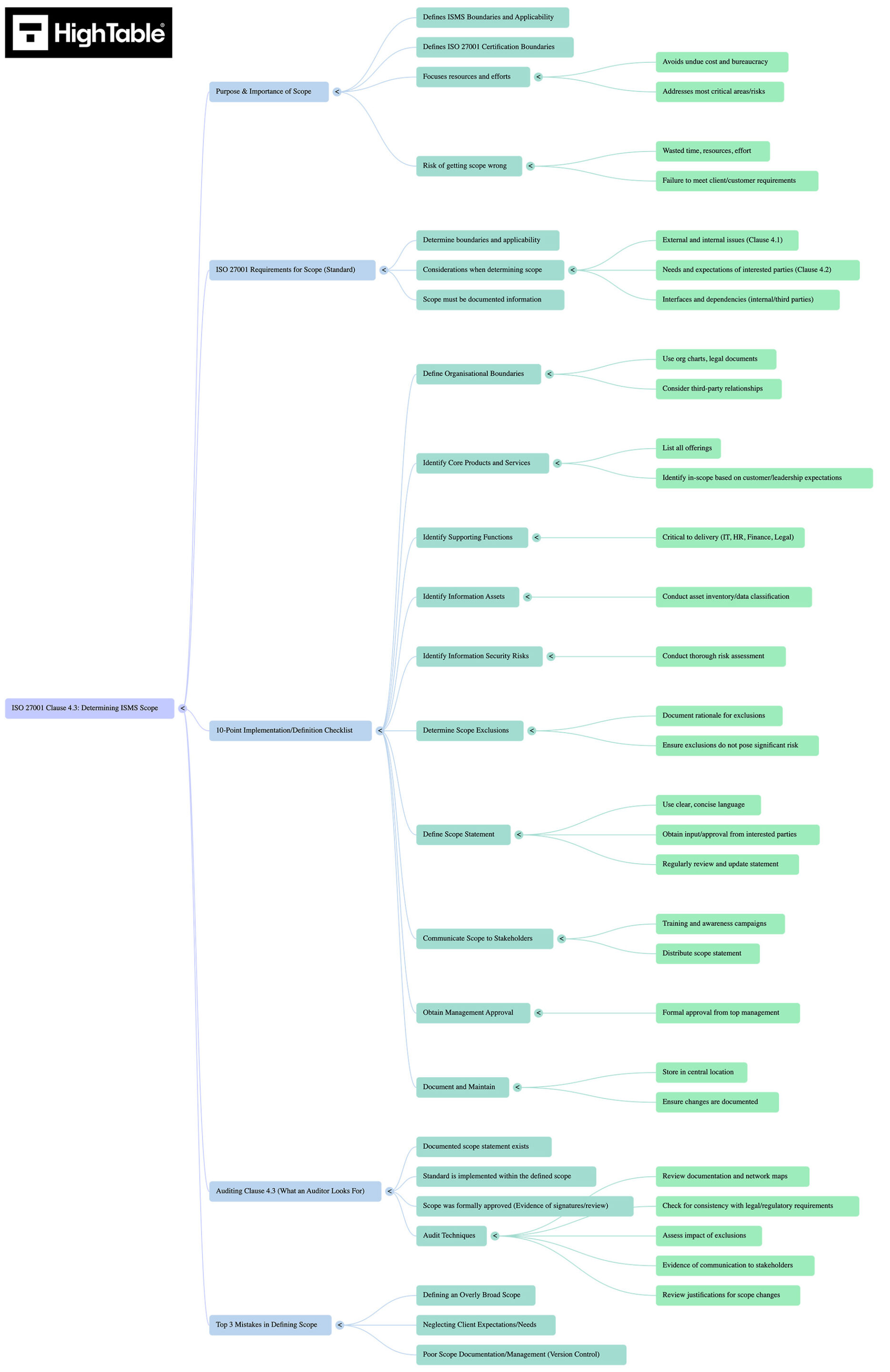
ISO 27001 Clause 4.3 Mind Map

Identifying scope is not a box-ticking exercise; it is a filtering process. You are distinguishing between what you are protecting for good business practice and what you are protecting for certification and that must be audited.

This blueprint visualises the five vectors of influence that define your scope compliance obligations. Use this blueprint to audit your own understanding or to facilitate brainstorming sessions with your ISMS steering committee.
ISO 27001 Clause 4.3 Implementation Video Tutorial

In this briefing, Lead Auditor Stuart Barker deconstructs the specific evidence requirements for Clause 4.3. Watch to learn how to distinguish between a “wish” and a “requirement” to avoid over-engineering your compliance scope.

ISO 27001 Clause 4.3 Podcast

Listen to the briefing: In this episode, we move beyond the textbook definition. Stuart discusses how to handle determine a practical scope for your information security management system.

ISO 27001 Clause 4.3 Strategic Implementation Briefing

In the strategic blueprint we give you the strategic blueprint for ISO 27001 Clause 4.3 including what it is, how to implement it, what an auditor wants to see and common mistakes people make from the perspective of an ISO 27001 lead auditor.

ISO 27001 Clause 4.3 Auditor Requirements

The ISO 27001 standard states that the organization shall determine the boundaries and applicability of the information security management system (ISMS) to establish its scope. To satisfy a UKAS-accredited auditor, you must demonstrate:

  • Integration of Inputs: You must provide evidence that your scope definition was not created in a vacuum. You must explicitly demonstrate how the Internal & External Issues (Clause 4.1) and the Interested Party Requirements (Clause 4.2) were considered when drawing the boundary lines. If a client contract (4.2) requires cloud security, your scope cannot exclude your cloud infrastructure.
  • Interfaces & Dependencies: You must clearly define the physical and logical boundaries. An auditor will look for specific descriptions of interfaces with third parties (e.g., where your responsibility ends and a managed service provider’s begins) and dependencies between in-scope and out-of-scope processes.

The Trap: Do not attempt “Gaming the Scope.” You cannot exclude part of your business solely to avoid difficult controls or audit scrutiny if that part processes information relevant to the scope. If the “Marketing Department” is excluded but they share the same network and office as the “in-scope” Finance team, an auditor will likely reject the scope as invalid due to lack of network segmentation.

How to Implement ISO 27001 Clause 4.3

Follow the ISO 27001 Lead Auditor Guidance on How to implement ISO 27001 Clause 4.3
How to implement ISO 27001 Clause 4.3

How to audit ISO 27001 Clause 4.3

Follow the ISO 27001 Leader Auditor Guidance on How to audit ISO 27001 Clause 4.3
How to audit ISO 27001 Clause 4.3

ISO 27001 Clause 4.3 Audit Checklist

The ISO 27001 Lead Auditor ISO 27001 Clause 4.3 Audit Checklist
ISO 27001 clause 4.3 audit checklist

ISO 27001 Clause 4.3 Templates

We have already built the pre-configured templates for Clause 4.3. The ISO 27001 Implementation Suite includes:

  • ISO 27001 Scope document

Fully formatted, auditor-verified, and ready for your logo.

ISO 27001 Toolkit Business Edition

About the author

Stuart Barker is a veteran practitioner with over 30 years of experience in systems security and risk management.

Holding an MSc in Software and Systems Security, Stuart combines academic rigor with extensive operational experience. His background includes over a decade leading Data Governance for General Electric (GE) across Europe, as well as founding and exiting a successful cyber security consultancy.

As a qualified ISO 27001 Lead Auditor and Lead Implementer, Stuart possesses distinct insight into the specific evidence standards required by certification bodies. He has successfully guided hundreds of organizations – from high-growth technology startups to enterprise financial institutions – through the audit lifecycle.

His toolkits represents the distillation of that field experience into a standardised framework. They move beyond theoretical compliance, providing a pragmatic, auditor-verified methodology designed to satisfy ISO/IEC 27001:2022 while minimising operational friction.

ISO 27001:2022 requirements

ISO 27001 Clauses

ISO 27001 Clause 4.1 – Understanding The Organisation And Its Context

ISO 27001 Clause 4.2 – Understanding The Needs And Expectations of Interested Parties

ISO 27001 Clause 4.3 – Determining The Scope Of The Information Security Management System

ISO 27001 Clause 4.4 – Information Security Management System

ISO 27001 Clause 5.1 – Leadership and Commitment

ISO 27001 Clause 5.3 – Organisational Roles, Responsibilities and Authorities

ISO 27001 Clause 6.1.1 – Planning General

ISO 27001 Clause 6.1.2 – Information Security Risk Assessment

ISO 27001 Clause 6.1.3 – Information Security Risk Treatment

ISO 27001 Clause 6.2 – Information Security Objectives and Planning to Achieve Them

ISO 27001 Clause 6.3 – Planning Of Changes

ISO 27001 Clause 7.1 – Resources

ISO 27001 Clause 7.2 – Competence

ISO 27001 Clause 7.3 – Awareness

ISO 27001 Clause 7.4 – Communication

ISO 27001 Clause 7.5.1 – Documented Information

ISO 27001 Clause 7.5.2 – Creating and Updating Documented Information

ISO 27001 Clause 8.3 – Information Security Risk Treatment

ISO 27001 Clause 9.1 – Monitoring, Measurement, Analysis, Evaluation

ISO 27001 Clause 9.2 – Internal Audit

ISO 27001 Clause 9.3 – Management Review

ISO 27001 Clause 10.1 – Continual Improvement

ISO 27001 Clause 10.2 – Nonconformity and Corrective Action

ISO 27001 Organisation Controls

ISO 27001 Annex A 5.1: Policies for information security

ISO 27001 Annex A 5.2: Information Security Roles and Responsibilities

ISO 27001 Annex A 5.3: Segregation of duties

ISO 27001 Annex A 5.4: Management responsibilities

ISO 27001 Annex A 5.5: Contact with authorities

ISO 27001 Annex A 5.6: Contact with special interest groups

ISO 27001 Annex A 5.7: Threat intelligence

ISO 27001 Annex A 5.8: Information security in project management

ISO 27001 Annex A 5.9: Inventory of information and other associated assets

ISO 27001 Annex A 5.10: Acceptable use of information and other associated assets

ISO 27001 Annex A 5.11: Return of assets

ISO 27001 Annex A 5.12: Classification of information

ISO 27001 Annex A 5.13: Labelling of information

ISO 27001 Annex A 5.14: Information transfer

ISO 27001 Annex A 5.15: Access control

ISO 27001 Annex A 5.16: Identity management

ISO 27001 Annex A 5.17: Authentication information

ISO 27001 Annex A 5.18: Access rights

ISO 27001 Annex A 5.19: Information security in supplier relationships

ISO 27001 Annex A 5.20: Addressing information security within supplier agreements

ISO 27001 Annex A 5.21: Managing information security in the ICT supply chain

ISO 27001 Annex A 5.22: Monitoring, review and change management of supplier services

ISO 27001 Annex A 5.23: Information security for use of cloud services

ISO 27001 Annex A 5.24: Information security incident management planning and preparation

ISO 27001 Annex A 5.25: Assessment and decision on information security events

ISO 27001 Annex A 5.26: Response to information security incidents

ISO 27001 Annex A 5.27: Learning from information security incidents

ISO 27001 Annex A 5.28: Collection of evidence

ISO 27001 Annex A 5.29: Information security during disruption

ISO 27001 Annex A 5.30: ICT readiness for business continuity

ISO 27001 Annex A 5.31: Identification of legal, statutory, regulatory and contractual requirements

ISO 27001 Annex A 5.32: Intellectual property rights

ISO 27001 Annex A 5.33: Protection of records

ISO 27001 Annex A 5.34: Privacy and protection of PII

ISO 27001 Annex A 5.35: Independent review of information security

ISO 27001 Annex A 5.36: Compliance with policies and standards for information security

ISO 27001 Annex A 5.37: Documented operating procedures

ISO 27001 Technical Controls

ISO 27001 Annex A 8.1: User Endpoint Devices

ISO 27001 Annex A 8.2: Privileged Access Rights

ISO 27001 Annex A 8.3: Information Access Restriction

ISO 27001 Annex A 8.4: Access To Source Code

ISO 27001 Annex A 8.5: Secure Authentication

ISO 27001 Annex A 8.6: Capacity Management

ISO 27001 Annex A 8.7: Protection Against Malware

ISO 27001 Annex A 8.8: Management of Technical Vulnerabilities

ISO 27001 Annex A 8.9: Configuration Management 

ISO 27001 Annex A 8.10: Information Deletion

ISO 27001 Annex A 8.11: Data Masking

ISO 27001 Annex A 8.12: Data Leakage Prevention

ISO 27001 Annex A 8.13: Information Backup

ISO 27001 Annex A 8.14: Redundancy of Information Processing Facilities

ISO 27001 Annex A 8.15: Logging

ISO 27001 Annex A 8.16: Monitoring Activities

ISO 27001 Annex A 8.17: Clock Synchronisation

ISO 27001 Annex A 8.18: Use of Privileged Utility Programs

ISO 27001 Annex A 8.19: Installation of Software on Operational Systems

ISO 27001 Annex A 8.20: Network Security

ISO 27001 Annex A 8.21: Security of Network Services

ISO 27001 Annex A 8.22: Segregation of Networks

ISO 27001 Annex A 8.23: Web Filtering

ISO 27001 Annex A 8.24: Use of Cryptography

ISO 27001 Annex A 8.25: Secure Development Life Cycle

ISO 27001 Annex A 8.26: Application Security Requirements

ISO 27001 Annex A 8.27: Secure Systems Architecture and Engineering Principles

ISO 27001 Annex A 8.28: Secure Coding

ISO 27001 Annex A 8.29: Security Testing in Development and Acceptance

ISO 27001 Annex A 8.30: Outsourced Development

ISO 27001 Annex A 8.31: Separation of Development, Test and Production Environments

ISO 27001 Annex A 8.32: Change Management

ISO 27001 Annex A 8.33: Test Information

ISO 27001 Annex A 8.34: Protection of information systems during audit testing