ISO 27001:2022 Clause 4.2: Understanding The Needs And Expectations of Interested Parties [Strategic Blueprint]

Home / ISO 27001 / ISO 27001:2022 Clause 4.2: Understanding The Needs And Expectations of Interested Parties [Strategic Blueprint]

Last updated Dec 11, 2025

Author: Stuart Barker | ISO 27001 Lead Auditor

The auditor-verified guide to identifying stakeholders, documenting their requirements, and ensuring your ISMS meets the expectations of regulators, clients, and employees.

What is ISO 27001 Clause 4.2?

ISO 27001 Clause 4.2 (Understanding the needs and expectations of interested parties) requires you to determine the relevant stakeholders who can affect, be affected by, or perceive themselves to be affected by your Information Security Management System (ISMS).

In plain English, you cannot build a security system in a vacuum. You must identify who cares about your security (e.g., clients, regulators, shareholders) and explicitly document what they require from you.

To satisfy this clause, you must document:

  • The Interested Parties: Who are they? (e.g., Customers, Suppliers, The ICO, Employees).
  • The Requirements: What do they need? (e.g., “SOC 2 alignment,” “GDPR compliance,” “99.9% Availability”).
  • The Relevance: Which of these requirements will become mandatory controls within your ISMS?

Failure to evidence this analysis is a common source of Major Non-Conformities because it proves the ISMS is disconnected from the business reality.

Visual Blueprint: The Architectural Workflow

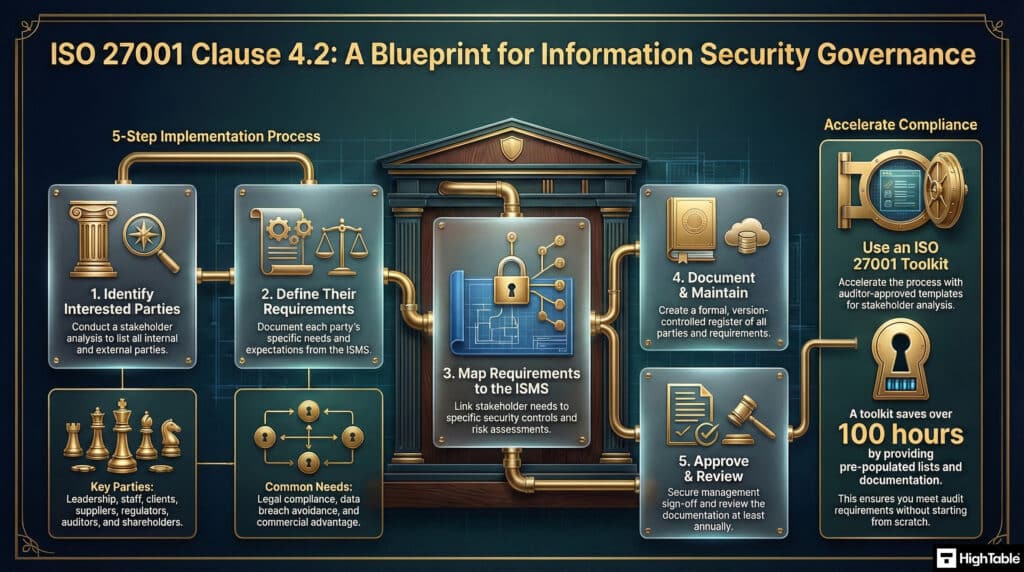
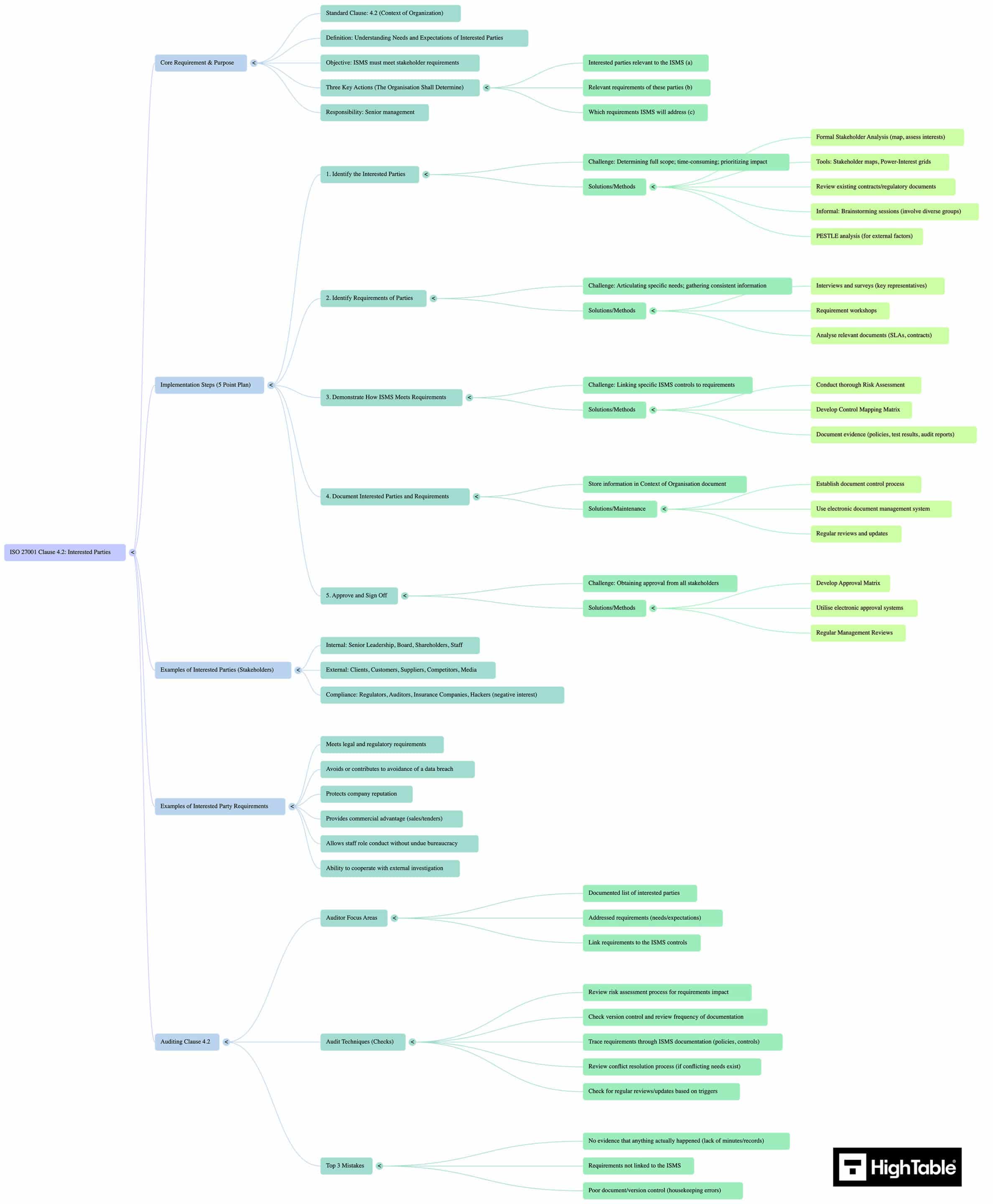
The ISO 27001 Clause 4.2 Mind Map

Identifying interested parties is not a box-ticking exercise; it is a filtering process. You are distinguishing between a stakeholder’s “wish” and a mandatory “requirement” that must be audited.

This blueprint visualises the five vectors of influence that define your compliance obligations. Use this blueprint to audit your own understanding or to facilitate brainstorming sessions with your ISMS steering committee.
Implementation Masterclass: Clause 4.2 Strategic Overview

In this briefing, Lead Auditor Stuart Barker deconstructs the specific evidence requirements for Clause 4.2. Watch to learn how to distinguish between a “wish” and a “requirement” to avoid over-engineering your compliance scope.

The ISO 27001 Clause 4.2 Briefing Pack

The Lead Auditor Podcast: Clause 4.2 Deep Dive

Listen to the briefing: In this episode, we move beyond the textbook definition. Stuart discusses how to handle conflicting stakeholder requirements (e.g., Client A wants data encrypted, Regulator B wants data accessible) and how to leverage Clause 4.2 to justify security budget increases.

ISO 27001 Clause 4.2 Explainer – The Strategic Blueprint

In the strategic blueprint we give you the strategic blueprint for ISO 27001 Clause 4.2 including what it is, how to implement it, what an auditor wants to see and common mistakes people make from the perspective of an ISO 27001 lead auditor.

Decoding the Requirement: What the Auditor Wants

The ISO 27001 standard states that the organisation shall determine interested parties and their requirements. To satisfy a UKAS-accredited auditor, you must demonstrate:

  • Traceability: You must show a “Golden Thread” from a stakeholder requirement (e.g., “Client Contract”) to a specific risk or control in your ISMS.
  • Legal Obligation: You must explicitly identify which interested parties generate legal & regulatory requirements (linked to Clause 4.1 and Clause 9.3).
  • The Trap: Do not list everyone. The cleaner asks for a pay rise; that is not an ISMS requirement. Only list parties relevant to Information Security.

How to Implement Clause 4.2: Step-by-Step

Identifying interested parties is a strategic audit of your business relationships. Follow this 5-step protocol to capture, analyze, and document the requirements as required by the standard.

Step 1: The Brainstorming Session

The Objective: Extract tribal knowledge from department heads to identify “silent” stakeholders.

  • Action: Convene a workshop with Legal, Sales, and HR.
  • Ask: “Who imposes security clauses on us?” (Clients). “Who regulates our data?” (Government). “Who keeps the lights on?” (IT Suppliers).

Step 2: Determine Specific Requirements

The Objective: Move from vague lists to concrete obligations.

  • Review Contracts: Look at client Master Service Agreements (MSAs). Do they require ISO 27001? Penetration Testing?
  • Review Legislation: If you process PII, the GDPR/CCPA is a mandatory interested party requirement.

Step 3: Filter for Relevance

The Objective: Prevent scope creep.

  • The Filter: Ask, “Does this requirement affect the Confidentiality, Integrity, or Availability of our data?” If no, discard it.
  • The Output: A refined list of relevant interested parties.

Step 4: Formalise the Evidence

The Objective: Create the audit artifact.

  • Documentation: Populate your [Context of Organisation Template] or a dedicated [Stakeholder Register].
  • Mapping: Ensure every mandatory requirement listed is addressed somewhere in your Statement of Applicability (SoA).

Step 5: Monitor & Review

The Objective: Demonstrate continual improvement.

  • Trigger Events: Update this list whenever you sign a major new client, enter a new market, or when laws change (e.g., DORA).

Audit Checklist: How to Pass Clause 4.2

Use this checklist to simulate a certification audit and identify non-conformities before the external auditor arrives.

1. Verify Identification Methodology

  • Objective: Confirm no critical groups were missed.
  • The Challenge: Auditors often check for “Implied” stakeholders like insurance providers or landlords who enforce physical security rules.
  • Audit Technique: Review the Legal Register and insurance policies to ensure they appear in the Interested Parties list.

2. Check for “Wish” vs “Requirement”

  • Objective: Ensure the ISMS is focused on mandatory obligations.
  • The Challenge: Documenting vague expectations (e.g., “Customers want us to be safe”) instead of specific requirements (e.g., “Customers require encryption at rest”).
  • Audit Technique: Challenge the document owner to point to the source of the requirement (e.g., a contract clause).

3. Evidence of Review

  • Objective: Prove the list is dynamic.
  • The Challenge: Presenting a static document dated 12 months ago.
  • Audit Technique: Check Management Review Minutes (Clause 9.3) for discussion of “Changes in Interested Parties.”

Don’t Draft from Scratch: Pre-Configured Templates

We have already built the pre-configured templates for Clause 4.2. The ISO 27001 Implementation Suite includes:

  • Context of Organisation Template (Includes Interested Parties Register)
  • Legal & Regulatory Register
  • Communication Plan Template

Fully formatted, auditor-verified, and ready for your logo.

ISO 27001 Toolkit Business Edition

ISO 27001 Clause 4.2 FAQ

Why do you need ISO 27001 Clause 4.1?

You can’t have an effective information security management system (ISMS) in a bubble. This step makes sure you consider everyone who has a stake in your security. If you don’t meet these expectations, you could lose customers, face legal issues, or damage your reputation. It also helps you prioritise your security efforts on what really matters to these key groups.

When do you need ISO 27001 Clause 4.2?

You should do this right after you understand your own organisational context. It’s the second step in your ISO 27001 journey. You need to do it at the beginning of your project and then review and update it regularly. Whenever a new stakeholder appears, or an existing one changes their needs, you’ll need to update your document.

Who needs ISO 27001 Clause 4.2?

You, as the person leading the ISO 27001 project, will need to put this together. You should also involve your management team and key people from different departments, like sales, HR, and legal. Their input is key to making sure you capture everyone’s expectations accurately.

Where do you need ISO 27001 Clause 4.2?

This isn’t a physical place. It’s a key piece of your ISO 27001 documentation. You’ll likely store this document in a central, secure place with all your other ISO 27001 files, so it’s easy to access and review.

How do you write ISO 27001 Clause 4.2?

Start by making a list of everyone who could be considered an interested party. Think about your employees, customers, suppliers, and even the government. Then, for each group, write down their specific needs and expectations. For example, your customers need their data to be kept private, and your employees need clear security policies to follow. You can use a table format to keep it neat and easy to read.

How do you implement ISO 27001 Clause 4.2?

Once you have your list, you need to use this information. It should directly influence your security policies and controls. For instance, if your customers expect their data to be encrypted, you will need to implement an encryption control. The needs and expectations of your interested parties will inform your entire risk assessment process.

Which other information security standards need ISO 27001 Clause 4.2?

This concept of identifying interested parties is a core part of the Annex SL framework. This means that any management system standard built on this framework, like ISO 9001 (Quality Management) and ISO 14001 (Environmental Management), will also require you to do this. It is also applicable to:
GDPR (General Data Protection Regulation)
CCPA (California Consumer Privacy Act)
DORA (Digital Operational Resilience Act)
NIS2 (Network and Information Security (NIS) Directive) 
SOC 2 (Service Organisation Control 2)
NIST (National Institute of Standards and Technology) 
HIPAA (Health Insurance Portability and Accountability Act)

Is an interested party just a customer?

No, an interested party can be anyone from an employee to a government agency.

How do I figure out what my interested parties want?

You can ask them directly, look at their contracts, or review industry regulations.

Do I have to list every single person?

No, you should list groups of people, like “customers” or “suppliers.”

Can the needs of interested parties conflict? 

Yes, sometimes they do. For example, a customer wants easy access, but a regulator wants very strict controls. You have to find a balance.

What if I miss a group?

 You can always add them later. The document is meant to be updated as your business grows and changes.

Does my list have to be formal?

 Yes, it needs to be documented so an auditor can review it.

Is this the same as a risk assessment?

 No. This step helps you figure out what to include in your risk assessment.

What if my business is very small?

 Your list of interested parties will be smaller, which is fine!

Do I need to get everyone to sign off on this document?

 It’s a good idea to have your management team review and approve it.

How often should I review this?

 At least once a year, or whenever there’s a big change in your business.

How detailed should I be? 

Be detailed enough to clearly understand what is expected, but not so much that it’s overwhelming.

What’s the difference between needs and expectations? 

A need is something they must have (like compliance), while an expectation is something they want (like quick response times).

Can interested parties be internal?

 Yes, your employees and management are important interested parties.

How does this help with compliance? 

By identifying relevant regulations, you ensure your security plan meets legal requirements.

What if a stakeholder’s needs change? 

You must update your document and, if needed, your security controls.

ISO 27001:2022 requirements

ISO 27001 Clauses

ISO 27001 Clause 4.1 – Understanding The Organisation And Its Context

ISO 27001 Clause 4.2 – Understanding The Needs And Expectations of Interested Parties

ISO 27001 Clause 4.3 – Determining The Scope Of The Information Security Management System

ISO 27001 Clause 4.4 – Information Security Management System

ISO 27001 Clause 5.1 – Leadership and Commitment

ISO 27001 Clause 5.3 – Organisational Roles, Responsibilities and Authorities

ISO 27001 Clause 6.1.1 – Planning General

ISO 27001 Clause 6.1.2 – Information Security Risk Assessment

ISO 27001 Clause 6.1.3 – Information Security Risk Treatment

ISO 27001 Clause 6.2 – Information Security Objectives and Planning to Achieve Them

ISO 27001 Clause 6.3 – Planning Of Changes

ISO 27001 Clause 7.1 – Resources

ISO 27001 Clause 7.2 – Competence

ISO 27001 Clause 7.3 – Awareness

ISO 27001 Clause 7.4 – Communication

ISO 27001 Clause 7.5.1 – Documented Information

ISO 27001 Clause 7.5.2 – Creating and Updating Documented Information

ISO 27001 Clause 8.3 – Information Security Risk Treatment

ISO 27001 Clause 9.1 – Monitoring, Measurement, Analysis, Evaluation

ISO 27001 Clause 9.2 – Internal Audit

ISO 27001 Clause 9.3 – Management Review

ISO 27001 Clause 10.1 – Continual Improvement

ISO 27001 Clause 10.2 – Nonconformity and Corrective Action

ISO 27001 Organisation Controls

ISO 27001 Annex A 5.1: Policies for information security

ISO 27001 Annex A 5.2: Information Security Roles and Responsibilities

ISO 27001 Annex A 5.3: Segregation of duties

ISO 27001 Annex A 5.4: Management responsibilities

ISO 27001 Annex A 5.5: Contact with authorities

ISO 27001 Annex A 5.6: Contact with special interest groups

ISO 27001 Annex A 5.7: Threat intelligence

ISO 27001 Annex A 5.8: Information security in project management

ISO 27001 Annex A 5.9: Inventory of information and other associated assets

ISO 27001 Annex A 5.10: Acceptable use of information and other associated assets

ISO 27001 Annex A 5.11: Return of assets

ISO 27001 Annex A 5.12: Classification of information

ISO 27001 Annex A 5.13: Labelling of information

ISO 27001 Annex A 5.14: Information transfer

ISO 27001 Annex A 5.15: Access control

ISO 27001 Annex A 5.16: Identity management

ISO 27001 Annex A 5.17: Authentication information

ISO 27001 Annex A 5.18: Access rights

ISO 27001 Annex A 5.19: Information security in supplier relationships

ISO 27001 Annex A 5.20: Addressing information security within supplier agreements

ISO 27001 Annex A 5.21: Managing information security in the ICT supply chain

ISO 27001 Annex A 5.22: Monitoring, review and change management of supplier services

ISO 27001 Annex A 5.23: Information security for use of cloud services

ISO 27001 Annex A 5.24: Information security incident management planning and preparation

ISO 27001 Annex A 5.25: Assessment and decision on information security events

ISO 27001 Annex A 5.26: Response to information security incidents

ISO 27001 Annex A 5.27: Learning from information security incidents

ISO 27001 Annex A 5.28: Collection of evidence

ISO 27001 Annex A 5.29: Information security during disruption

ISO 27001 Annex A 5.30: ICT readiness for business continuity

ISO 27001 Annex A 5.31: Identification of legal, statutory, regulatory and contractual requirements

ISO 27001 Annex A 5.32: Intellectual property rights

ISO 27001 Annex A 5.33: Protection of records

ISO 27001 Annex A 5.34: Privacy and protection of PII

ISO 27001 Annex A 5.35: Independent review of information security

ISO 27001 Annex A 5.36: Compliance with policies and standards for information security

ISO 27001 Annex A 5.37: Documented operating procedures

ISO 27001 Technical Controls

ISO 27001 Annex A 8.1: User Endpoint Devices

ISO 27001 Annex A 8.2: Privileged Access Rights

ISO 27001 Annex A 8.3: Information Access Restriction

ISO 27001 Annex A 8.4: Access To Source Code

ISO 27001 Annex A 8.5: Secure Authentication

ISO 27001 Annex A 8.6: Capacity Management

ISO 27001 Annex A 8.7: Protection Against Malware

ISO 27001 Annex A 8.8: Management of Technical Vulnerabilities

ISO 27001 Annex A 8.9: Configuration Management 

ISO 27001 Annex A 8.10: Information Deletion

ISO 27001 Annex A 8.11: Data Masking

ISO 27001 Annex A 8.12: Data Leakage Prevention

ISO 27001 Annex A 8.13: Information Backup

ISO 27001 Annex A 8.14: Redundancy of Information Processing Facilities

ISO 27001 Annex A 8.15: Logging

ISO 27001 Annex A 8.16: Monitoring Activities

ISO 27001 Annex A 8.17: Clock Synchronisation

ISO 27001 Annex A 8.18: Use of Privileged Utility Programs

ISO 27001 Annex A 8.19: Installation of Software on Operational Systems

ISO 27001 Annex A 8.20: Network Security

ISO 27001 Annex A 8.21: Security of Network Services

ISO 27001 Annex A 8.22: Segregation of Networks

ISO 27001 Annex A 8.23: Web Filtering

ISO 27001 Annex A 8.24: Use of Cryptography

ISO 27001 Annex A 8.25: Secure Development Life Cycle

ISO 27001 Annex A 8.26: Application Security Requirements

ISO 27001 Annex A 8.27: Secure Systems Architecture and Engineering Principles

ISO 27001 Annex A 8.28: Secure Coding

ISO 27001 Annex A 8.29: Security Testing in Development and Acceptance

ISO 27001 Annex A 8.30: Outsourced Development

ISO 27001 Annex A 8.31: Separation of Development, Test and Production Environments

ISO 27001 Annex A 8.32: Change Management

ISO 27001 Annex A 8.33: Test Information

ISO 27001 Annex A 8.34: Protection of information systems during audit testing