How to audit ISO 27001 Clause 4.1

Home / ISO 27001 / What is ISO 27001 Clause 4.1? / How to audit ISO 27001 Clause 4.1

Last updated Dec 18, 2025

Author: Stuart Barker | ISO 27001 Lead Auditor

How to audit ISO 27001 Clause 4.1. Follow these steps to audit how the organization determines internal and external issues relevant to its ISMS.
Time needed: 1 hour and 30 minutes

How to audit ISO 27001 Clause 4.1

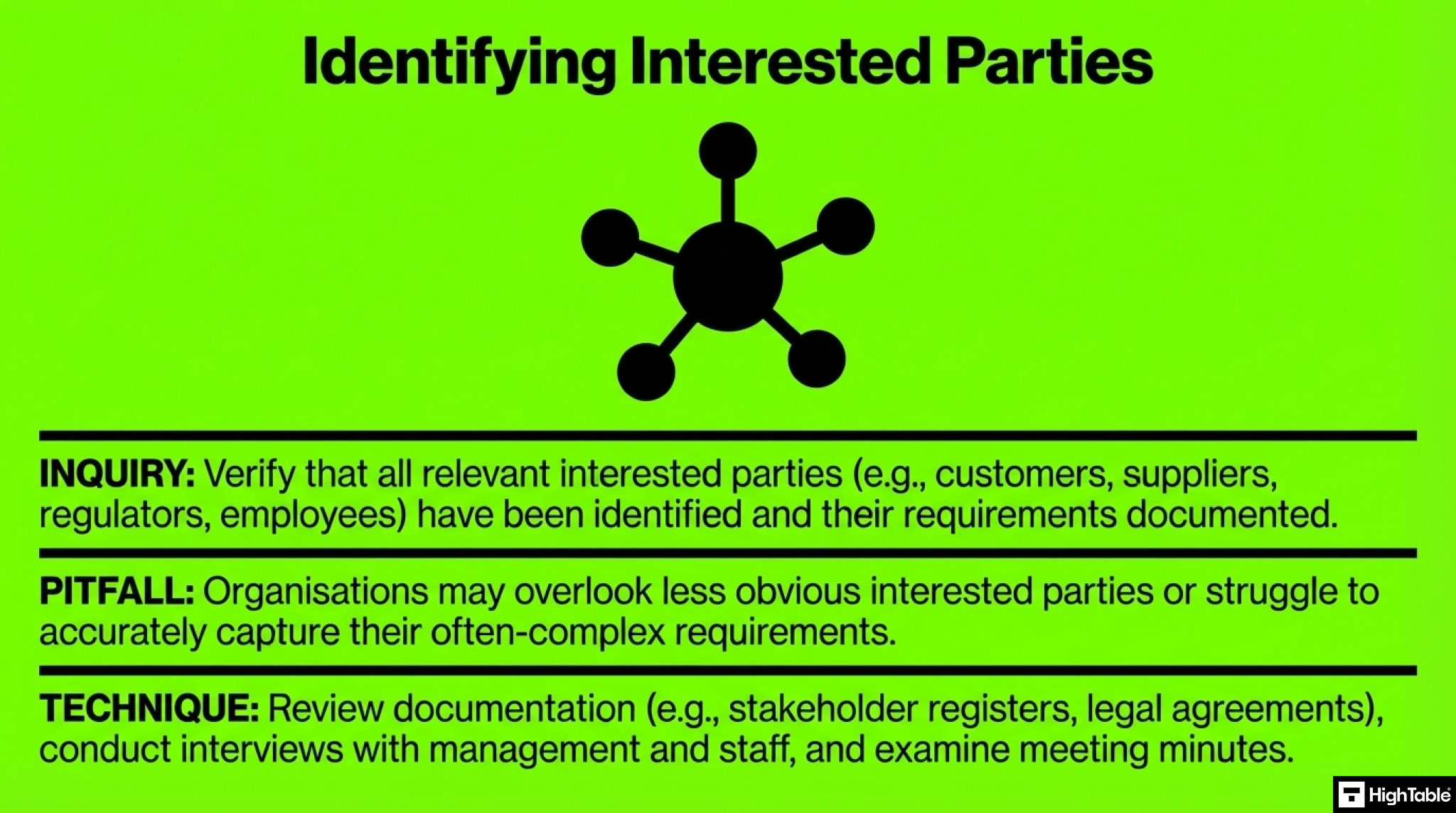
  1. Ensure Interested Parties were identified

    Verify that all relevant interested parties (e.g., customers, suppliers, regulators, employees) have been identified and their requirements documented.

    Challenge
    Organisations may overlook less obvious interested parties or struggle to accurately capture their often-complex requirements.

    Audit Technique
    Review documentation (e.g., stakeholder registers, legal agreements), conduct interviews with management and staff, and examine meeting minutes.

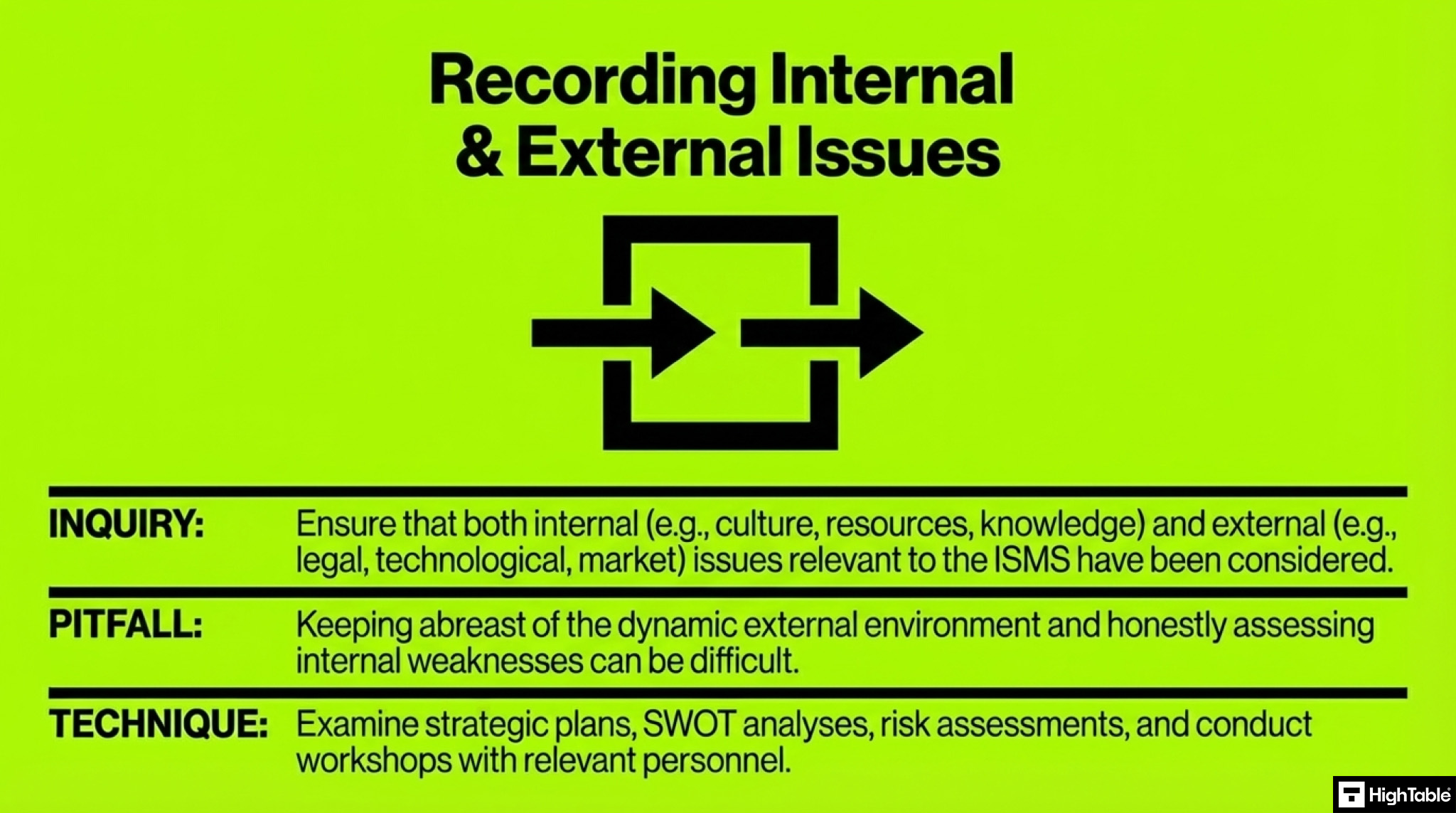
  2. Check Internal and External Issues were recorded

    Ensure that both internal (e.g., culture, resources, knowledge) and external (e.g., legal, technological, market) issues relevant to the ISMS have been considered.

    Challenge
    Keeping abreast of the dynamic external environment and honestly assessing internal weaknesses can be difficult.

    Audit Technique
    Examine strategic plans, SWOT analyses, risk assessments, and conduct workshops with relevant personnel.

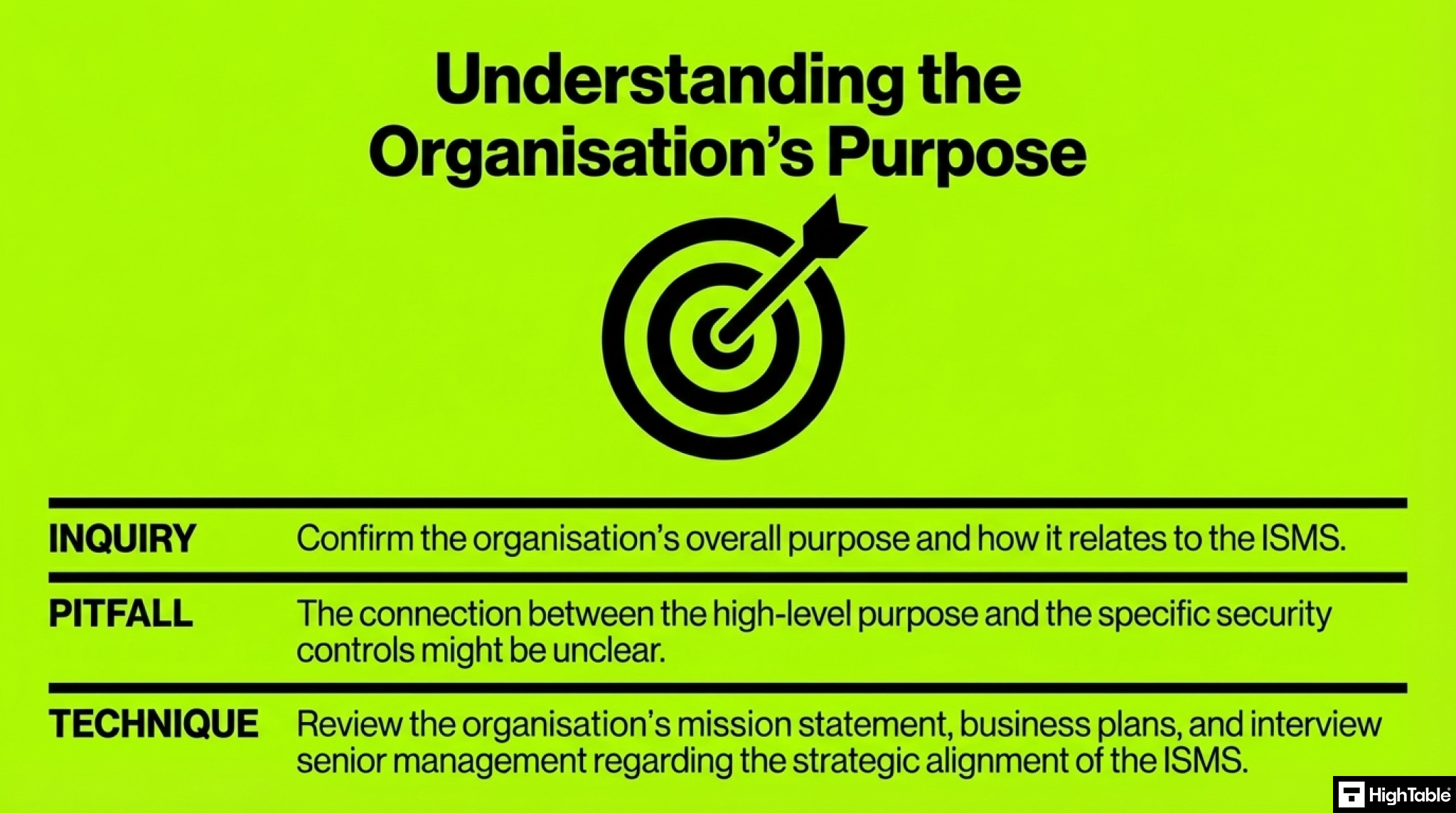
  3. Understanding the Organisation’s Purpose

    Confirm the organisation’s overall purpose and how it relates to the ISMS.

    Challenge
    The connection between the high-level purpose and the specific security controls might be unclear.

    Audit Technique
    Review the organisation’s mission statement, business plans, and interview senior management regarding the strategic alignment of the ISMS.

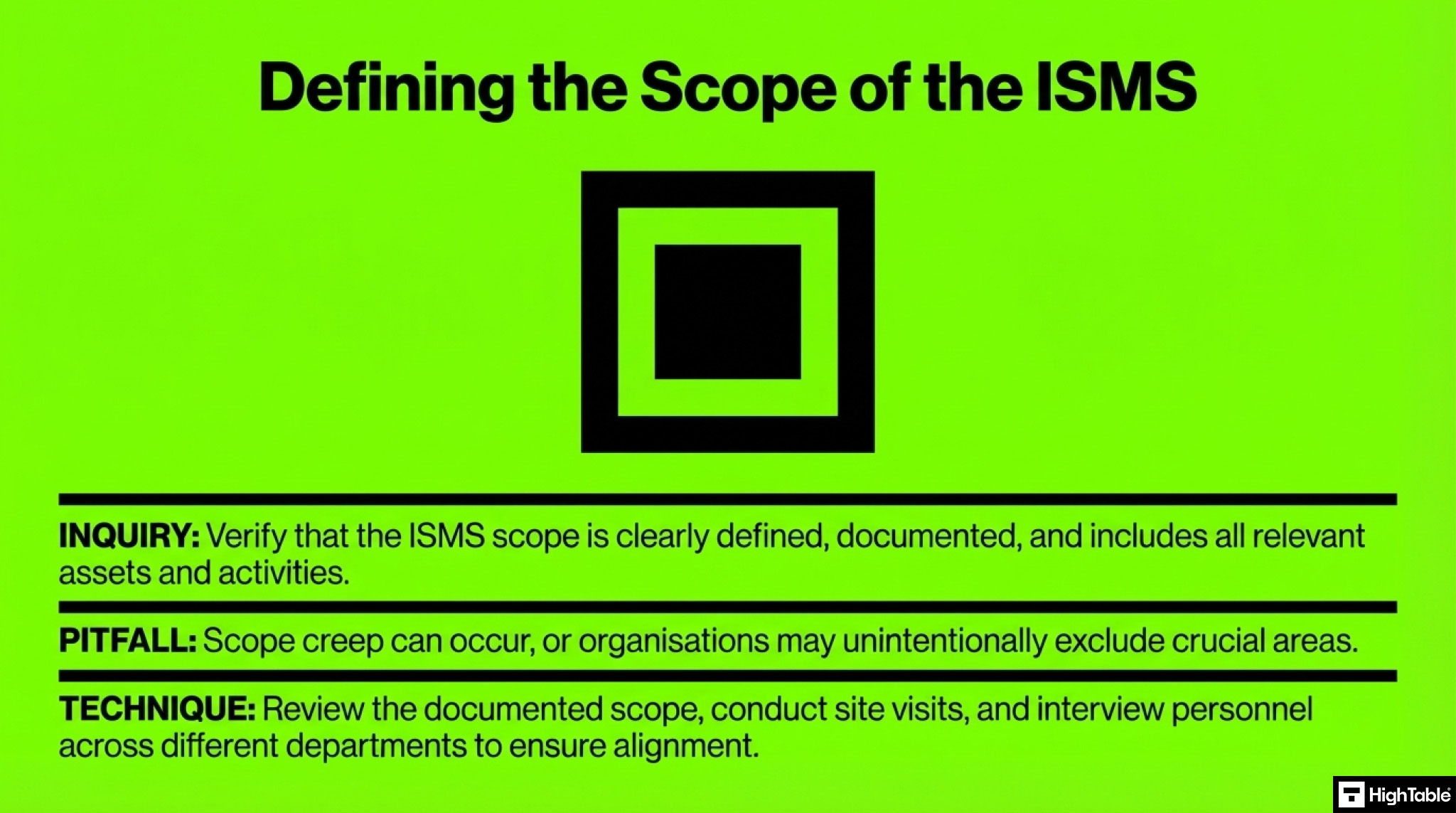
  4. Defining the Scope of the ISMS

    Verify that the ISMS scope is clearly defined, documented, and includes all relevant assets and activities.

    Challenge
    Scope creep can occur, or organisations may unintentionally exclude crucial areas.

    Audit Technique
    Review the documented scope, conduct site visits, and interview personnel across different departments to ensure alignment.

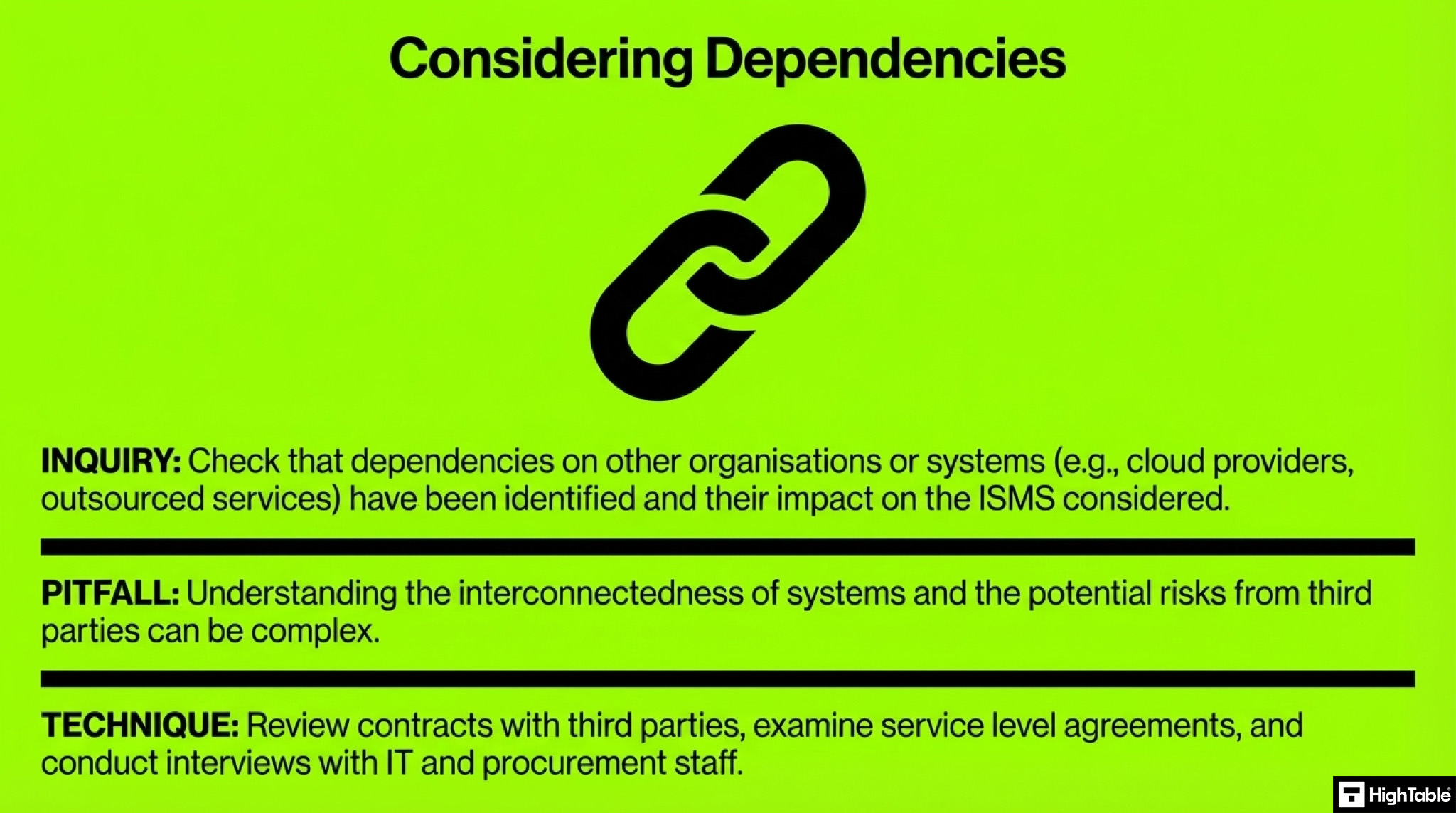
  5. Considering Dependencies

    Check that dependencies on other organisations or systems (e.g., cloud providers, outsourced services) have been identified and their impact on the ISMS considered.

    Challenge
    Understanding the interconnectedness of systems and the potential risks from third parties can be complex.

    Audit Technique
    Review contracts with third parties, examine service level agreements, and conduct interviews with IT and procurement staff.

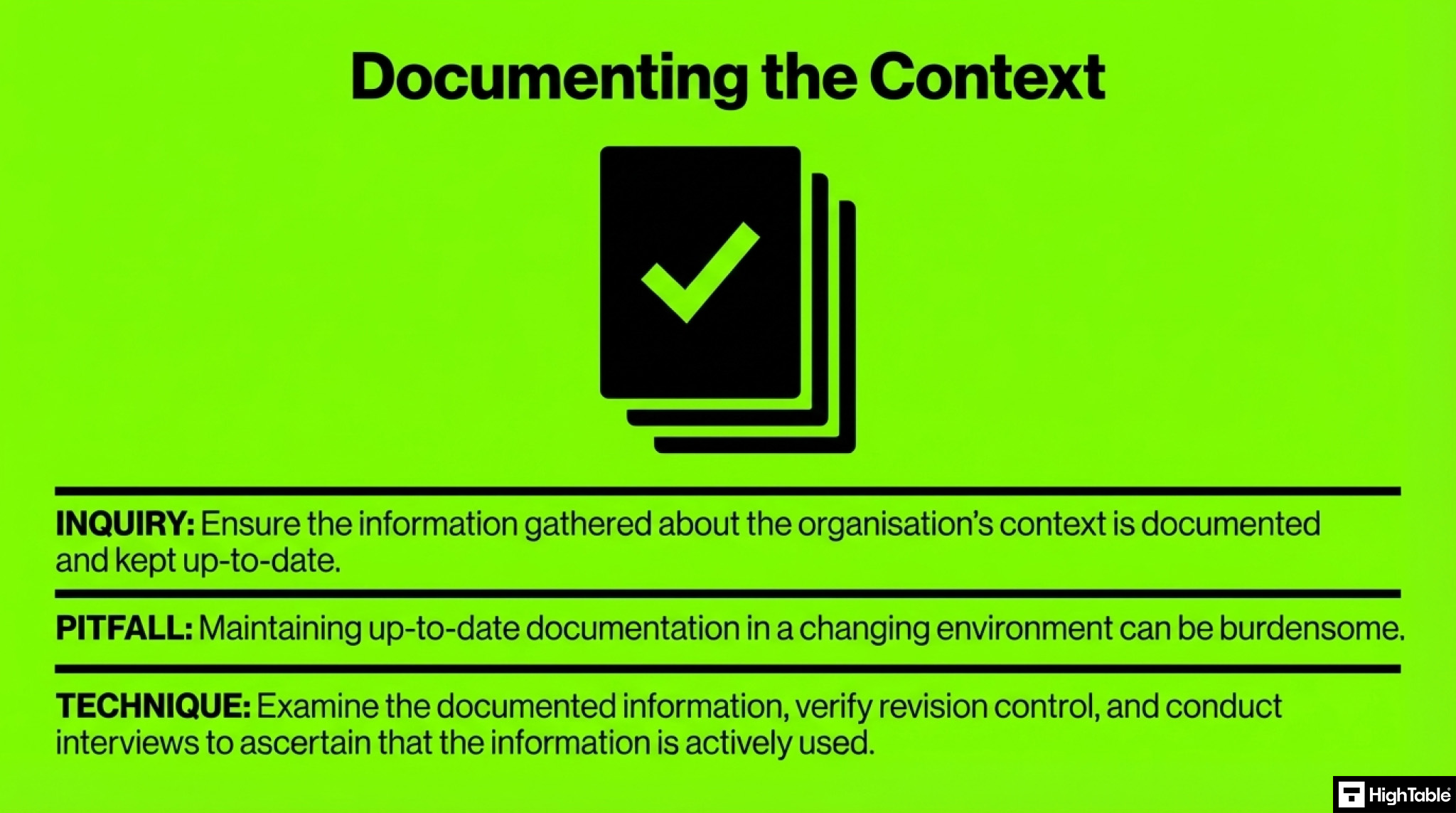
  6. Documenting the Context

    Ensure the information gathered about the organisation’s context is documented and kept up-to-date.

    Challenge
    Maintaining up-to-date documentation in a changing environment can be burdensome.

    Audit Technique
    Examine the documented information, verify revision control, and conduct interviews to ascertain that the information is actively used.

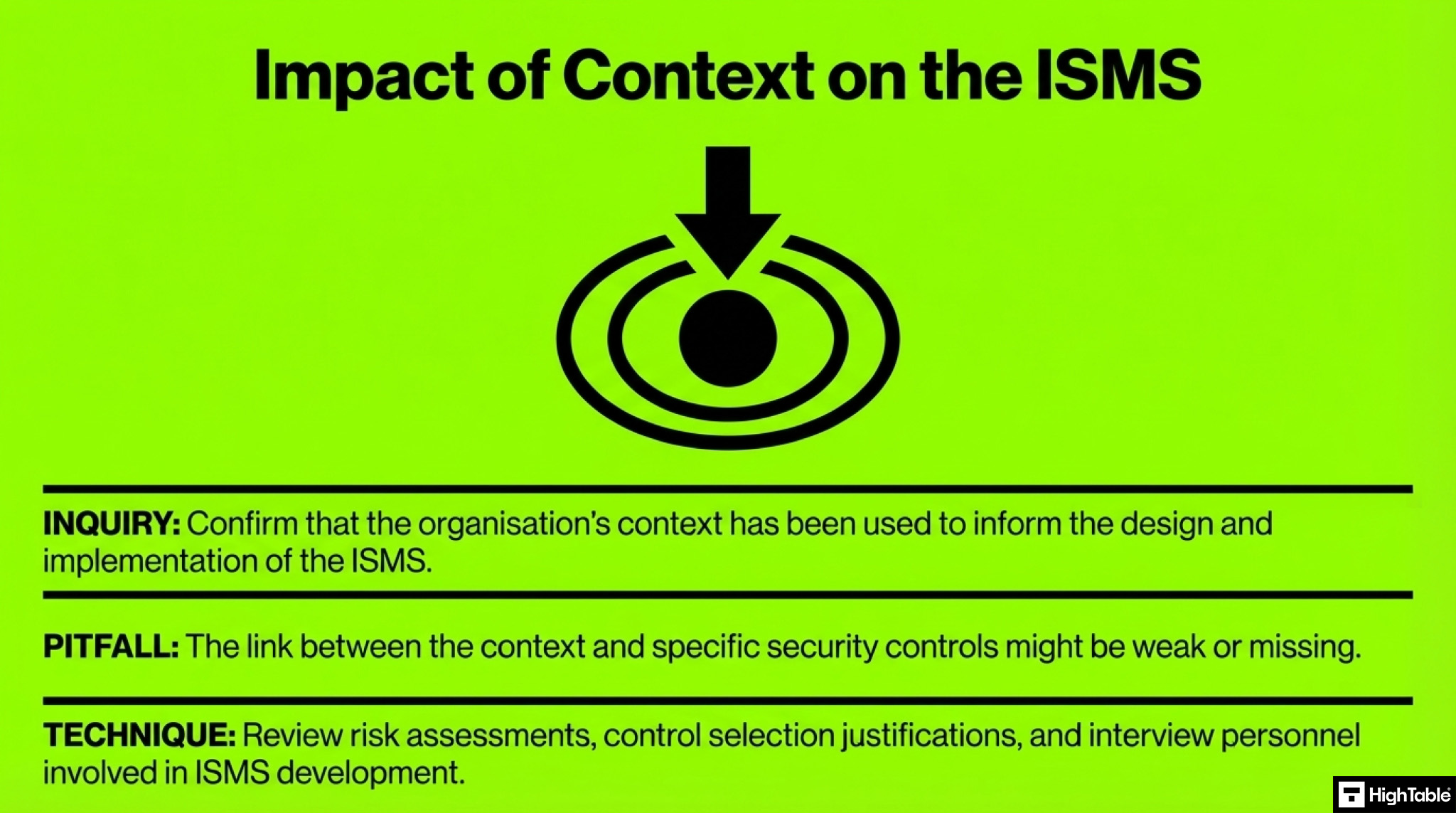
  7. Impact of the Context on the ISMS

    Confirm that the organisation’s context has been used to inform the design and implementation of the ISMS.

    Challenge
    The link between the context and specific security controls might be weak or missing.

    Audit Technique

    Review risk assessments, control selection justifications, and interview personnel involved in ISMS development.

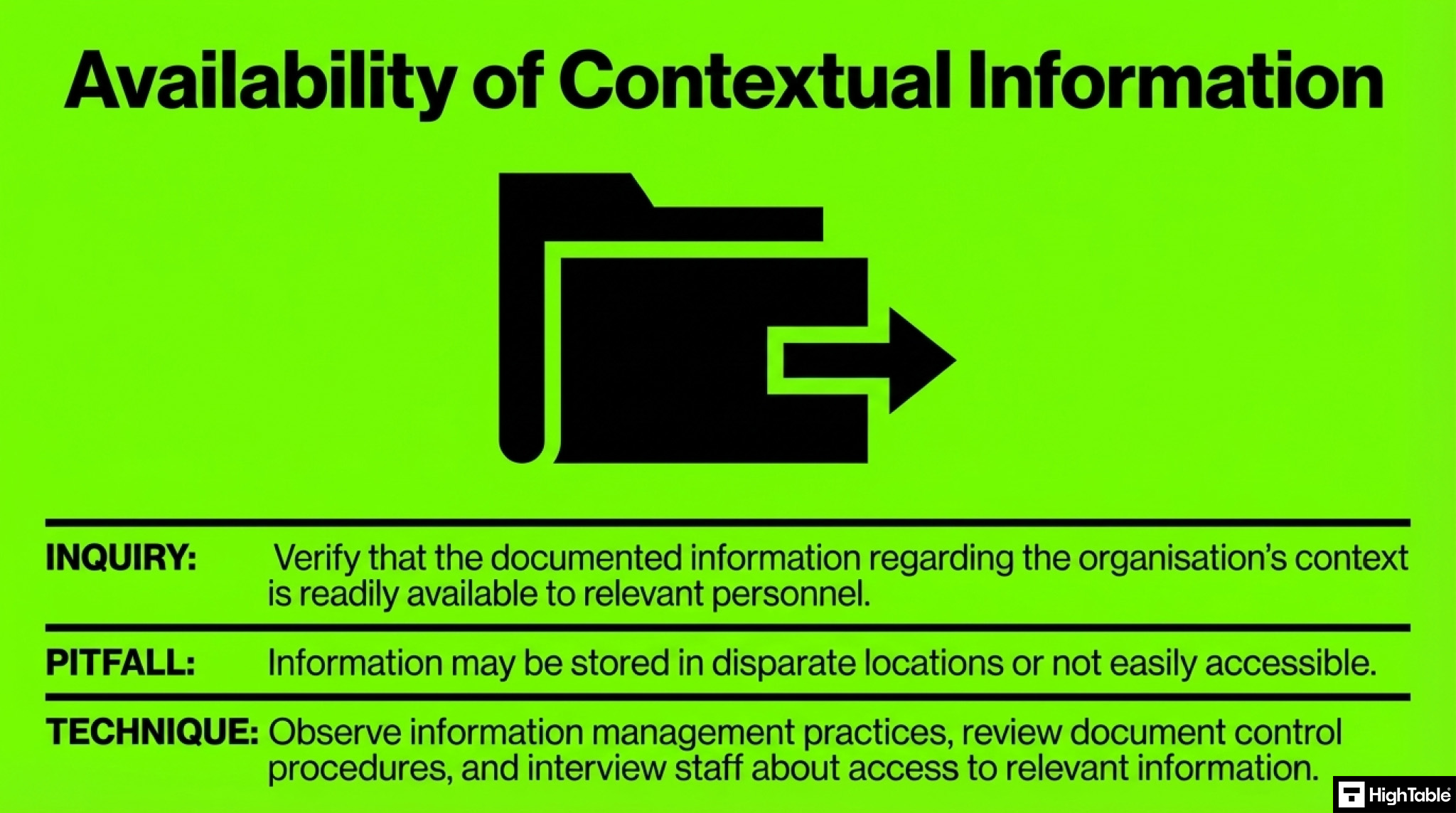
  8. Availability of Contextual Information

    Verify that the documented information regarding the organisation’s context is readily available to relevant personnel.

    Challenge
    Information may be stored in disparate locations or not easily accessible.

    Audit Technique
    Observe information management practices, review document control procedures, and interview staff about access to relevant information.

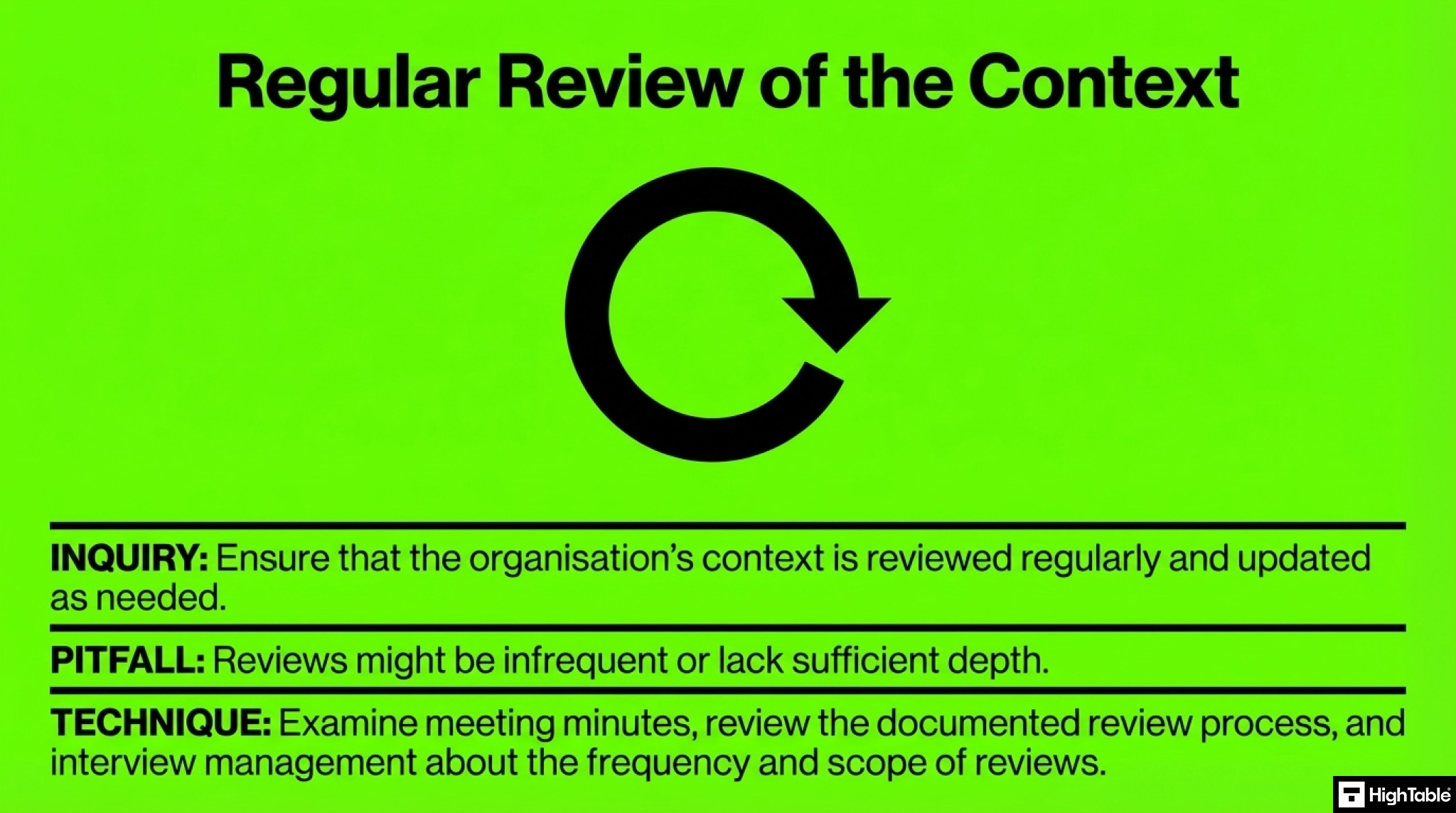
  9. Regular Review of the Context

    Ensure that the organisation’s context is reviewed regularly and updated as needed.

    Challenge
    Reviews might be infrequent or lack sufficient depth.

    Audit Technique
    Examine meeting minutes, review the documented review process, and interview management about the frequency and scope of reviews.

  10. Continual Improvement Related to Context

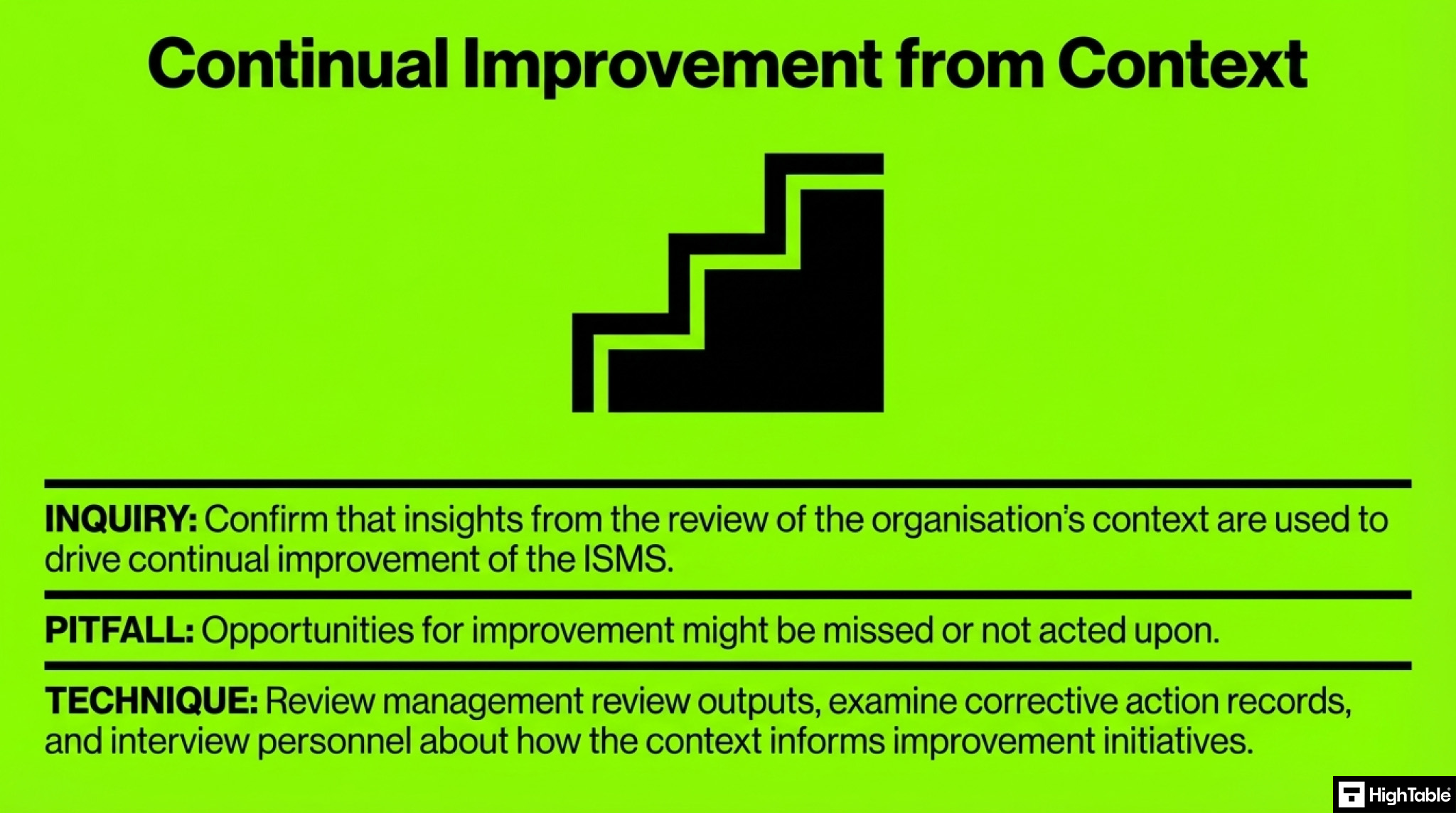
    Confirm that insights from the review of the organisation’s context are used to drive continual improvement of the ISMS.

    Challenge
    Opportunities for improvement might be missed or not acted upon.

    Audit Technique
    Review management review outputs, examine corrective action records, and interview personnel about how the context informs improvement initiatives.
Further Reading

What is ISO 27001 Clause 4.1?

How to implement ISO 27001 Clause 4.1

ISO 27001 Clause 4.1 Implementation Checklist

How to audit ISO 27001 Clause 4.1

ISO 27001 Clause 4.1 Audit Checklist

ISO 27001:2022 Amendment 1 – Absolutely Everything You Need to Know

ISO27001:2022 Amendment 1 Climate Action Changes – Definitive Briefing

ISO 27001 Clause 4.1 Understanding the Organisation and Its Context Explained

About the author

Stuart Barker is a veteran practitioner with over 30 years of experience in systems security and risk management.

Holding an MSc in Software and Systems Security, Stuart combines academic rigor with extensive operational experience. His background includes over a decade leading Data Governance for General Electric (GE) across Europe, as well as founding and exiting a successful cyber security consultancy.

As a qualified ISO 27001 Lead Auditor and Lead Implementer, Stuart possesses distinct insight into the specific evidence standards required by certification bodies. He has successfully guided hundreds of organizations – from high-growth technology startups to enterprise financial institutions – through the audit lifecycle.

His toolkits represents the distillation of that field experience into a standardised framework. They move beyond theoretical compliance, providing a pragmatic, auditor-verified methodology designed to satisfy ISO/IEC 27001:2022 while minimising operational friction.

ISO 27001:2022 requirements

ISO 27001 Clauses

ISO 27001 Clause 4.1 – Understanding The Organisation And Its Context

ISO 27001 Clause 4.2 – Understanding The Needs And Expectations of Interested Parties

ISO 27001 Clause 4.3 – Determining The Scope Of The Information Security Management System

ISO 27001 Clause 4.4 – Information Security Management System

ISO 27001 Clause 5.1 – Leadership and Commitment

ISO 27001 Clause 5.3 – Organisational Roles, Responsibilities and Authorities

ISO 27001 Clause 6.1.1 – Planning General

ISO 27001 Clause 6.1.2 – Information Security Risk Assessment

ISO 27001 Clause 6.1.3 – Information Security Risk Treatment

ISO 27001 Clause 6.2 – Information Security Objectives and Planning to Achieve Them

ISO 27001 Clause 6.3 – Planning Of Changes

ISO 27001 Clause 7.1 – Resources

ISO 27001 Clause 7.2 – Competence

ISO 27001 Clause 7.3 – Awareness

ISO 27001 Clause 7.4 – Communication

ISO 27001 Clause 7.5.1 – Documented Information

ISO 27001 Clause 7.5.2 – Creating and Updating Documented Information

ISO 27001 Clause 8.3 – Information Security Risk Treatment

ISO 27001 Clause 9.1 – Monitoring, Measurement, Analysis, Evaluation

ISO 27001 Clause 9.2 – Internal Audit

ISO 27001 Clause 9.3 – Management Review

ISO 27001 Clause 10.1 – Continual Improvement

ISO 27001 Clause 10.2 – Nonconformity and Corrective Action

ISO 27001 Organisation Controls

ISO 27001 Annex A 5.1: Policies for information security

ISO 27001 Annex A 5.2: Information Security Roles and Responsibilities

ISO 27001 Annex A 5.3: Segregation of duties

ISO 27001 Annex A 5.4: Management responsibilities

ISO 27001 Annex A 5.5: Contact with authorities

ISO 27001 Annex A 5.6: Contact with special interest groups

ISO 27001 Annex A 5.7: Threat intelligence

ISO 27001 Annex A 5.8: Information security in project management

ISO 27001 Annex A 5.9: Inventory of information and other associated assets

ISO 27001 Annex A 5.10: Acceptable use of information and other associated assets

ISO 27001 Annex A 5.11: Return of assets

ISO 27001 Annex A 5.12: Classification of information

ISO 27001 Annex A 5.13: Labelling of information

ISO 27001 Annex A 5.14: Information transfer

ISO 27001 Annex A 5.15: Access control

ISO 27001 Annex A 5.16: Identity management

ISO 27001 Annex A 5.17: Authentication information

ISO 27001 Annex A 5.18: Access rights

ISO 27001 Annex A 5.19: Information security in supplier relationships

ISO 27001 Annex A 5.20: Addressing information security within supplier agreements

ISO 27001 Annex A 5.21: Managing information security in the ICT supply chain

ISO 27001 Annex A 5.22: Monitoring, review and change management of supplier services

ISO 27001 Annex A 5.23: Information security for use of cloud services

ISO 27001 Annex A 5.24: Information security incident management planning and preparation

ISO 27001 Annex A 5.25: Assessment and decision on information security events

ISO 27001 Annex A 5.26: Response to information security incidents

ISO 27001 Annex A 5.27: Learning from information security incidents

ISO 27001 Annex A 5.28: Collection of evidence

ISO 27001 Annex A 5.29: Information security during disruption

ISO 27001 Annex A 5.30: ICT readiness for business continuity

ISO 27001 Annex A 5.31: Identification of legal, statutory, regulatory and contractual requirements

ISO 27001 Annex A 5.32: Intellectual property rights

ISO 27001 Annex A 5.33: Protection of records

ISO 27001 Annex A 5.34: Privacy and protection of PII

ISO 27001 Annex A 5.35: Independent review of information security

ISO 27001 Annex A 5.36: Compliance with policies and standards for information security

ISO 27001 Annex A 5.37: Documented operating procedures

ISO 27001 Technical Controls

ISO 27001 Annex A 8.1: User Endpoint Devices

ISO 27001 Annex A 8.2: Privileged Access Rights

ISO 27001 Annex A 8.3: Information Access Restriction

ISO 27001 Annex A 8.4: Access To Source Code

ISO 27001 Annex A 8.5: Secure Authentication

ISO 27001 Annex A 8.6: Capacity Management

ISO 27001 Annex A 8.7: Protection Against Malware

ISO 27001 Annex A 8.8: Management of Technical Vulnerabilities

ISO 27001 Annex A 8.9: Configuration Management 

ISO 27001 Annex A 8.10: Information Deletion

ISO 27001 Annex A 8.11: Data Masking

ISO 27001 Annex A 8.12: Data Leakage Prevention

ISO 27001 Annex A 8.13: Information Backup

ISO 27001 Annex A 8.14: Redundancy of Information Processing Facilities

ISO 27001 Annex A 8.15: Logging

ISO 27001 Annex A 8.16: Monitoring Activities

ISO 27001 Annex A 8.17: Clock Synchronisation

ISO 27001 Annex A 8.18: Use of Privileged Utility Programs

ISO 27001 Annex A 8.19: Installation of Software on Operational Systems

ISO 27001 Annex A 8.20: Network Security

ISO 27001 Annex A 8.21: Security of Network Services

ISO 27001 Annex A 8.22: Segregation of Networks

ISO 27001 Annex A 8.23: Web Filtering

ISO 27001 Annex A 8.24: Use of Cryptography

ISO 27001 Annex A 8.25: Secure Development Life Cycle

ISO 27001 Annex A 8.26: Application Security Requirements

ISO 27001 Annex A 8.27: Secure Systems Architecture and Engineering Principles

ISO 27001 Annex A 8.28: Secure Coding

ISO 27001 Annex A 8.29: Security Testing in Development and Acceptance

ISO 27001 Annex A 8.30: Outsourced Development

ISO 27001 Annex A 8.31: Separation of Development, Test and Production Environments

ISO 27001 Annex A 8.32: Change Management

ISO 27001 Annex A 8.33: Test Information

ISO 27001 Annex A 8.34: Protection of information systems during audit testing