ISO 27001 Clause 4.1 Audit Checklist

Home / ISO 27001 / What is ISO 27001 Clause 4.1? / ISO 27001 Clause 4.1 Audit Checklist

Last updated Dec 18, 2025

Author: Stuart Barker | ISO 27001 Lead Auditor

The ISO 27001 Clause 4.1 audit checklist is designed to help an ISO 27001 Lead Auditor conduct internal audits and external audits of ISO 27001 Clause 4.1.

It complements the guide – How to audit ISO 27001 Clause 4.1

Use this checklist to simulate a certification audit and identify non-conformities regarding the Context of the Organization before the external auditor arrives.

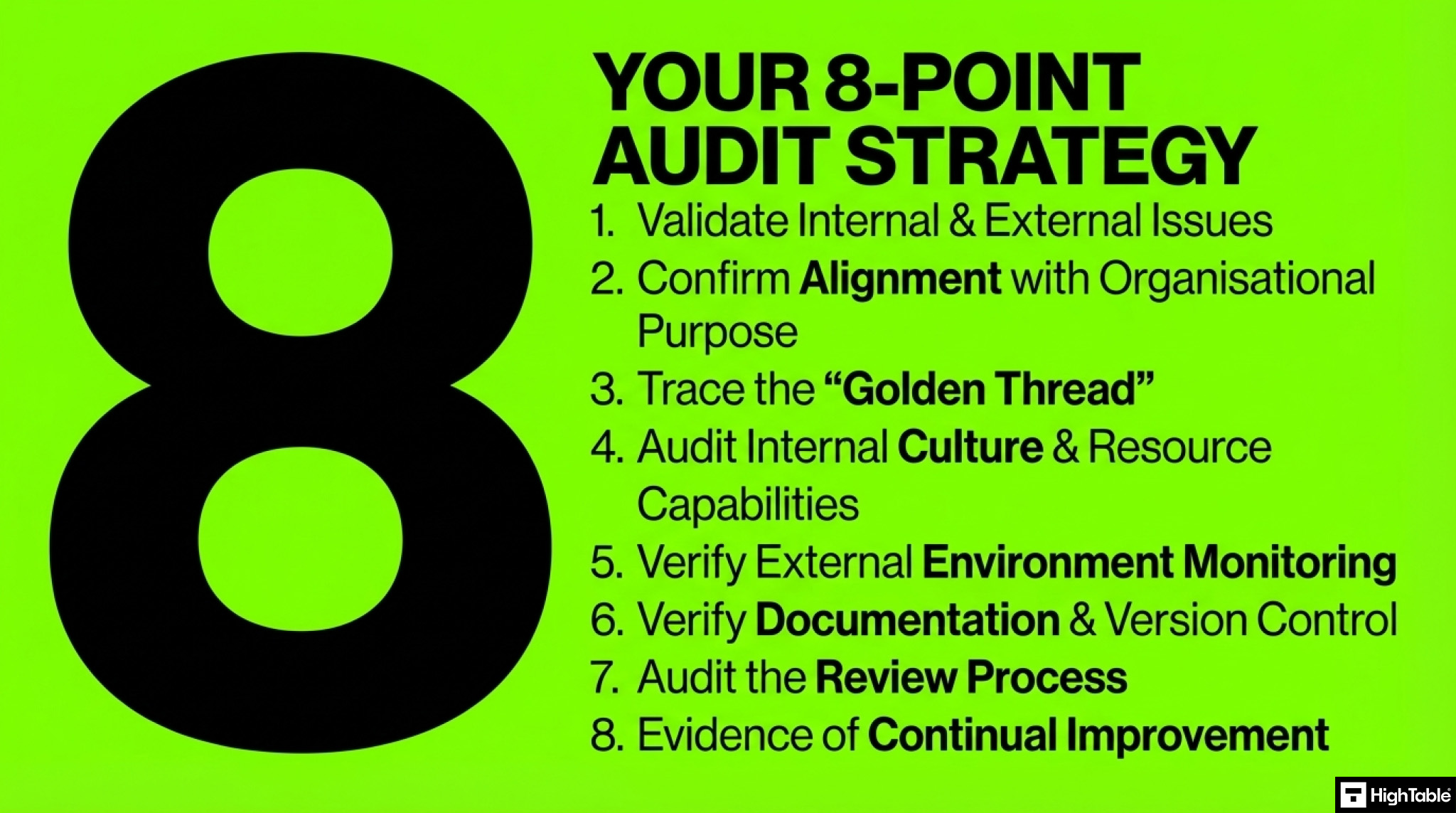
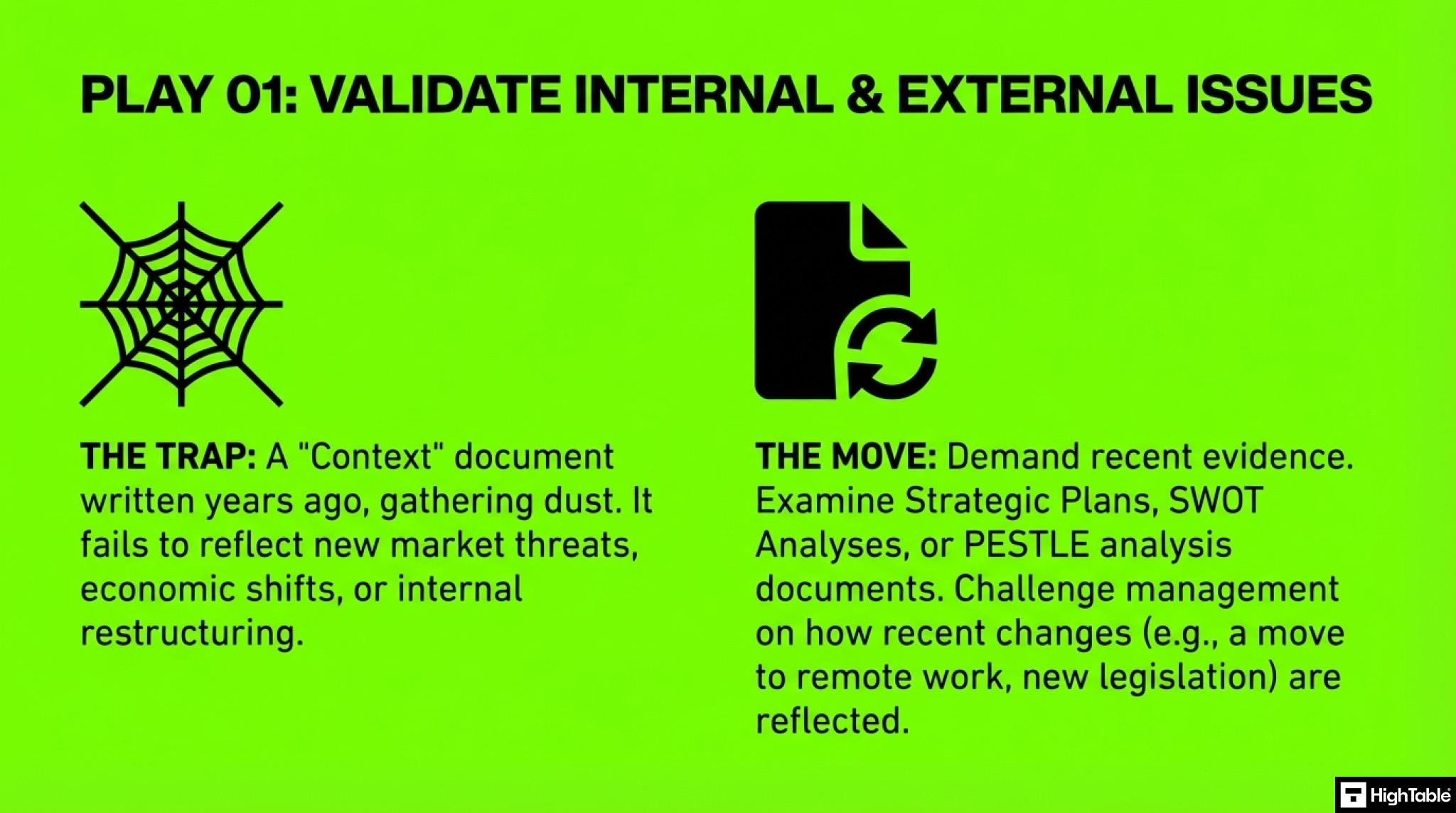
1. Validate Internal & External Issues (The Core Requirement)

Objective: Ensure the organization has explicitly determined the internal (culture, resources) and external (legal, market, threat landscape) issues that affect its ability to achieve ISMS outcomes.

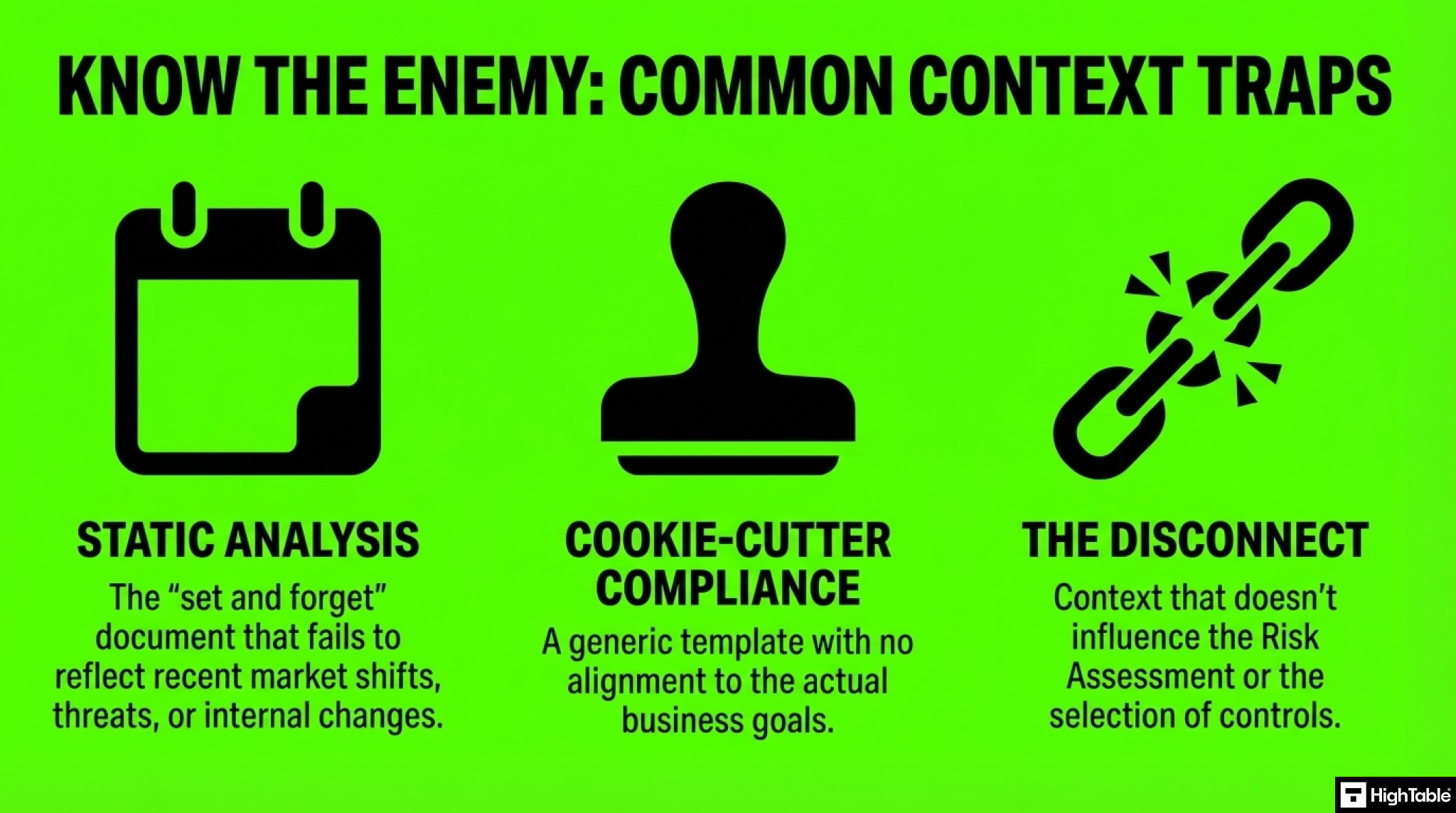
  • The Challenge: Static analysis. Auditors often find “Context” documents written years ago that were never updated to reflect new market threats, economic shifts, or internal restructuring.
  • Audit Technique: Examine Strategic Plans, SWOT Analyses, or PESTLE analysis documents. Challenge management on how recent changes (e.g., a new product launch, a change in legislation, or a move to remote work) are reflected in the documented context.

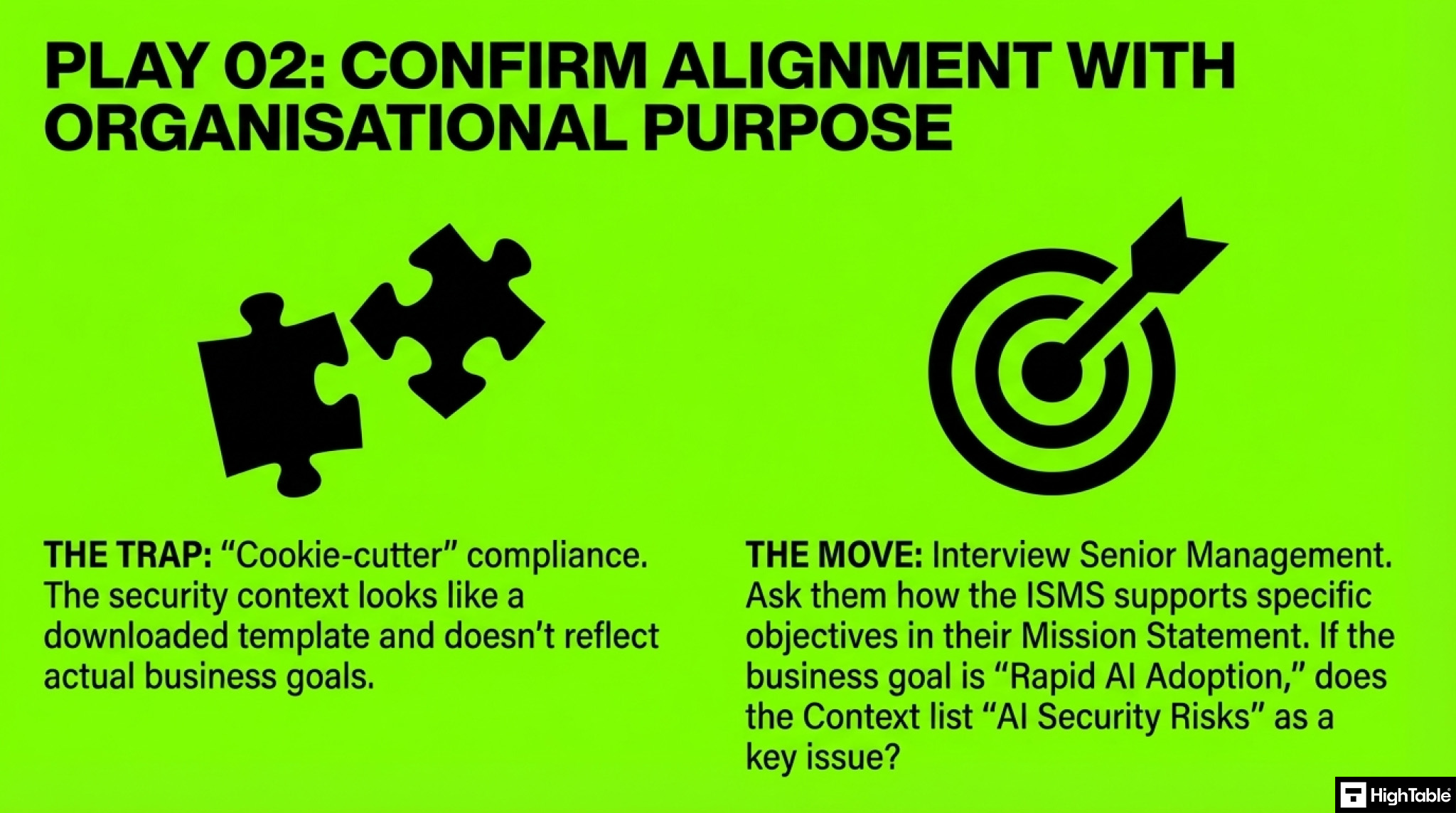
2. Confirm Alignment with Organisational Purpose

Objective: Verify that the ISMS is not generic but directly aligned with the organization’s strategic direction as required by Clause 4.1.

  • The Challenge: “Cookie-cutter” compliance. The security context looks like a downloaded template and doesn’t reflect the actual business goals (e.g., a startup prioritizing speed to market vs. a bank prioritizing data integrity).
  • Audit Technique: Interview Senior Management. Ask them to explain how the ISMS supports specific business objectives found in their Mission Statement or Annual Report. If the business goal is “Rapid AI Adoption,” does the Context analysis list “AI Security Risks” as a key issue?

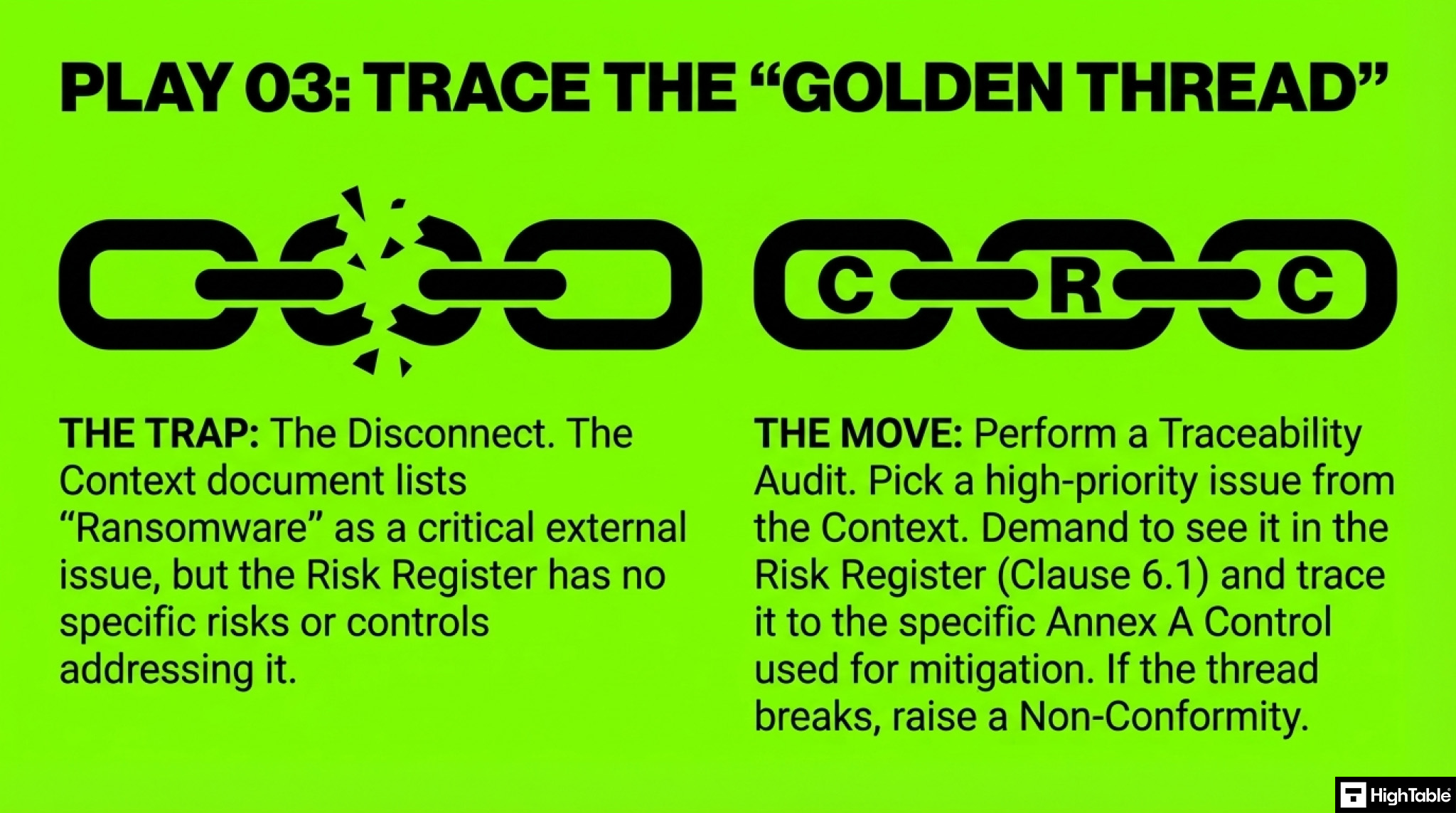
3. Trace the “Golden Thread” (Context > Risk > Control)

Objective: Confirm that the issues identified in Clause 4.1 actually influenced the Risk Assessment and Statement of Applicability (SoA). This proves the Context is functional, not just paperwork.

  • The Challenge: The “Disconnect.” The Context document lists “Ransomware” as a critical external issue, but the Risk Register has no specific risks or controls addressing it.
  • Audit Technique: Perform a Traceability Audit.
    1. Pick one high-priority external issue (e.g., “GDPR Compliance” or “Supply Chain Instability”).
    2. Ask to see where this appears in the Risk Register (Clause 6.1).
    3. Trace it to the specific Annex A Control selected to mitigate it. If the thread breaks, raise a Non-Conformity.

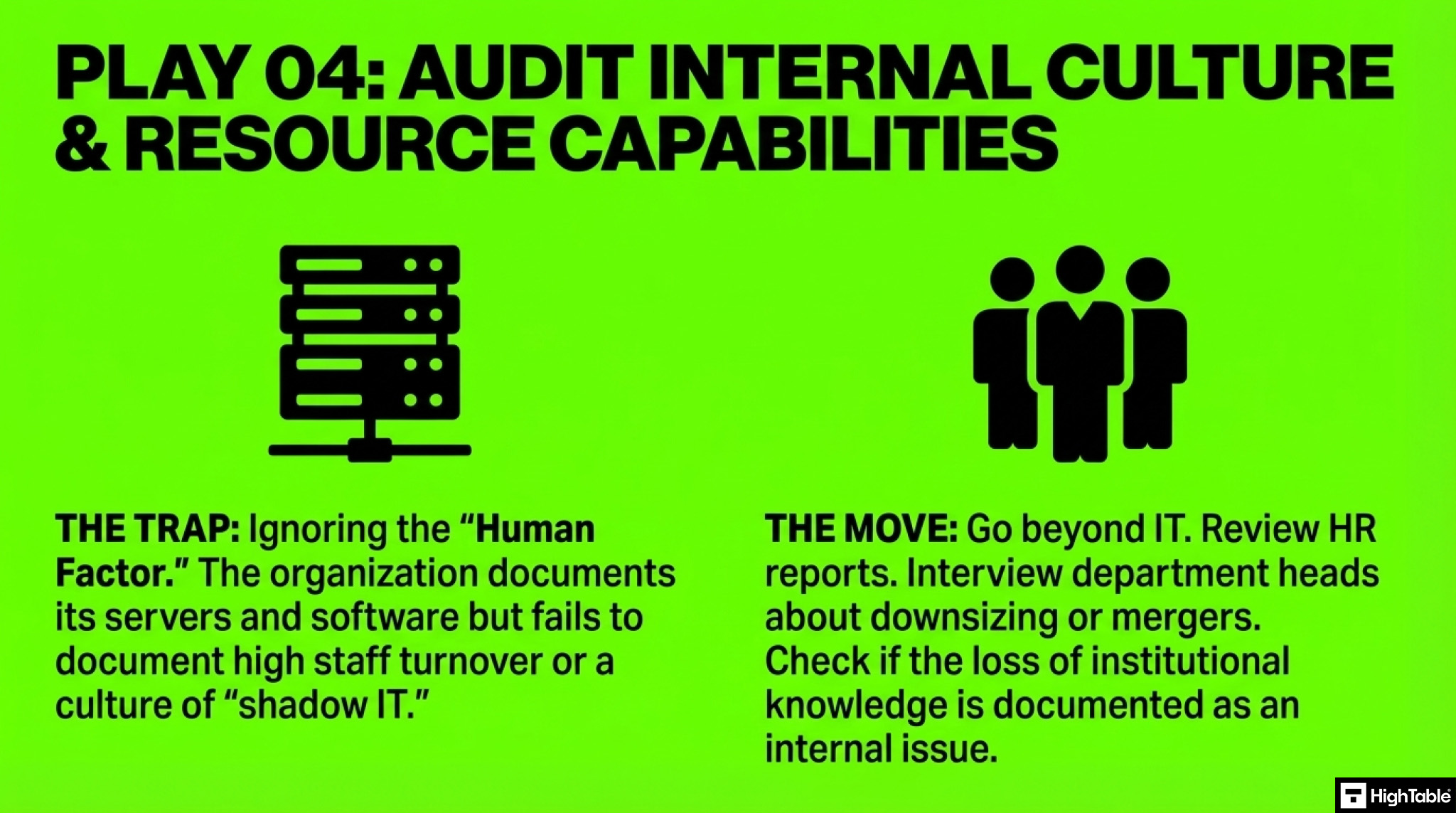
4. Audit Internal Culture & Resource Capabilities

Objective: Verify that “Internal Issues” go beyond just hardware. They must include organisational culture, knowledge, and resource availability.

  • The Challenge: Ignoring the “Human Factor.” The organization documents its servers and software but fails to document that they have a high staff turnover rate or a culture of “shadow IT.”
  • Audit Technique: Review HR reports or interview department heads. If the organization has recently downsized or merged, check if the “Internal Context” has been updated to reflect the loss of institutional knowledge or changes in reporting lines.

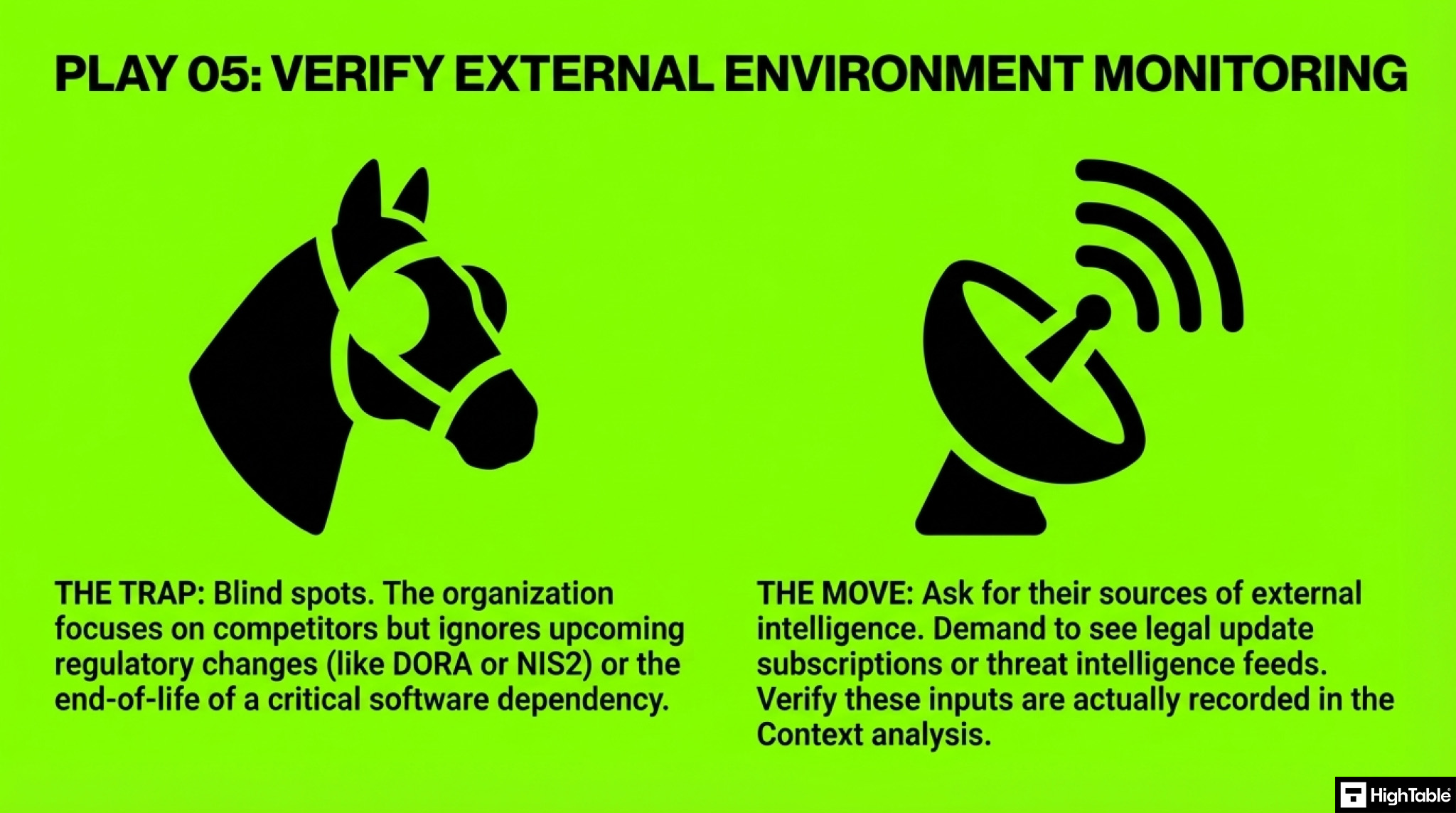
Objective: Ensure the organization monitors the broader environment, including legal, technological, and competitive factors.

  • The Challenge: Blind spots. The organization focuses heavily on competitors but ignores upcoming regulatory changes (like DORA or NIS2) or technological shifts (like the end-of-life of a critical software dependency).
  • Audit Technique: Ask for the sources of their external intelligence. Do they subscribe to legal updates? Do they receive threat intelligence feeds? Verify that these inputs are actually recorded in the Context analysis.

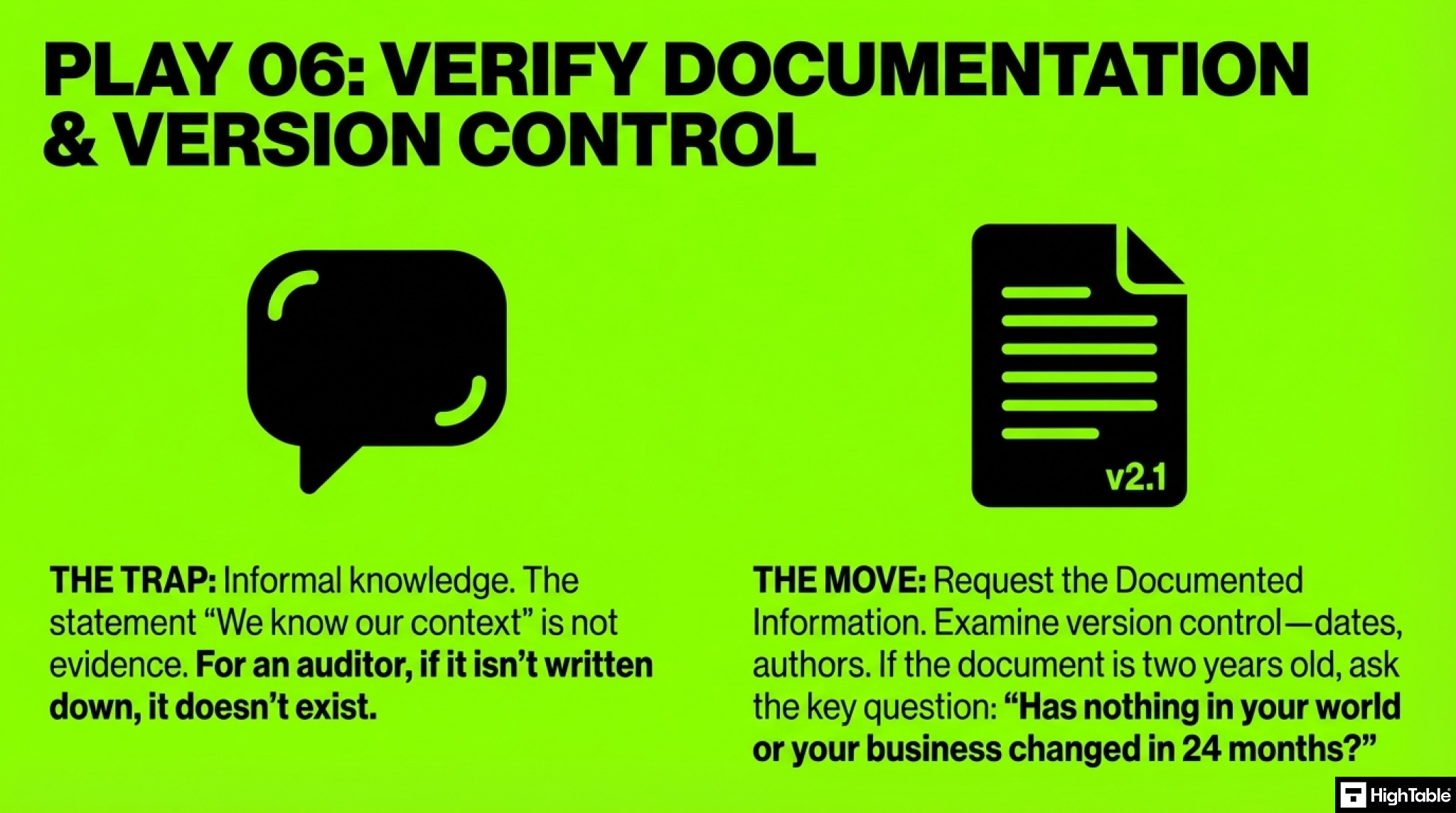
6. Verify Documentation & Version Control

Objective: Confirm that the “Context of Organization” is documented information that is controlled, maintained, and retained.

  • The Challenge: Informal knowledge. “We know our context” is not evidence. If it isn’t written down, it doesn’t exist for the auditor.
  • Audit Technique: Examine the Documented Information for version control (dates, authors). If the document date is two years old, ask: “Has nothing in the world or your business changed in 24 months?”

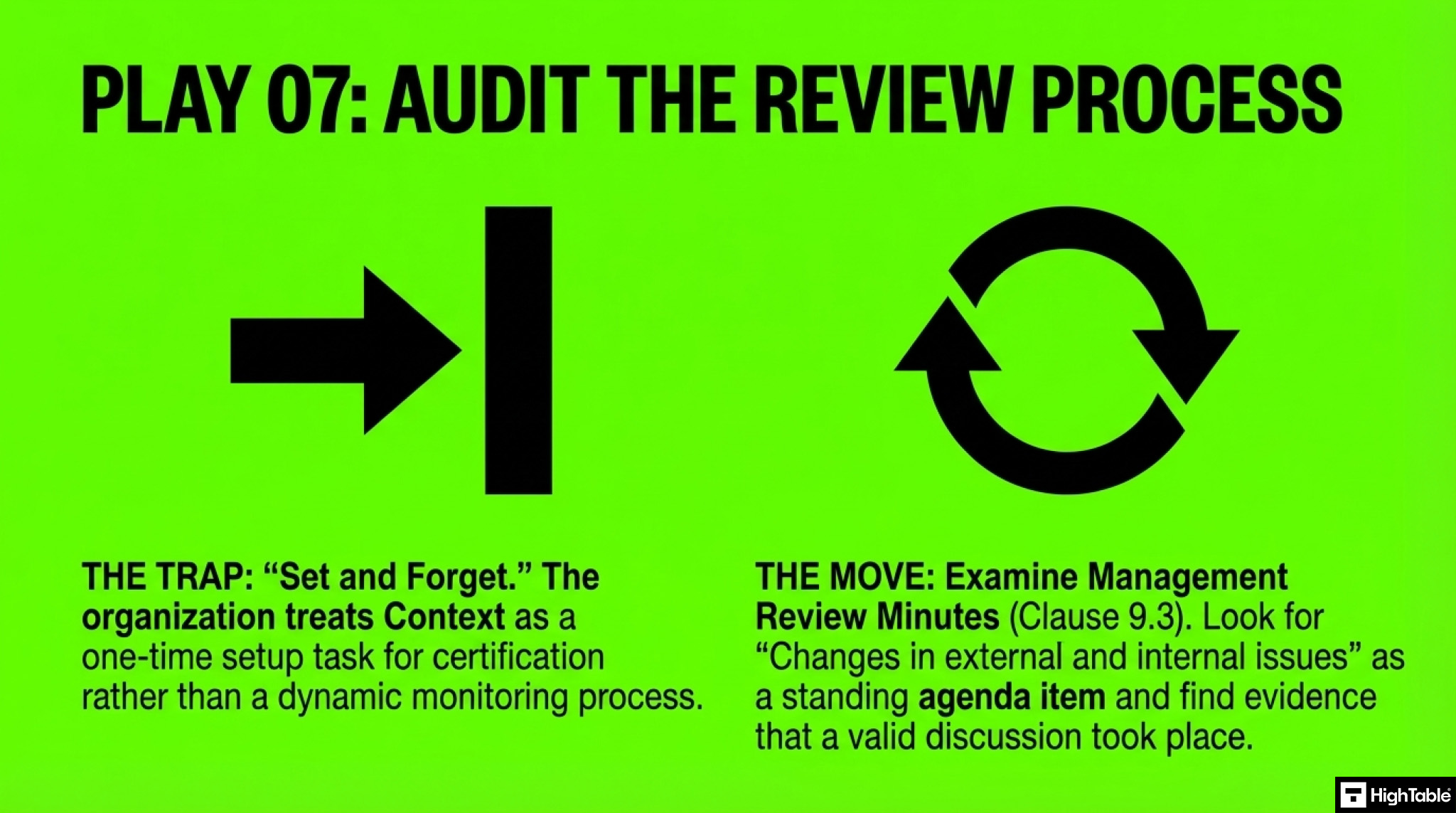
7. Audit the Review Process (Dynamic Monitoring)

Objective: Ensure that the context is reviewed at planned intervals or when significant changes occur.

  • The Challenge: “Set and Forget.” The organization treats Context as a one-time setup task rather than a dynamic monitoring process.
  • Audit Technique: Examine Management Review Minutes (Clause 9.3). Look for evidence that “Changes in external and internal issues” is a standing agenda item and that valid discussions actually took place regarding recent events.

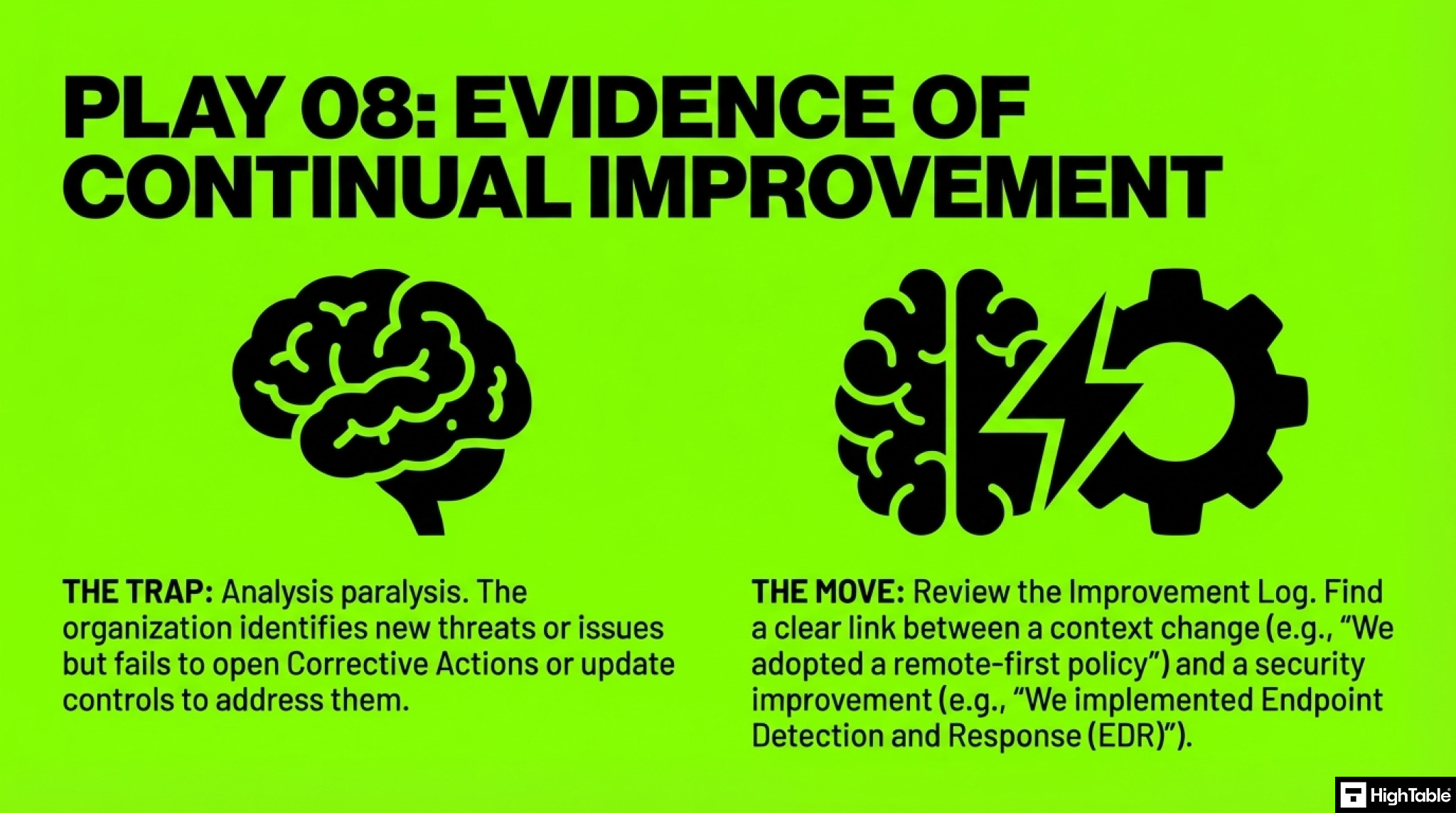
8. Evidence of Continual Improvement

Objective: Confirm that updates to the context analysis lead to tangible improvements in the ISMS.

  • The Challenge: Analysis paralysis. The organization identifies new threats or issues but fails to open Corrective Actions or update controls to address them.
  • Audit Technique: Review the Improvement Log. Look for a clear link between a change in context (e.g., “We adopted a remote-first policy”) and a security improvement (e.g., “We implemented Endpoint Detection and Response (EDR) and updated the Mobile Device Policy”).
Further Reading

What is ISO 27001 Clause 4.1?

How to implement ISO 27001 Clause 4.1

ISO 27001 Clause 4.1 Implementation Checklist

How to audit ISO 27001 Clause 4.1

ISO 27001 Clause 4.1 Audit Checklist

ISO 27001:2022 Amendment 1 – Absolutely Everything You Need to Know

ISO27001:2022 Amendment 1 Climate Action Changes – Definitive Briefing

ISO 27001 Clause 4.1 Understanding the Organisation and Its Context Explained

ISO 27001 Clause 4.1 Understanding the Organisation and Its Context Explained

About the author

Stuart Barker is a veteran practitioner with over 30 years of experience in systems security and risk management.

Holding an MSc in Software and Systems Security, Stuart combines academic rigor with extensive operational experience. His background includes over a decade leading Data Governance for General Electric (GE) across Europe, as well as founding and exiting a successful cyber security consultancy.

As a qualified ISO 27001 Lead Auditor and Lead Implementer, Stuart possesses distinct insight into the specific evidence standards required by certification bodies. He has successfully guided hundreds of organizations – from high-growth technology startups to enterprise financial institutions – through the audit lifecycle.

His toolkits represents the distillation of that field experience into a standardised framework. They move beyond theoretical compliance, providing a pragmatic, auditor-verified methodology designed to satisfy ISO/IEC 27001:2022 while minimising operational friction.

ISO 27001:2022 requirements

ISO 27001 Clauses

ISO 27001 Clause 4.1 – Understanding The Organisation And Its Context

ISO 27001 Clause 4.2 – Understanding The Needs And Expectations of Interested Parties

ISO 27001 Clause 4.3 – Determining The Scope Of The Information Security Management System

ISO 27001 Clause 4.4 – Information Security Management System

ISO 27001 Clause 5.1 – Leadership and Commitment

ISO 27001 Clause 5.3 – Organisational Roles, Responsibilities and Authorities

ISO 27001 Clause 6.1.1 – Planning General

ISO 27001 Clause 6.1.2 – Information Security Risk Assessment

ISO 27001 Clause 6.1.3 – Information Security Risk Treatment

ISO 27001 Clause 6.2 – Information Security Objectives and Planning to Achieve Them

ISO 27001 Clause 6.3 – Planning Of Changes

ISO 27001 Clause 7.1 – Resources

ISO 27001 Clause 7.2 – Competence

ISO 27001 Clause 7.3 – Awareness

ISO 27001 Clause 7.4 – Communication

ISO 27001 Clause 7.5.1 – Documented Information

ISO 27001 Clause 7.5.2 – Creating and Updating Documented Information

ISO 27001 Clause 8.3 – Information Security Risk Treatment

ISO 27001 Clause 9.1 – Monitoring, Measurement, Analysis, Evaluation

ISO 27001 Clause 9.2 – Internal Audit

ISO 27001 Clause 9.3 – Management Review

ISO 27001 Clause 10.1 – Continual Improvement

ISO 27001 Clause 10.2 – Nonconformity and Corrective Action

ISO 27001 Organisation Controls

ISO 27001 Annex A 5.1: Policies for information security

ISO 27001 Annex A 5.2: Information Security Roles and Responsibilities

ISO 27001 Annex A 5.3: Segregation of duties

ISO 27001 Annex A 5.4: Management responsibilities

ISO 27001 Annex A 5.5: Contact with authorities

ISO 27001 Annex A 5.6: Contact with special interest groups

ISO 27001 Annex A 5.7: Threat intelligence

ISO 27001 Annex A 5.8: Information security in project management

ISO 27001 Annex A 5.9: Inventory of information and other associated assets

ISO 27001 Annex A 5.10: Acceptable use of information and other associated assets

ISO 27001 Annex A 5.11: Return of assets

ISO 27001 Annex A 5.12: Classification of information

ISO 27001 Annex A 5.13: Labelling of information

ISO 27001 Annex A 5.14: Information transfer

ISO 27001 Annex A 5.15: Access control

ISO 27001 Annex A 5.16: Identity management

ISO 27001 Annex A 5.17: Authentication information

ISO 27001 Annex A 5.18: Access rights

ISO 27001 Annex A 5.19: Information security in supplier relationships

ISO 27001 Annex A 5.20: Addressing information security within supplier agreements

ISO 27001 Annex A 5.21: Managing information security in the ICT supply chain

ISO 27001 Annex A 5.22: Monitoring, review and change management of supplier services

ISO 27001 Annex A 5.23: Information security for use of cloud services

ISO 27001 Annex A 5.24: Information security incident management planning and preparation

ISO 27001 Annex A 5.25: Assessment and decision on information security events

ISO 27001 Annex A 5.26: Response to information security incidents

ISO 27001 Annex A 5.27: Learning from information security incidents

ISO 27001 Annex A 5.28: Collection of evidence

ISO 27001 Annex A 5.29: Information security during disruption

ISO 27001 Annex A 5.30: ICT readiness for business continuity

ISO 27001 Annex A 5.31: Identification of legal, statutory, regulatory and contractual requirements

ISO 27001 Annex A 5.32: Intellectual property rights

ISO 27001 Annex A 5.33: Protection of records

ISO 27001 Annex A 5.34: Privacy and protection of PII

ISO 27001 Annex A 5.35: Independent review of information security

ISO 27001 Annex A 5.36: Compliance with policies and standards for information security

ISO 27001 Annex A 5.37: Documented operating procedures

ISO 27001 Technical Controls

ISO 27001 Annex A 8.1: User Endpoint Devices

ISO 27001 Annex A 8.2: Privileged Access Rights

ISO 27001 Annex A 8.3: Information Access Restriction

ISO 27001 Annex A 8.4: Access To Source Code

ISO 27001 Annex A 8.5: Secure Authentication

ISO 27001 Annex A 8.6: Capacity Management

ISO 27001 Annex A 8.7: Protection Against Malware

ISO 27001 Annex A 8.8: Management of Technical Vulnerabilities

ISO 27001 Annex A 8.9: Configuration Management 

ISO 27001 Annex A 8.10: Information Deletion

ISO 27001 Annex A 8.11: Data Masking

ISO 27001 Annex A 8.12: Data Leakage Prevention

ISO 27001 Annex A 8.13: Information Backup

ISO 27001 Annex A 8.14: Redundancy of Information Processing Facilities

ISO 27001 Annex A 8.15: Logging

ISO 27001 Annex A 8.16: Monitoring Activities

ISO 27001 Annex A 8.17: Clock Synchronisation

ISO 27001 Annex A 8.18: Use of Privileged Utility Programs

ISO 27001 Annex A 8.19: Installation of Software on Operational Systems

ISO 27001 Annex A 8.20: Network Security

ISO 27001 Annex A 8.21: Security of Network Services

ISO 27001 Annex A 8.22: Segregation of Networks

ISO 27001 Annex A 8.23: Web Filtering

ISO 27001 Annex A 8.24: Use of Cryptography

ISO 27001 Annex A 8.25: Secure Development Life Cycle

ISO 27001 Annex A 8.26: Application Security Requirements

ISO 27001 Annex A 8.27: Secure Systems Architecture and Engineering Principles

ISO 27001 Annex A 8.28: Secure Coding

ISO 27001 Annex A 8.29: Security Testing in Development and Acceptance

ISO 27001 Annex A 8.30: Outsourced Development

ISO 27001 Annex A 8.31: Separation of Development, Test and Production Environments

ISO 27001 Annex A 8.32: Change Management

ISO 27001 Annex A 8.33: Test Information

ISO 27001 Annex A 8.34: Protection of information systems during audit testing