

In this guide, I will show you exactly how to implement ISO 27001 Objectives and ensure you pass your audit. You will get a complete walkthrough of objectives, practical implementation examples, and access to the ISO 27001 templates and toolkit that make compliance easy.
I am Stuart Barker, an ISO 27001 Lead Auditor with over 30 years of experience conducting hundreds of audits. I will cut through the jargon to show you exactly what changed in the 2022 update and provide you with plain-English advice to get you certified.
Table of contents
- What are ISO 27001 Objectives?
- Key Points
- How to implement ISO 27001 Objectives
- Examples
- How to write ISO 27001 objectives
- The framework for setting ISO 27001 objectives
- ISO 27001 objectives training video
- Applicability of ISO 27001 Objectives across different business models.
- ISO 27001 Objectives Process Flow
- ISO 27001 Objectives FAQ
Stop Guessing. Start Passing.
AI-generated policies are generic and fail audits. Our Lead-Auditor templates have a 100% success rate. Don’t risk your certification on a prompt

What are ISO 27001 Objectives?
ISO 27001 Objectives are statements of what you want the information security management system to achieve.
Objectives should be:
- Specific
- Measurable
- Achievable
- Realistic
- Timely
For each information security objective you record
- What will be done
- What resources will be required
- Who will be responsible
- When will it be completed
- How the results are evaluated
The objectives should be measurable and clear so that you can track your progress over time.
Key Points
You need to understand your organisation and its context before setting goals.
The goals should be focussed on the needs of the business and improving security.
The goals do not have to be overly complex.
How to implement ISO 27001 Objectives
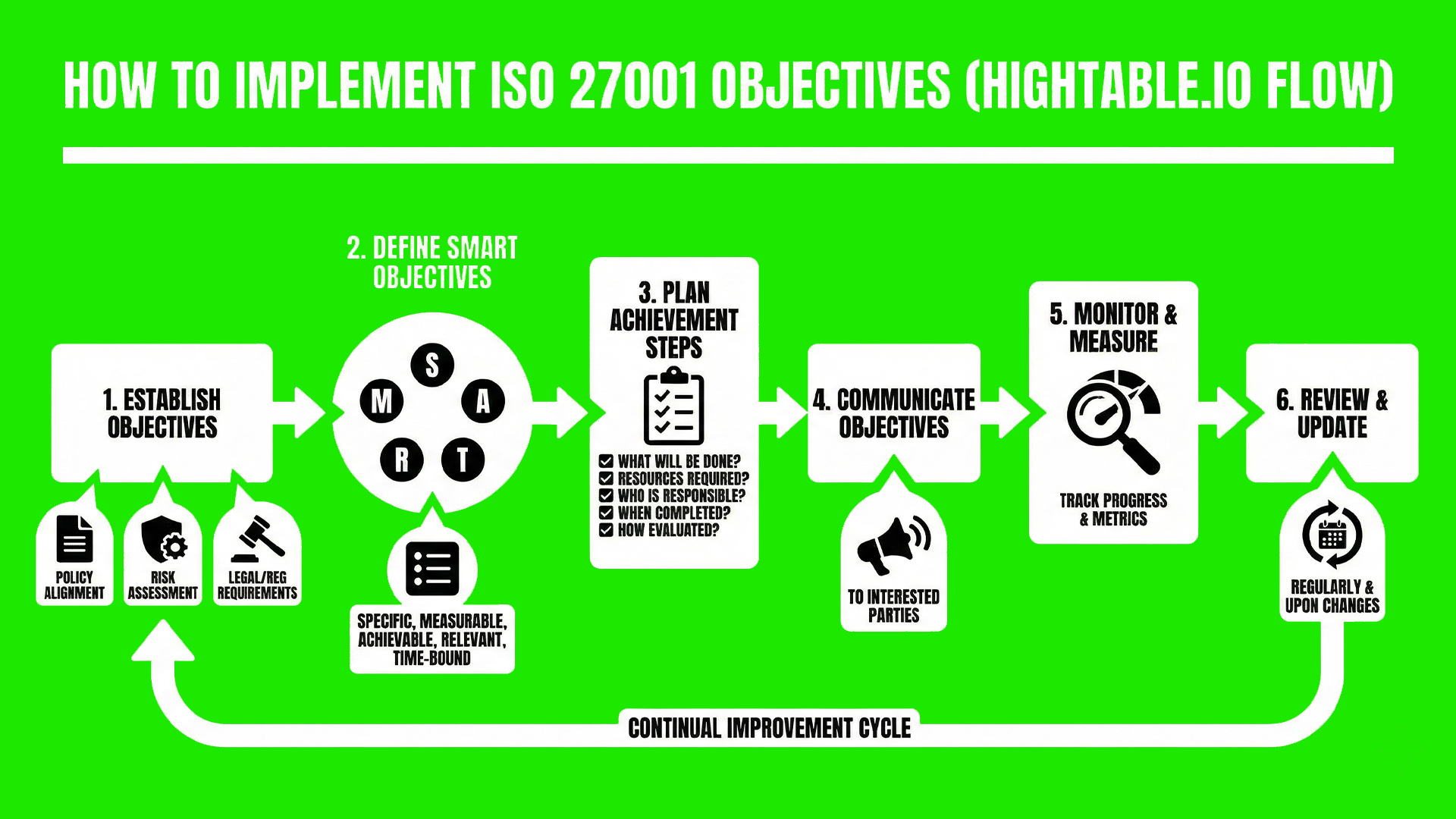
Implementing ISO 27001 Objectives requires more than drafting a wish list; it demands a structured approach to translating business risks into measurable security outcomes. Follow this technical workflow to establish, document, and monitor information security objectives that satisfy auditors and drive continual improvement.
1. Analyse Context and Stakeholder Requirements
Before setting targets, you must ground them in the reality of your organisation (Clause 4.1) and the needs of interested parties (Clause 4.2). Objectives drafted in isolation often fail to secure management buy-in or address actual business risks.
- Review External Issues: Analyse legal, regulatory, and contractual obligations that dictate specific security thresholds (e.g., GDPR data retention or SLA uptime requirements).
- Consult Stakeholders: Interview department heads to identify their specific security pain points, such as remote access latency or supplier onboarding delays.
- Map to Risks: Ensure every objective directly addresses a high-priority risk identified in your Risk Treatment Plan to demonstrate strategic alignment.
2. Draft SMART Security Objectives
Auditors require objectives to be measurable “if practicable”. Vague statements like “improve security” will lead to non-conformities. You must draft objectives using the SMART framework (Specific, Measurable, Achievable, Relevant, Time-bound).
- Quantify Success: Define precise metrics, such as “Maintain 99.9% availability for client portals” or “Reduce critical vulnerability patch time to <48 hours".
- Set Deadlines: Assign strict completion dates (e.g., “by Q4 2026”) rather than open-ended timeframes to drive urgency.
- Verify Relevance: Confirm that achieving the objective will measurably improve the confidentiality, integrity, or availability (CIA) of your information assets.
3. Provision Resources and Assign Ownership
Clause 6.2 explicitly requires you to determine “what resources will be required” and “who will be responsible”. Without dedicated resources and clear ownership, objectives are merely theoretical.
- Assign Roles: Designate a specific role (e.g., “Head of Infrastructure” or “CISO”) as the owner. Avoid assigning “IT Team” to prevent diffusion of responsibility.
- Allocate Budget: Formally approve the budget for necessary tools, training, or external consultancy required to hit the target.
- Update Competency Matrices: Ensure the assigned owners have the requisite skills and authority to drive the objective to completion.
4. Formalize the Objectives Documentation
You must maintain “documented information” on your objectives. Create a centralised Information Security Objectives Register or include a dedicated section in your high-level policy.
- Structure the Document: Create columns for Objective Description, Owner, Resources, Target Date, and Evaluation Method.
- Define Evaluation Methods: Explicitly state how you will verify success, such as “Internal Audit Report”, “Penetration Test Results”, or “Helpdesk Ticket Analytics”.
- Link to Strategy: Cross-reference each objective with your broader Information Security Policy to show a unified strategy.
5. Communicate and Integrate
Security objectives often fail because staff are unaware of them. You must integrate these goals into daily operations and communicate them to all relevant functions and levels (Clause 7.4).
- Publish Internally: Post objectives on your intranet, SharePoint, or internal wiki where all staff can reference them.
- Embed in Job Descriptions: Update roles and responsibilities to include specific contributions toward security objectives (e.g., “Developers must complete secure coding training”).
- Conduct Awareness Training: Brief staff on how their daily actions (like reporting phishing emails) contribute to the organisation’s broader security goals.
6. Monitor and Evaluate Performance
This is the “Check” phase of the PDCA cycle. You must regularly evaluate progress and report results to Top Management to ensure the ISMS remains effective.
- Track KPIs Monthly: Use a dashboard to monitor leading indicators (e.g., percentage of staff trained) and lagging indicators (e.g., number of incidents).
- Conduct Management Reviews: Present the status of objectives during formal Management Reviews (Clause 9.3). This is a mandatory agenda item.
- Trigger Corrective Actions: If an objective is missed, raise a non-conformity or corrective action to investigate the root cause and adjust the plan.
Examples
The following are common best practice ISO 27001 objectives:
| Objective | ISO 27001:2022 Control Reference | What will be done | Resources Required | Responsibility | Timeline / Deadline | Evaluation Method |
|---|---|---|---|---|---|---|
| 1. Meet Legal & Regulatory Obligations | 5.31 (Legal, statutory, regulatory and contractual requirements) | Implementation of Legal Register; Adherence to Standard; Achieve Accredited Certification. | Experienced ISO 27001 implementation resource. | Assigned Owner (Recorded in Roles Doc). | Legal Register Sign Off: [Date]; Certification Audit: [Date]. | Legal Register Signed Off; Audits Booked/Completed; Certificate Issued. |
| 2. Manage Third-Party Supplier Risk | 5.19 (Information security in supplier relationships) | Implement Third Party Policy & Register; Review contracts for security assurances. | Supplier Management resources. | Assigned Owner (Recorded in Roles Doc). | Policy Implementation: [Date]; Initial Review: [Date]; Ongoing: Monthly. | Register complete; Contracts active with security clauses; Valid ISO certificates or assurances on file. |
| 3. Ensure Confidentiality, Integrity & Availability (CIA) | Clause 6.1 (Actions to address risks) & Clause 8.2 (Risk assessment) | Risk Management implementation; Annex A Controls via SoA; Monitor control measurement. | Information Security Management resources. | Assigned Owner (Recorded in Roles Doc). | SoA Implementation: [Date]; Effectiveness Review: Monthly. | Measures reported to Management Review; Internal Audit checks; External verification. |
| 4. Resource Provisioning & Continual Improvement | Clause 7.1 (Resources) & Clause 10.1 (Continual improvement) | Assign Roles/Responsibilities; Implement Risk Register; Implement CIP & Incident Log. | Information Security Management resources. | Assigned Owner (Recorded in Roles Doc). | Roles Assigned: [Date]; Risk/CIP Policy: [Date]; Reviews: Annual. | Documentation up to date; Corrective actions evidenced; Meeting minutes recorded. |
| 5. Culture, Training & Awareness | 6.3 (Information security awareness, education and training) | Execute Communication Plan; Implement Training Tool; Establish Management Review Team. | Training Tool; Awareness Management resources. | Assigned Owner (Recorded in Roles Doc). | Comms Plan: [Date]; Training Tool: [Date]; Basic Training: Annually. | Meeting Minutes; Evidence of Communication; Training completion records. |
How to write ISO 27001 objectives
Writing objectives for the information security management system is a straightforward process. These are the steps to follow:
Writing effective ISO 27001 objectives is a precise exercise in governance. You must translate high-level business risks into concrete, auditable goals that satisfy the mandatory requirements of Clause 6.2. Use this structured workflow to draft objectives that are compliant, measurable, and directly supportive of your Information Security Management System (ISMS).
1. Identify Business and Risk Drivers
Do not write objectives in a vacuum. You must ground every goal in the reality of your organisation’s context (Clause 4.1) and risk landscape (Clause 6.1) to ensure they add genuine value.
- Consult the Risk Treatment Plan: Select high-priority risks that require tracking and draft objectives that mandate their mitigation (e.g., “Reduce phishing susceptibility”).
- Review the Legal Register: Identify strict regulatory thresholds (like GDPR breach notification windows) and write objectives that guarantee compliance.
- Interview Department Heads: Gather specific operational pain points to ensure the objectives address real-world inefficiencies rather than just theoretical security concerns.
2. Draft SMART Objective Statements
Auditors will issue non-conformities for vague goals like “improve security”. You must use the SMART framework (Specific, Measurable, Achievable, Relevant, Time-bound) to create auditable statements.
- Define the Metric: Incorporate a clear percentage or number, such as “98% of laptops encrypted” or “Zero critical non-conformities”.
- Set the Deadline: Append a specific date or frequency, such as “by 31st December” or “Maintained Monthly”, to drive accountability.
- Ensure Achievability: Verify that the target is realistic given your current budget and technical maturity to avoid setting the team up for failure.
3. Define the Mandatory Planning Attributes
Writing the objective statement is only half the task. Clause 6.2 mandates that you must also document the “plan to achieve it”. For every objective, you must explicitly define five specific elements.
- What will be done: List the specific initiatives or projects (e.g., “Roll out MDM solution”) required to hit the target.
- Resources required: Specify the budget, software licences, or external consultancy days needed.
- Responsibility: Assign a named individual (e.g., “Head of IT”) rather than a generic department to ensure ownership.
- Completion date: Set the final deadline for the project phase.
- Evaluation method: State exactly how you will prove success to an auditor (e.g., “Penetration Test Report” or “Monthly KPI Dashboard”).
4. Verify Alignment with Security Policy
You must ensure your objectives are consistent with your high-level Information Security Policy (Clause 5.2). Contradictions between your policy statements and your specific objectives are a common audit failure.
- Cross-Reference Policy Claims: If your policy states “we have zero tolerance for data loss”, ensure your objectives reflect strict controls around DLP and backups.
- Resolve Conflicts: If an objective is financially driven (e.g., “Reduce IT spend”) but conflicts with a policy requirement (e.g., “Implement redundant firewalls”), you must adjust the objective to prioritise security.
5. Formalise the Objectives Register
You must maintain “documented information” as evidence. Centralise your drafted goals into a formal Information Security Objectives Register to demonstrate control to auditors.
- Version Control the Document: Ensure the register has a clear version history, author, and approval date.
- Obtain Management Sign-off: Present the drafted objectives to Top Management for formal approval, ensuring they are aware of the resource commitments.
- Publish to Staff: Upload the finalised register to your intranet or document management system so relevant staff can view their targets.
6. Establish a Monitoring Schedule
Writing the objective is the start, not the end. You must establish a routine for data collection and review to satisfy the “Monitoring, Measurement, Analysis and Evaluation” requirements of Clause 9.1.
- Assign Data Collection: Designate who is responsible for gathering the raw data (e.g., helpdesk tickets, patch logs) each month.
- Schedule Management Reviews: Add “Review of Objectives” as a standing agenda item for your Quarterly Management Review meetings.
- Update as Necessary: If a business goal changes, you must revise the objective immediately rather than waiting for the annual review.
The framework for setting ISO 27001 objectives
You will document your framework for setting objectives. The following is a great framework that you can consider adopting.
- Review Frequency: Objectives are reviewed at least annually or when significant change occurs to the organisation.
- Management Approval: Objectives are approved and signed off by the Management Review Team.
- Policy Publication: Objectives are published in the Information Security Policy which is communicated to and accepted by all staff.
- Strategic Alignment: The objectives are based on a clear understanding of the business requirements and, as a minimum, are based on:
- The Organisation Overview that records the business objectives.
- The Context of Organisation that records interested parties, internal issues, and external issues.
- Feedback from interested parties captured as part of the Management Review process.
- Output from Risk Assessment and Risk Treatments.
- Performance Measurement: Objectives are measured and progress against objectives is tracked at the Management Review Team Meeting.
- Documentation and Resources: The objectives are recorded in the Information Security Objectives document that sets out what will be done, what resources are required, who will be responsible, and when it will be completed.
ISO 27001 objectives training video
In this free ISO 27001 training video we look specifically at implementing ISO 27001 Objectives.
Applicability of ISO 27001 Objectives across different business models.
| Business Type | Applicability of Clause 6.2 | Tailored Objective Example |
|---|---|---|
| Small Businesses | High Priority: Focuses on meeting basic legal obligations and client contracts to ensure business survival without over-engineering the management system. | “Achieve 100% staff completion of information security awareness training to reduce phishing risks and meet GDPR compliance requirements.” |
| Tech Startups | Critical: Essential for demonstrating product maturity to investors and enterprise clients. Objectives often align with product uptime and secure development lifecycles. | “Ensure the confidentiality, integrity, and availability of the SaaS platform by maintaining 99.9% uptime and resolving critical vulnerabilities within 48 hours.” |
| AI Companies | Vital: Centres on the integrity of training data and the ethical application of algorithms. Objectives must address unique risks like model inversion or data poisoning. | “Protect the integrity of AI models by implementing strict access controls on training datasets and conducting quarterly algorithmic bias reviews.” |
ISO 27001 Objectives Process Flow
ISO 27001 Objectives FAQ
What are ISO 27001 information security objectives?
ISO 27001 objectives are the specific, measurable goals an organization sets to track the performance of its Information Security Management System (ISMS). These objectives define what success looks like for your security program and must act as the bridge between your high-level Information Security Policy and daily operations. To be effective, they should be:
- Aligned: Directly support business goals and the Information Security Policy.
- Risk-Based: Address specific risks identified in your risk assessment.
- Trackable: Allow for quantitative evaluation (e.g., percentages, timeframes).
What are the mandatory requirements for ISO 27001 Clause 6.2?
Clause 6.2 requires that information security objectives be documented, measurable, and consistent with the information security policy. To achieve certification, an auditor will verify that your objectives meet the following strict criteria:
- Consistency: They must not contradict your high-level security policy.
- Measurability: You must be able to measure progress (if practicable).
- Communication: Relevant staff must be aware of the objectives and their role in achieving them.
- Monitoring: You must regularly update and evaluate the results.
- Planning: You must determine resources, responsibilities, and deadlines for each objective.
What are examples of effective ISO 27001 objectives?
Effective objectives focus on legal compliance, supplier management, and the confidentiality, integrity, and availability (CIA) of data. Rather than vague statements like “improve security,” auditors look for precise targets such as:
- Compliance: “Achieve 100% adherence to GDPR requirements by Q4.”
- Supplier Risk: “Ensure all high-risk third-party suppliers have a valid security audit on file.”
- Availability: “Maintain 99.9% uptime for critical customer-facing services.”
- Awareness: “Ensure 100% of staff complete information security awareness training annually.”
- Incident Management: “Reduce the average time to resolve low-priority security incidents by 15%.”
How do you write SMART objectives for ISO 27001?
You should write objectives using the SMART framework to ensure they are actionable and audit-ready. This method prevents vague goals that lead to non-conformities during an audit:
- Specific: Clearly define what needs to be accomplished (e.g., “Implement Multi-Factor Authentication”).
- Measurable: Assign a number or metric (e.g., “for 100% of remote users”).
- Achievable: Ensure you have the budget and resources to do it.
- Relevant: It must address a real business risk or requirement.
- Timely: Set a strict deadline (e.g., “by December 31st”).
Who is responsible for setting and monitoring ISMS objectives?
Top management is ultimately accountable for establishing objectives, but functional leads often monitor them. Responsibility typically flows as follows:
- Top Management: Approves the objectives during the Management Review (Clause 9.3).
- Information Security Manager: Drafts the objectives and tracks data.
- Department Heads: Ensure their specific teams meet relevant targets (e.g., IT Head ensures 99.9% uptime).
What documentation is required for ISO 27001 objectives?
You must maintain documented information that outlines the objectives and the plan to achieve them. For every objective, your documentation must explicitly state:
- What will be done.
- What resources (budget, people, tools) are required.
- Who is responsible.
- When it will be completed.
- How the results will be evaluated.
How often should information security objectives be updated?
Objectives should be reviewed at least annually during the Management Review or whenever significant changes occur. They are not static; you must update them if:
- The organization’s context or risks change significantly.
- An objective has been achieved and needs to be replaced with a new goal.
- An objective is consistently missed, indicating it may be unrealistic or under-resourced.