

ISO 27001 Information Classification and Handling Policy
In this guide, you will learn what an ISO 27001 Information Classification and Handling Policy is, how to write it yourself and I give you a template you can download and use right away.
Table of contents
- ISO 27001 Information Classification and Handling Policy
- What is an ISO 27001 Information Classification and Handling Policy?
- ISO 27001 Information Classification and Handling Policy Example
- ISO 27001 Information Classification and Handling Policy Walkthrough Video
- ISO 27001 Information Classification and Handling Policy Template
- Applicability to Small Businesses, Tech Startups, and AI Companies
- ISO 27001 Information Classification and Handling Policy Strategic Overview
- How to implement an ISO 27001 Information Classification and Handling Policy
- Information security standards that need an ISO 27001 Information Classification and Handling Policy
- List of relevant ISO 27001:2022 controls
- Comparison: HighTable ISO 27001 Toolkit vs. Compliance SaaS Platforms
- ISO 27001 Information Classification and Handling Policy FAQ
What is an ISO 27001 Information Classification and Handling Policy?
The ISO 27001 Information Classification and Handling policy sets out the rules for categorising information and handling it based on that categorisation.
Think of an ISO 27001 Information Classification and Handling Policy as a simple rulebook. It’s a set of guidelines that tells you and your team how to protect your company’s information. It helps you figure out what information is important, like customer data or trade secrets, and how to handle it safely. This policy makes sure that everyone knows the right way to use, store, and share information so it doesn’t get lost, stolen, or misused.
ISO 27001 Information Classification and Handling Policy Example
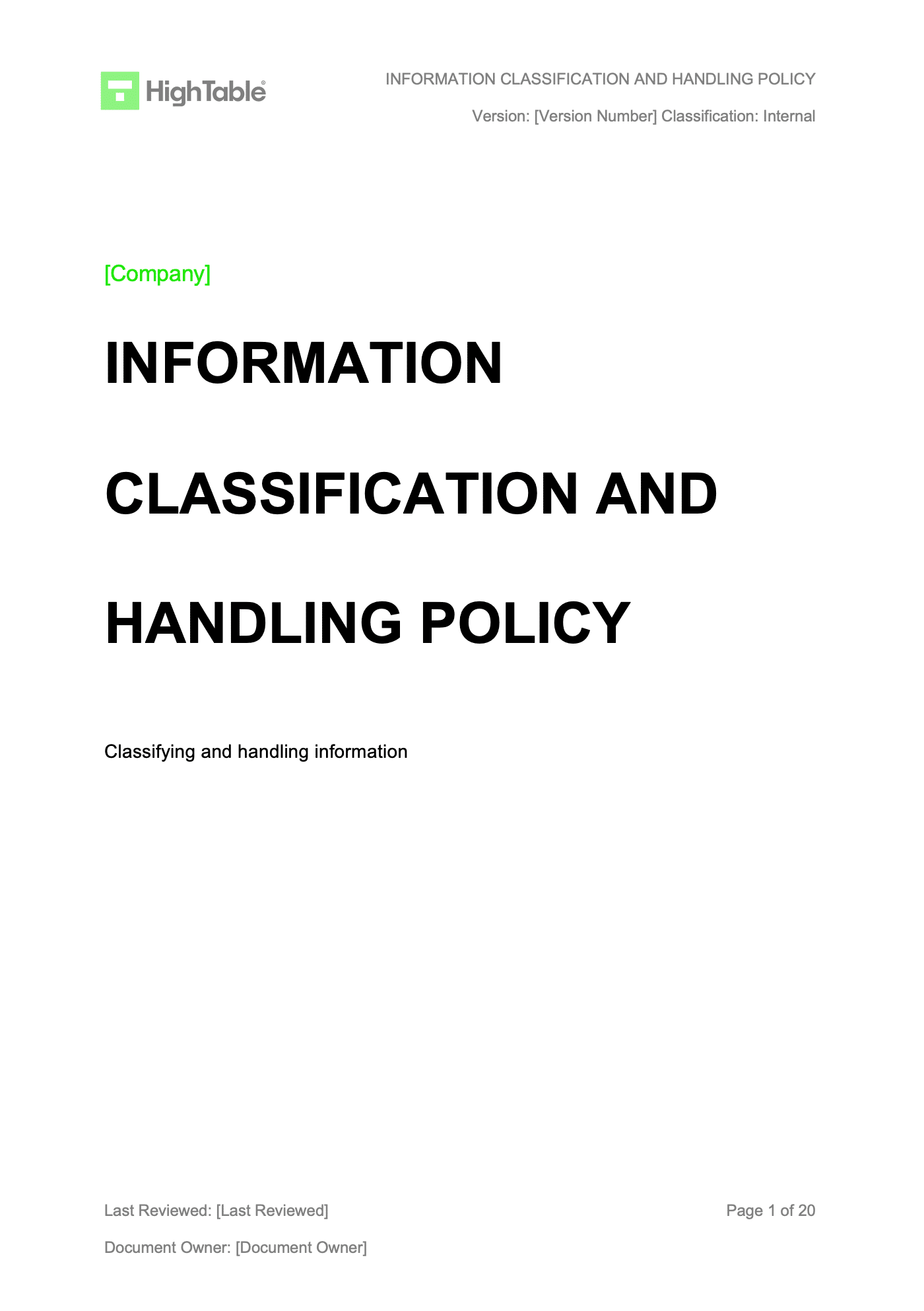
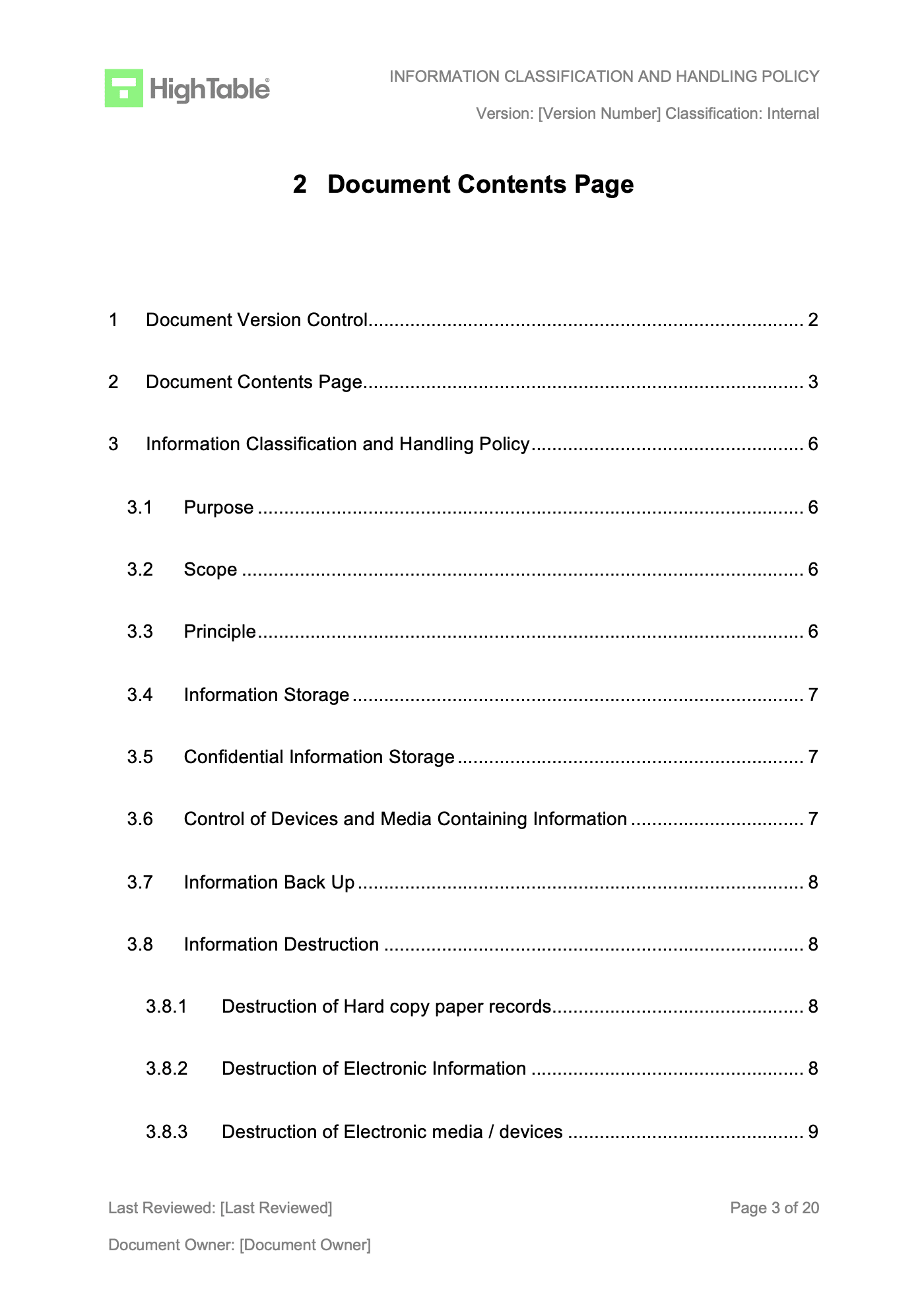
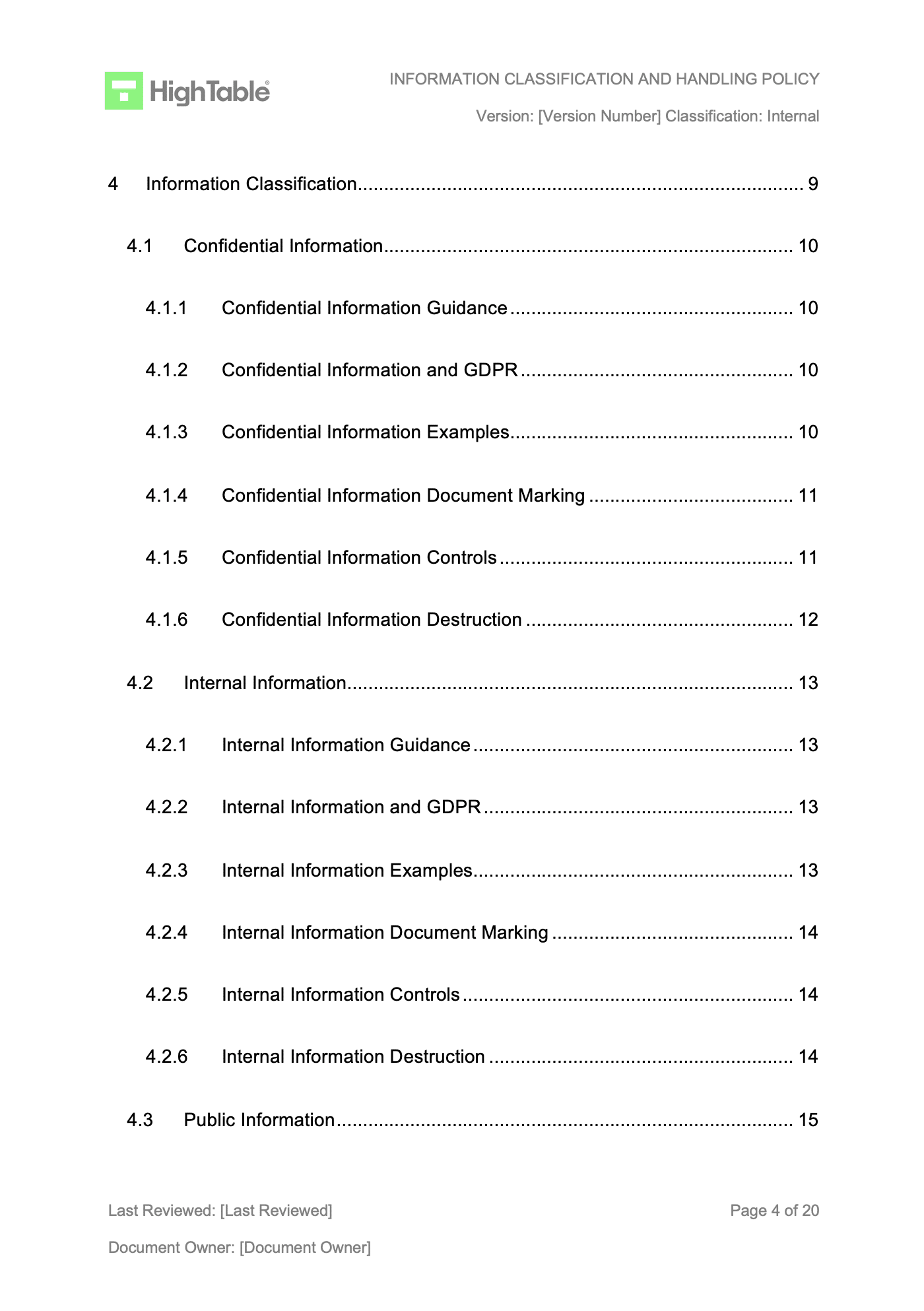
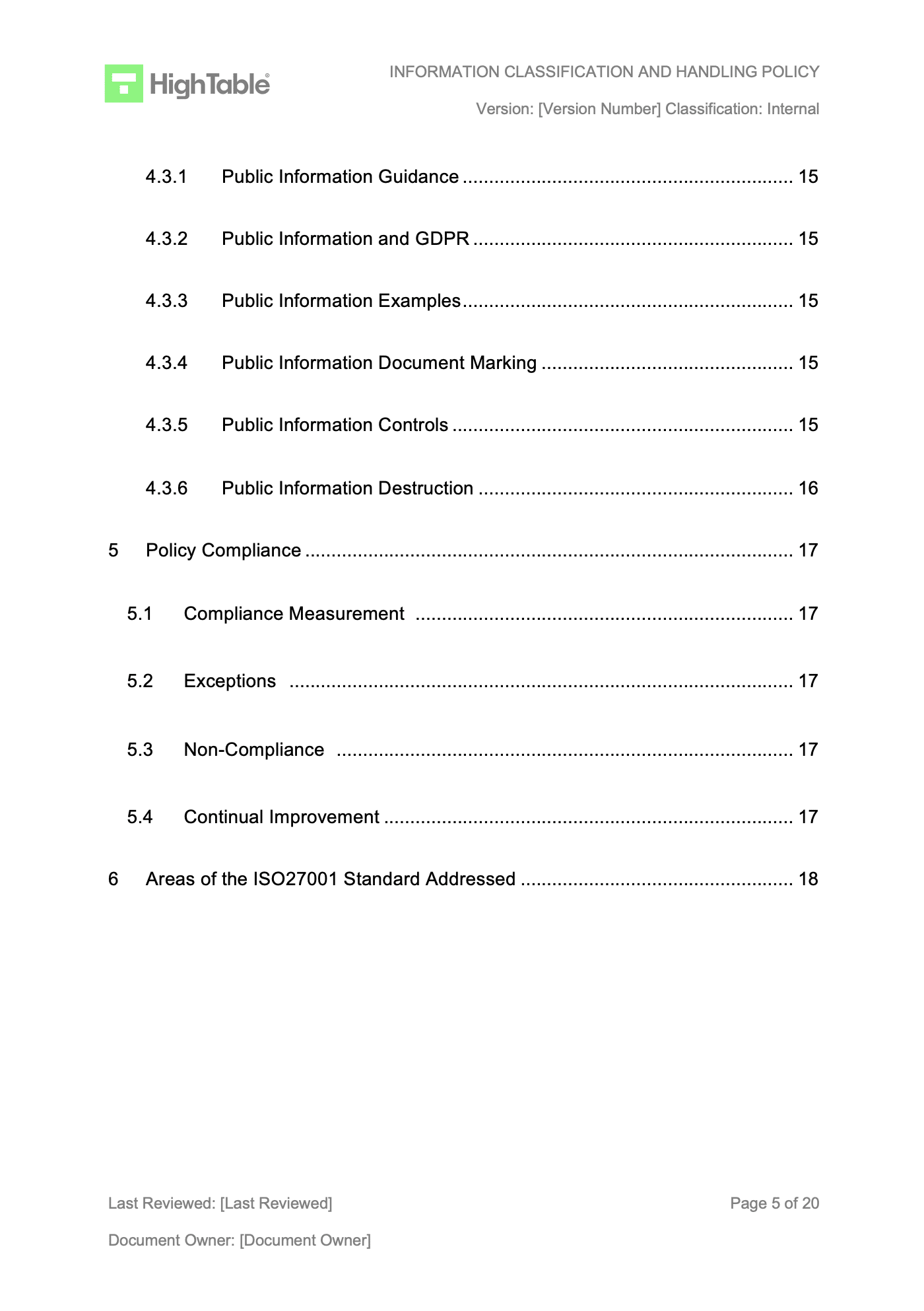
An example ISO 27001 Information Classification and Handling Policy:
ISO 27001 Information Classification and Handling Policy Walkthrough Video
ISO 27001 Information Classification and Handling Policy Template
The ISO 27001:2022 Information Classification and Handling Policy Template is designed to fast track your implementation and give you an exclusive, industry best practice policy template that is pre written and ready to go. It is included in the ISO 27001 toolkit.

Applicability to Small Businesses, Tech Startups, and AI Companies
| Business Sector | Strategic Importance | Practical Implementation Examples |
|---|---|---|
| Small Businesses | Protects customer lists and financial records; maintains operational continuity and client trust. | Utilising secure payment systems to avoid local storage of card data; enforcing clear desk policies (locking computers). |
| Tech Startups | Safeguards intellectual property and proprietary technology; essential for scalable growth and market success. | Classifying app source code as “Highly Confidential”; restricting access to authorised developers; enforcing robust password hygiene. |
| AI Companies | Secures massive training datasets; ensures ethical data use and privacy compliance for AI model development. | Storing training data in isolated, secure environments; strictly limiting data usage to specific AI training purposes to protect data subjects. |
ISO 27001 Information Classification and Handling Policy Strategic Overview
| Category | Requirement and Strategic Implementation |
|---|---|
| Why | Essential for safeguarding information security, mitigating expensive data breaches, and building stakeholder trust to facilitate business growth. |
| When | Implementation should occur as soon as sensitive data is handled; ideally established prior to seeking formal ISO 27001 certification. |
| Who | Applicable to the entire organisation, from the CEO to interns, ensuring every individual understands their specific role in data protection. |
| Where | A company-wide mandate applicable across all physical offices, corporate assets, and personal devices used for professional purposes. |
| How | Identify information types, rank them by sensitivity, and establish clear, simple rules for the management and handling of each category. |
| Support | The ISO 27001 toolkit provides a technical shortcut using pre-written, standard-compliant templates to accelerate policy deployment. |
How to implement an ISO 27001 Information Classification and Handling Policy
To implement an effective Information Classification and Handling Policy, organisations must categorise data based on value and risk. This process ensures that Confidential and Restricted assets receive prioritised security controls, such as encryption and MFA, while maintaining operational efficiency for Public and Internal information across the ISMS.
1. Formalise Classification Levels
Formalise a four-tier classification structure to ensure consistent data protection across the ISMS. This involves defining Public, Internal, Confidential, and Highly Restricted categories based on legal, regulatory, and business impact assessments.
2. Catalogue Information Assets
Catalogue all information assets within the scope of the ISMS to establish a clear baseline for risk management. Use a formal Asset Register to record the location, format, and sensitivity of data across on-premises and cloud environments.
3. Designate Asset Owners
Designate accountable owners for each asset category to manage access permissions and ensure classification accuracy. Owners are responsible for periodic reviews of access rights and ensuring that handling requirements are followed by all users.
4. Apply Metadata Labelling
Apply physical or digital metadata labels to all classified information to signal handling requirements to users. Utilise automated discovery tools or manual tagging to embed classification levels directly into documents and database schemas.
5. Provision Technical Controls
Provision granular IAM roles, MFA, and encryption protocols based on the classification level to mitigate unauthorised disclosure and enforce the Rules of Engagement (ROE). Ensure that Restricted data is encrypted at rest and in transit using industry-standard algorithms.
Information security standards that need an ISO 27001 Information Classification and Handling Policy
This policy is a key part of ISO 27001, which is an international standard for managing information security. Other standards that need it include:
| Security Standard / Framework | Relevance to Information Classification |
|---|---|
| ISO 27001 | The primary international standard requiring formal classification and handling of information assets. |
| CCPA | Requires identification and classification of personal information for California residents. |
| DORA | Mandates operational resilience through the classification of critical financial sector data. |
| NIS2 | Essential for categorising network and information systems security for essential entities. |
| SOC 2 | Focuses on Trust Services Criteria, requiring clear data handling and confidentiality controls. |
| NIST | Uses the Cybersecurity Framework (CSF) to identify and protect sensitive information assets. |
| HIPAA | Demands strict classification of Protected Health Information (PHI) to ensure patient privacy. |
| GDPR | Requires the classification of personal data and special categories of data for processing compliance. |
List of relevant ISO 27001:2022 controls
The ISO 27001:2022 standard has specific controls that relate to secure development. Some of the most important ones include:
| Standard Reference | Control Name & Functional Requirement |
|---|---|
| Annex A 5.12 | Classification of Information: Ensuring information is categorised based on business value and legal sensitivity. |
| Annex A 5.13 | Labelling of Information: Developing and implementing a consistent set of labels for classified data. |
| Clause 7.5.1 | Documented Information: Inclusion of documentation required by the standard and determined by the organisation. |
| Clause 7.5.2 | Creating and Updating: Ensuring appropriate identification, format, and review of documented info. |
| Clause 7.5.3 | Control of Documented Information: Managing availability, protection, and distribution of records. |
| Annex A 5.37 | Documented Operating Procedures: Defining how information systems and assets are managed securely. |
| Annex A 5.33 | Protection of Records: Safeguarding logs and records against tampering and unauthorised access. |
| Annex A 8.24 | Use of Cryptography: Applying encryption to protect the confidentiality and integrity of information. |
| Annex A 8.10 | Information Deletion: Ensuring secure disposal of information when no longer required. |
Comparison: HighTable ISO 27001 Toolkit vs. Compliance SaaS Platforms
| Feature | HighTable ISO 27001 Toolkit | Online SaaS Platforms |
|---|---|---|
| Data Ownership | Perpetual Ownership: You buy the files once and keep them forever on your own secure servers. | Digital Rental: You lose access to your “live” policies and tools the moment you stop paying. |
| Operational Simplicity | Native Familiarity: Built on Word and Excel. No training required; your team is already proficient. | Complex Onboarding: Requires staff training on proprietary interfaces and new software workflows. |
| Total Cost of Ownership | One-Off Fee: A single investment with zero recurring costs or “compliance taxes.” | Compounding Costs: Expensive monthly or annual subscriptions that drain OpEx indefinitely. |
| Vendor Freedom | Zero Lock-In: Total portability. Move, edit, or archive your ISMS without third-party permission. | Proprietary Lock-In: Difficult to migrate data out of “black box” systems if the vendor raises prices. |
ISO 27001 Information Classification and Handling Policy FAQ
What is an information classification and handling policy?
An information classification and handling policy is a fundamental document that defines data sensitivity levels and establishes clear rules for the use and protection of specific information types. By formalising these standards, organisations ensure that every stakeholder understands the boundaries of data usage, reducing the risk of accidental disclosure or mishandling by 100% of the workforce.
How many levels of data classification are there?
There are as many levels of classification as are appropriate for the business, though simplicity is the most effective approach for compliance. We typically advise using 3 levels—Confidential, Internal, and Public—to ensure the scheme is easy to follow while still covering the primary risk profiles found in most modern organisations.
What are the 3 levels of information classification?
The 3 most common levels of information classification are Confidential, Internal, and Public. These tiers provide a graduated scale of protection:
- Confidential: Sensitive data requiring maximum protection and encryption.
- Internal: Standard business data intended for staff use only.
- Public: Information intended for general release with no security risk.
Where can I download an Information Classification Handling Policy template?
You can download a trusted Information Classification Handling Policy template from HighTable: The ISO 27001 Company. Using a pre-verified template ensures that your documentation meets the rigorous requirements of Annex A 5.12 and 5.13, saving your compliance team approximately 15-20 hours of drafting time.
Do I need an information classification and handling policy for ISO 27001?
Yes, you strictly require an information classification and handling policy for ISO 27001. It is a core component of the ISMS and is specifically audited under Annex A 5.12 (Classification of Information) and 5.13 (Labelling of Information) to ensure assets are identified and protected according to their value.
What is the purpose of the Information Classification & Handling policy?
The primary purpose is to provide clear guidance on the classification of information and define the specific security levels required for each tier. It acts as the “Rules of Engagement” for data, ensuring that technical controls—such as encryption or physical locking—are applied consistently across the entire asset inventory.
What is information classification in ISO 27001?
Information classification in ISO 27001 is the systematic process of evaluating data based on its business value, sensitivity, and legal requirements to assign a proportionate level of protection. This assessment is critical for identifying “Critical Assets” within your Statement of Applicability (SoA).
Who is responsible for classifying the data?
Data classification is the responsibility of designated Data Owners. While the Information Security Manager (ISM) provides the policy framework, the individual Data Owners—who possess the most context regarding the information—must decide the specific classification level for the assets they manage.
What is a data owner?
A data owner is a specific individual within the organisation accountable for a set of data. Every information asset must be assigned an owner to ensure accountability; this is a foundational requirement for asset management and risk ownership within any ISO 27001-compliant ISMS.
What responsibilities does a data owner have?
A data owner is responsible for determining the classification, retention period, and level of protection required for their data. Crucially, they also manage the data controls and are the sole authority for approving or revoking access to that information based on the “Need to Know” principle.
Is data classification required for GDPR?
Yes, data classification is essential for GDPR compliance. Article 30 requires a record of processing activities, which is virtually impossible to maintain accurately without a classification scheme that identifies “Special Category Data” versus standard personal information.
Is data classification required for data protection?
Yes, data classification is a prerequisite for robust data protection. Without knowing what data you hold and its level of sensitivity, it is impossible to apply the correct technical and organisational measures (TOMs) required by data protection laws to prevent breaches.
What are the benefits of data classification?
The main benefit of data classification is that it allows organisations to prioritise resources and security efforts on the data that is most important. By focusing controls on high-value “Confidential” data, companies can reduce their risk profile more efficiently than by applying blanket controls to all information.
