
The ISO 27001 competency matrix is a structured register of employees mapping their information security roles and responsibilities to the required list of skills, knowledge and experience. It allows you to demonstrate and evidence that you have the adequate skills to operate the Information Security Management System and to identify, track and manage any training or resourcing needs.
Table of contents
- What is it?
- ISO 27001 Competency Matrix Template
- Applicability to Small Businesses, Tech Startups, and AI Companies
- How the ISO 27001 toolkit can help
- Why you need it
- When you need it
- Who needs it?
- Where you need it
- How to write it
- How to build an ISO 27001 Competence Matrix Training Video
- How to implement it
- Information security standards that need it
- List of relevant ISO 27001:2022 controls
- ISO 27001 Competency Matrix Example
- ISO 27001 Competency Matrix FAQ
What is it?
Think of an ISO 27001 Competency Matrix as a special chart or spreadsheet. Its main job is to help you see who on your team knows what when it comes to keeping information safe. It’s like a map that shows all the skills everyone has and how those skills match up with what you need for ISO 27001, which is a big standard for information security. You use this matrix to figure out if your team has the right skills, if they need more training, and if you’re ready to meet all the rules of the standard. It’s a key tool for managing your team’s knowledge about security.
ISO 27001 Competency Matrix Template
The ISO 27001:2022 Competency Matrix Template is a simple and effective way to record and manage employee competency.
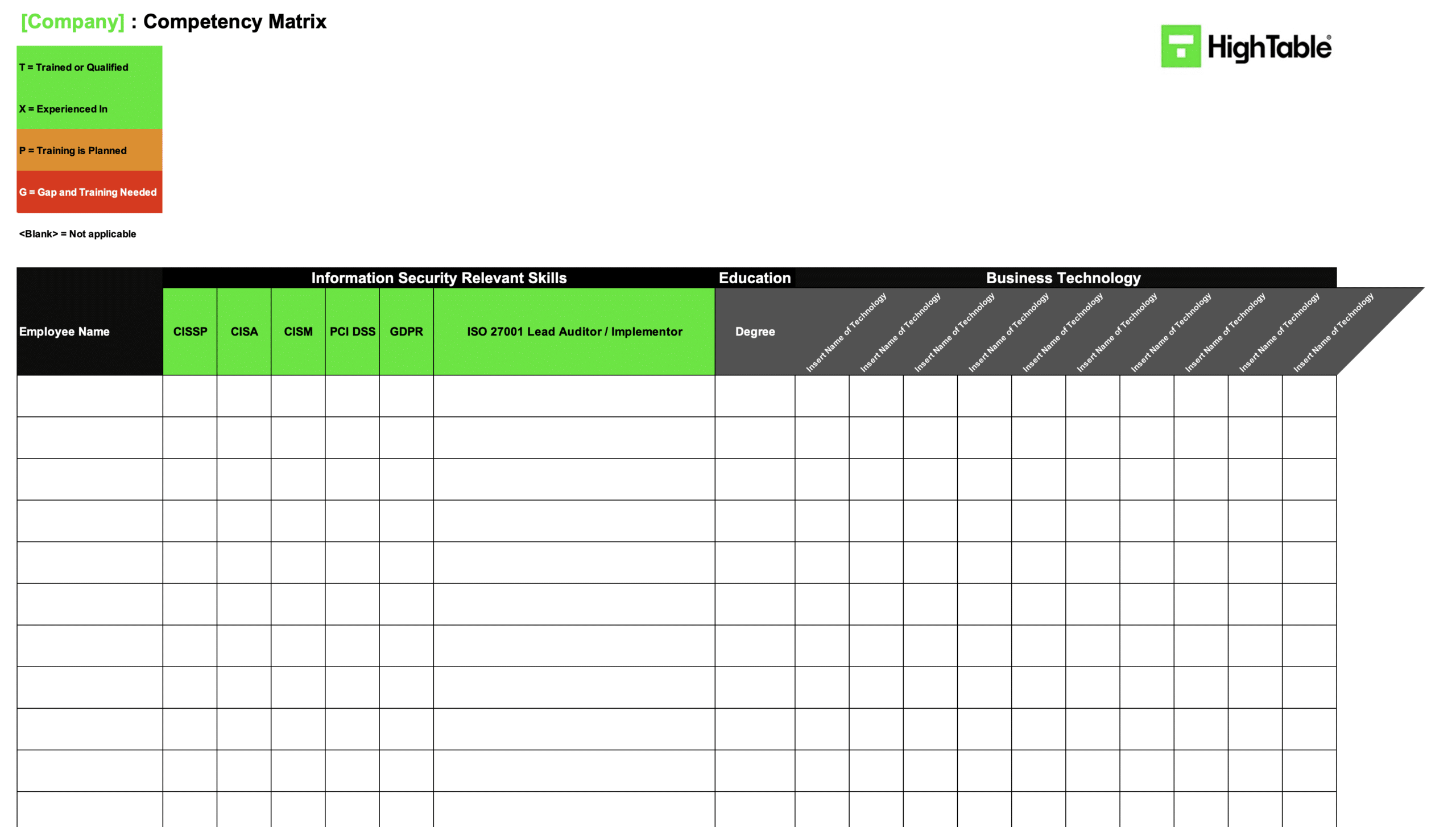
It is a record of the skills and training level of staff against information security and business technology.
Applicability to Small Businesses, Tech Startups, and AI Companies
| Sector | Key Security Competencies & Skills | Business Impact & Compliance Value |
|---|---|---|
| Small Businesses | Protecting credit card data, handling customer privacy queries, firewall management. | Ensures small teams can safely manage customer data and provides a roadmap for training to eliminate single-point-of-failure risks. |
| Tech Startups | Secure coding, managing cloud security, data encryption. | Builds early-stage investor trust and ensures product security integrity by identifying skill gaps before code deployment. |
| AI Companies | Protecting training data, securing AI models, managing research data access. | Essential for safeguarding proprietary data models and ensuring data scientists are trained in unique AI-specific security risks. |
How the ISO 27001 toolkit can help
An ISO 27001 toolkit is a collection of documents and templates that make your life easier. It comes with a ready-made competency matrix template. This saves you a lot of time because you don’t have to start from scratch. The toolkit also has a list of the skills you need to check for, which is a huge help!
Do it Yourself ISO 27001
Our Lead-Auditor verified templates with expert support have a 100% success rate.

Why you need it
You need this matrix for several good reasons. First, it helps you spot any gaps in knowledge on your team. If nobody knows how to handle a specific security problem, this chart will show you that right away. Second, it’s a big part of meeting the rules of ISO 27001. The standard wants you to prove that your people are good at their jobs, and this matrix is a great way to do that. It also helps you plan for training and make sure your team is always getting better at security.
When you need it
You’ll need this matrix from the start of your ISO 27001 journey. It’s one of the first things you’ll create. You’ll also use it to keep track of things over time. When you hire new people, you’ll update the matrix. When someone learns a new skill, you’ll change their score. You’ll also look at it before any audits to make sure you’re ready to show off your team’s skills.
Who needs it?
The person in charge of security at your company, often called the CISO or Information Security Officer, is the main person who needs this. Your HR team also needs it to help with hiring and training. And anyone who is part of the ISO 27001 project team will use it.
Where you need it
You can keep this matrix as a simple document. A secure shared drive, a cloud service like Google Sheets, or a company wiki are all good places for it. The key is to keep it somewhere that the right people can easily get to it but is also safe from others.
How to write it
- List the skills: Start by listing all the skills your team needs. These should come from the ISO 27001 controls (we’ll talk about those later). Think about things like understanding policies, handling security incidents, or knowing about access control.
- Add your team: Put your team members’ names in a column.
- Rate their skills: Go through and rate each person’s skill level for each task. You can use a simple scale, like “1 (not skilled)” to “5 (expert),” or just “yes” or “no.”
- Find the gaps: Look at the results. Where are the empty spots? Where does nobody on your team have the skills you need? Those are your training gaps.
- Plan your training: Use what you learned to create a plan for training.
How to build an ISO 27001 Competence Matrix Training Video
How to implement it
Step 1: Identify and Record ISMS Roles
Identify every position within your organisation that impacts Information Security Management System (ISMS) performance and record them in your accountability matrix. This includes technical leads managing Identity and Access Management (IAM) roles and administrative staff with privileged data access.
Step 2: Formalise Competency Benchmarks
Formalise the specific education, professional training, and years of experience required for each identified role to satisfy Clause 7.2. You must define measurable benchmarks for technical skills such as Multi-Factor Authentication (MFA) administration and secure coding practices.
Step 3: Execute Objective Skills Assessment
Execute a standardised assessment using a 1 to 5 scale to measure current employee competence against your established benchmarks. This action results in a data-driven gap analysis that highlights critical security weaknesses within your technical teams.
Step 4: Provision Targeted Remediation Training
Provision targeted training, mentoring, or external recruitment to bridge the competency gaps identified in your assessment. Ensure staff are briefed on Rules of Engagement (ROE) documents and incident response protocols to verify technical resilience.
Step 5: Centralise and Maintain Documented Evidence
Centralise training certificates, meeting minutes, and attendance logs in a secure evidence vault to satisfy auditor requirements for documented information. Regularly review and update the matrix to account for new hires or evolving technical threats.
Information security standards that need it
This competency matrix is a key part of ISO 27001, which is an international standard for managing information security. Other standards that need it include:
| Regulatory Framework / Standard | Applicability & Competence Requirement |
|---|---|
| ISO 27001 | Mandatory requirement under Clause 7.2 to evidence skills, education, and experience for ISMS roles. |
| GDPR (General Data Protection Regulation) | Demonstrates technical and organisational measures for staff handling personal data. |
| SOC 2 (Service Organisation Control 2) | Validates that personnel performing security-critical tasks have the necessary qualifications and training. |
| DORA (Digital Operational Resilience Act) | Critical for demonstrating digital resilience and staff readiness in financial sectors. |
| NIS2 Directive | Ensures cybersecurity competence across essential and important entities within the UK and EU. |
| NIST CSF / HIPAA | Essential for mapping workforce security awareness and technical skills to risk management controls. |
| CCPA (California Consumer Privacy Act) | Provides auditable proof that privacy teams understand state-specific data rights and protection protocols. |
List of relevant ISO 27001:2022 controls
The new ISO 27001:2022 has a bunch of rules you need to follow. The competency matrix helps you meet the rules in a few key areas, especially:
| Standard Reference | Control / Clause Name | Competency Matrix Application |
|---|---|---|
| ISO 27001:2022 Clause 7.2 | Competence | The primary mechanism for evidencing that personnel have the necessary education, training, and experience. |
| ISO 27001:2022 Clause 7.1 | Resources | Used to determine and provide the necessary resources (human capital) for the ISMS implementation and maintenance. |
| ISO 27001:2022 Annex A 6.3 | Information Security Awareness, Education, and Training | Provides the framework for tracking and delivering security awareness to all staff and relevant contractors. |
ISO 27001 Competency Matrix Example
This is an ISO 27001 Competency Matrix example and a great way to meet the requirement of the standard.
ISO 27001 Competency Matrix FAQ
What is an ISO 27001 Competency Matrix?
An ISO 27001 Competency Matrix is a mandatory record used to evidence compliance with Clause 7.2. It maps the specific education, training, and experience required for every role within your Information Security Management System (ISMS), ensuring personnel have the technical skills to protect 100% of identified data assets.
How do you implement an ISO 27001 Competency Matrix in 4 steps?
Implementation requires a structured approach to bridge the gap between HR and security. Following these four steps ensures 100% coverage of mandatory requirements:
- Identify Roles: List every position that impacts the performance and effectiveness of the ISMS.
- Define Benchmarks: Set specific requirements for education, professional training, and years of experience for each role.
- Gap Analysis: Assess current staff against these benchmarks to identify security skill shortages.
- Remediation: Deliver targeted training or recruitment to bridge gaps, documenting all outcomes as evidence.
What’s the best way to score skills?
A simple “1 to 5” scale or even a “yes/no” works great! The goal is to provide a clear, quantifiable measure of a team member’s proficiency in a specific security area.
How often should I update the matrix?
At least once a year, and every time someone new joins your team or learns a new skill. Continuous monitoring ensures that 100% of staff are evaluated against security standards before gaining access to sensitive production environments.
Is this a required document for ISO 27001?
While not named specifically in the standard, it’s the best way to prove you meet the “competence” rule outlined in Clause 7.2. Auditors expect a structured method to demonstrate that personnel have the necessary qualifications.
Do I need a fancy tool for this?
Nope! A simple spreadsheet is all you need to track and manage your ISO 27001 Competency Matrix effectively.
Can I use it to check for skills outside of security?
Yes, you can use the same idea for things like marketing or project management to ensure your entire team is aligned with your business objectives.
What if my team doesn’t have a lot of security skills?
That’s okay! The matrix will help you see those gaps so you can plan for targeted training or bring in external resources to bolster your security posture.
How do I prove the information is correct?
You can show training certificates, records of past experience, or detailed notes from internal review meetings as evidence for your ISO 27001 auditor.
Can one person be skilled in everything?
Probably not! The goal is to have a good mix of skills across the whole team to prevent single-point-of-failure risks and ensure comprehensive security coverage.
What if a team member leaves?
You’ll need to update the matrix immediately and figure out who will take over their security tasks to ensure there are no gaps in your ISMS operations.
Does a consultant need to write this for me?
No, you can write it yourself! Using a template or following the Clause 7.2 requirements makes this a straightforward task for any Internal Auditor or Compliance Manager.
How long does it take to create?
It can be quick, maybe just a few hours to start. The complexity depends on the size of your organisation and the variety of roles involved.
What if my company is too small for this?
Even a two-person company can benefit from knowing who handles what. It ensures critical security tasks aren’t overlooked in a small, fast-moving team.
Can this help me find a new hire?
Yes! It can show you what skills you’re missing so you know exactly what to look for in your next recruitment round to strengthen your team.
Is it the same as a training plan?
No, the matrix shows skills now, and the training plan is what you’ll do to fix the gaps identified by the matrix assessment.
Does the matrix need to be very detailed?
No, keep it simple so it’s easy to read and use. The focus should be on high-level competency areas relevant to the ISO 27001 standard.
About the author