ISO 27001 Legal Register Explained + Template

Stuart Barker - High Table - ISO27001 Director

In this guide, you will learn what an ISO 27001 Legal Register is, how to write it yourself and I give you a template you can download and use right away

Simply put, an ISO 27001 Legal Register is a document you create to list all the laws and regulations related to information security that your organisation must follow. It’s a key part of getting and keeping your ISO 27001 certification.

The ISO 27001 legal and contractual register is used to identify which laws apply to your organisation, what contractual requirements customers have placed on you, what regulatory requirements there maybe and what standards you are working towards. It is used to evidence that they have been reviewed, agreed and signed off and to show when they will next be reviewed. All of these will inform and influence your information security management system.

Requirement AspectDescription & PurposeApplication & Scope
Why You Need ItDemonstrates to auditors that legal responsibilities are identified and managed. It is a mandatory requirement for achieving certification.Regulatory Compliance & Audit Readiness
When You Need ItDeveloped during the initial phases of building your Information Security Management System (ISMS).Phase 1: ISMS Planning & Design
Who Needs ItMandatory for any organisation seeking ISO 27001 certification, specifically small businesses, tech startups, and AI companies handling sensitive data.All Certified Organisations
Where You Need ItMaintained as a ‘living document’ within the ISMS documentation suite, accessible for regular team reviews and updates.Centralised Compliance Repository
How to Write ItIdentify industry-specific and geographic information security laws, then document the law name, requirements, and internal owners.Risk Management & Legal Research

Template

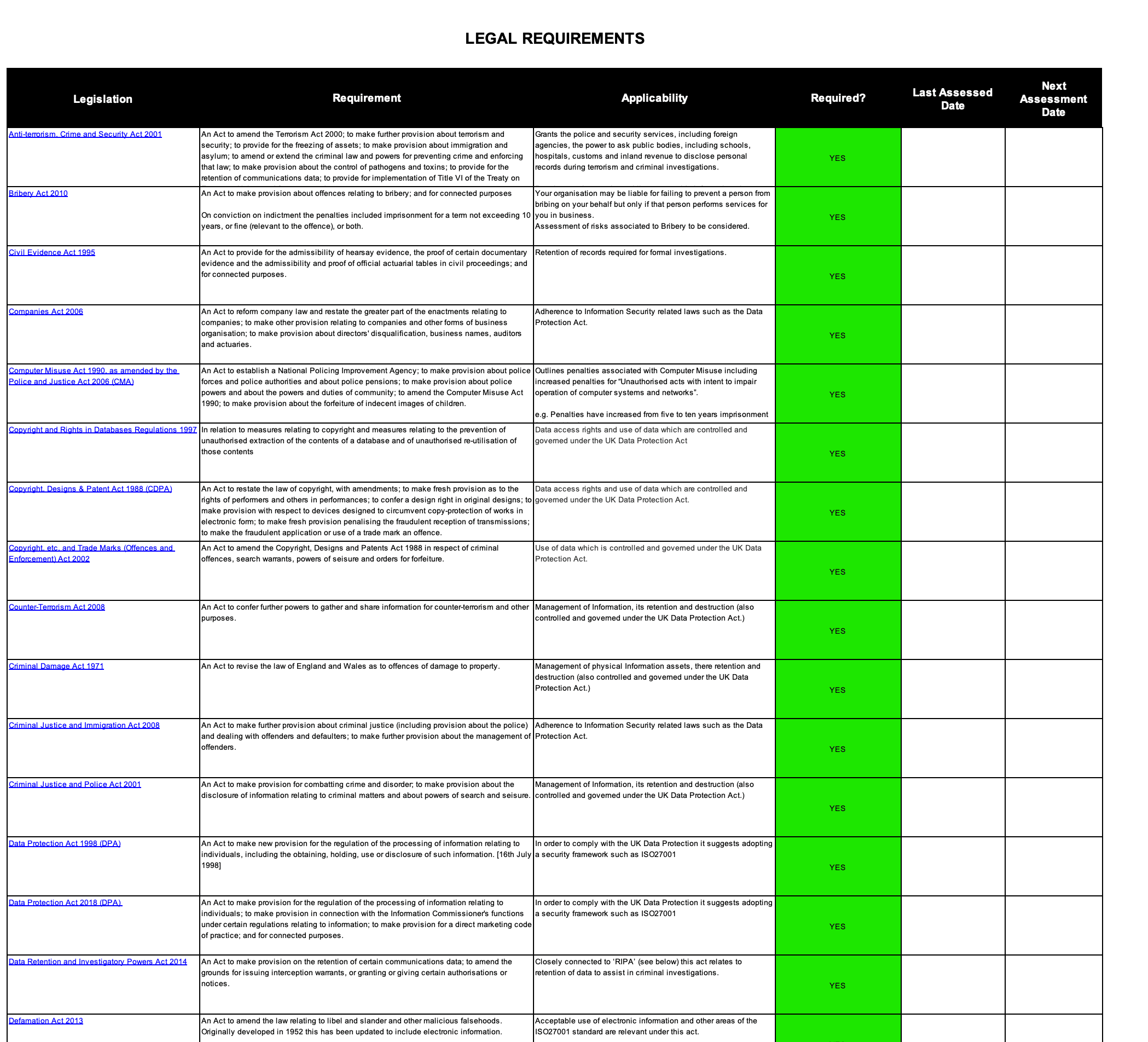
The ISO 27001:2022 Legal Register Template is designed to fast track your implementation and give you an exclusive, industry best practice policy template that is pre written and ready to go. It is included in the ISO 27001 toolkit. It is recording applicable laws, regulations and contractual requirements. It does not constitute legal advice although it does come pre-populated with common UK laws that I have come across over decades in consulting. It can be used globally and is a great foundation and starting point.
ISO 27001 Legal Register Template

This is a great ISO 27001 Legal Register Example taken as an extract from the ISO 27001 Legal Register Template.

ISO 27001 Legal Register Example

How to write it yourself

To achieve ISO 27001 certification, you must establish a formal process for identifying, documenting, and monitoring all statutory, regulatory, and contractual requirements. This “How-To” guide provides the steps required to satisfy Clause 4.2 and Annex A 5.31 using a high-performance Legal Register.

Step 1: Define Geographic and Regulatory Scope

Identify all jurisdictions where your organisation operates and handles data. This includes the physical location of servers, offices, and the residency of your data subjects.

  • Action: Review Articles of Association and contractual service level agreements (SLAs).
  • Result: A formalised list of applicable laws, such as GDPR (UK/EU), CCPA, or the EU AI Act.

Step 2: Identify Statutory and Contractual Requirements

Provision a centralised repository to document every specific legal obligation. You must include requirements from regulators, industry bodies, and client contracts.

  • Action: Extract security clauses from Master Service Agreements (MSAs) and verify industry-specific codes of practice.
  • Result: A comprehensive database of legal “must-haves” mapped to your ISMS controls.

Step 3: Assign Accountability and Technical Ownership

Formalise responsibility for each legal requirement. Use Identity and Access Management (IAM) roles to ensure only authorised compliance officers can modify the register.

  • Action: Designate a Lead Auditor or Data Protection Officer (DPO) as the primary owner for each entry.
  • Result: Clear accountability that prevents compliance gaps during external audits.

Step 4: Establish Continuous Monitoring and Review

Implement a recurring review cycle to capture changes in legislation or business operations. Use Multi-Factor Authentication (MFA) to secure the ISMS document management system.

  • Action: Set a quarterly schedule to review the register against new legislative updates or changes in client contracts.
  • Result: A living document that ensures ongoing alignment with Annex A 5.31.

Step 5: Verify Compliance through Internal Audit

Conduct a targeted audit of the Legal Register to ensure all identified laws have corresponding technical controls in place. Document the Rules of Engagement (ROE) for this audit.

  • Action: Cross-reference the register with your Statement of Applicability (SoA) and evidence logs.
  • Result: Validated compliance evidence ready for Stage 1 and Stage 2 certification audits.

Applicability to Small Businesses, Tech Startups, and AI Companies

This legal register is useful for businesses of all sizes, including small businesses, tech startups, and AI companies.

ISO 27001 Legal Register: Strategic Value & Compliance Examples for Growth Sectors
Organisation Type Strategic Benefit & Compliance Value Practical Examples of Legal Requirements
Small Businesses Mitigates regulatory risks and prevents substantial fines related to customer data handling. Essential for building long-term customer trust and demonstrating legal maturity. Mandatory inclusion of the General Data Protection Regulation (GDPR) for customer data and local consumer protection laws to ensure transactional transparency.
Tech Startups Establishes a robust foundation for scalability while managing high volumes of user data. Enhances professional standing during investor due diligence and early-stage customer acquisition. Inclusion of the California Consumer Privacy Act (CCPA) for regional user data privacy and strict financial regulations (e.g., PCI DSS) for payment processing security.
AI Companies Provides critical oversight for the governance of vast datasets. Ensures alignment with complex privacy regulations, ethical data usage guidelines, and algorithmic transparency requirements. Complex requirements including the EU AI Act for model training governance, personal data usage restrictions, and intellectual property laws regarding copyrighted training data.

How the ISO 27001 toolkit can help

The ISO 27001 toolkit is a collection of pre-made documents, templates, and guides. It can make creating your legal register much easier, giving you a ready-made template and guidance on what to include.

ISO 27001 Toolkit Business Edition

Information Security Standards That Need It

This legal register is a key part of ISO 27001, which is an international standard for managing information security. Other standards that need it include:

Standard / RegulationCompliance Framework CategoryFocus Area
ISO 27001International Standard (ISMS)Information Security Management
GDPRStatutory Regulation (EU/UK)Data Privacy & Protection
CCPAStatutory Regulation (US)Consumer Privacy Rights
DORAFinancial Sector RegulationDigital Operational Resilience
NIS2Critical Infrastructure DirectiveNetwork & Information Security
SOC 2Attestation FrameworkTrust Services Criteria
NISTSecurity Framework (US)Cybersecurity Standards
HIPAAHealthcare Regulation (US)Protected Health Information

List of Relevant ISO 27001 Controls

The ISO 27001:2022 standard has specific controls that relate to secure development. Some of the most important ones include:

Control IDControl NameRequirement Summary
Annex A 5.31Legal, statutory, regulatory and contractual requirementsIdentification and documentation of all legal, regulatory, and contractual obligations to ensure the ISMS remains compliant with external mandates.

Advanced Guidance

In the world of ISO 27001:2022, terms like “Legislation Register” and “Legal Register” are often used interchangeably, but for a Lead Auditor, they represent two distinct subsets of compliance. Understanding the difference between Statutory and Contractual requirements is vital for satisfying Clause 4.2.

FeatureLegislation Register (Statutory)Legal & Contractual Register (Total Scope)
Primary SourceGovernment-mandated Acts and Regulations (e.g., GDPR, Data Protection Act 2018).Includes all legislation PLUS private agreements, MSAs, and SLAs with clients.
AuthorityParliamentary or Regulatory bodies. Enforcement via fines and legal action.Civil authority based on mutual consent. Enforcement via breach of contract claims.
ISO 27001 ContextOften viewed as a subset of technical compliance.The full scope required by Annex A 5.31 to ensure audit readiness.
Review TriggerChanges in national or international law.New client onboarding or updates to existing Service Level Agreements (SLAs).

The Bottom Line: A Legislation Register only tracks what the government tells you to do. A comprehensive ISO 27001 Legal Register tracks what the government tells you plus what your customers expect you to do. To be 100% audit-ready, you must maintain the latter.

Evidence of Review: The Auditor’s Proof

For an ISO 27001 auditor, the most important part of your Legal Register isn’t the list of laws, it’s the evidence of review. You must prove that a competent person has looked at the requirements and confirmed the organisation’s compliance status. This log satisfies the evidence requirements for Clause 9.3.

Review DateReviewed By (Role)Scope of ReviewCompliance StatusAuditor Evidence Link
2026-01-15Information Security ManagerAnnual Statutory Review (UK GDPR, DPA 2018)✓ CompliantInternal Audit Report #001
2025-11-20Lead Auditor / DPONew Regulatory Assessment (EU AI Act)! Gap IdentifiedRisk Treatment Plan #44
2025-06-10Compliance OfficerQuarterly Contractual Review (Client MSAs/SLAs)✓ CompliantManagement Review Minutes

Lead Auditor Tip: When the auditor asks, “How do you know you are still compliant with the law?”, don’t show them the laws. Show them this Sign-off Log. It proves the ISMS is being governed, not just documented.

ISO 27001 Cryptographic Regulation Compliance Matrix

A common pitfall in ISO 27001 audits is overlooking the specific requirements for encryption management. In the 2022 revision, the standard merged the old Control 18.1.5 (Regulation of Cryptographic Controls) into the broader Annex A 5.31. This means your Legal Register must now explicitly track laws governing the use, import, and export of cryptographic software and hardware.

Compliance CategoryISO 27001:2022 ContextMandatory Register Entry
Export/Import ControlsFormerly 18.1.5, now 5.31. Controls the movement of high-strength encryption.Document laws restricting the transfer of encryption technology across borders (e.g., UK Export Control Act).
Usage RestrictionsRequirements for specific encryption standards in certain jurisdictions.Identification of countries where strong encryption is prohibited or requires a license.
Lawful AccessLegal rights for authorities to request decrypted data or keys.Document “Key Disclosure” laws (e.g., Part III of RIPA 2000 in the UK) to ensure staff know their legal duties.
Digital SignaturesRecognition of the legal validity of digital seals and signatures.Link to statutory frameworks (e.g., eIDAS Regulation) ensuring technical signatures are legally binding.

Lead Auditor Tip: If your startup uses VPNs, encrypted cloud storage, or proprietary encryption in your app, an auditor will expect to see these specific regulations listed. Without them, you haven’t technically identified your “legal landscape” under Clause 4.2.

While Annex A 5.31 mandates the identification of all legal requirements, Annex A 5.32 focuses specifically on the protection of Intellectual Property Rights. For a Lead Auditor, these two controls are inseparable. Your Legal Register must provide the statutory basis for how you protect your own IP and how you respect the IP rights of third parties, such as software vendors and data providers.

Asset TypeStatutory Basis (5.31)Security Protection (5.32)
Proprietary Code/AI ModelsCopyright Act / Patent LawImplementation of strict access controls, code obfuscation, and watermarking.
Third-Party SoftwareEnd User License Agreements (EULA)Maintenance of a software asset register and license usage monitoring.
Proprietary DatasetsDatabase Rights / Trade Secret LawData masking, encryption at rest, and non-disclosure agreements (NDAs).
Open Source ComponentsOSS Licenses (e.g., MIT, GNU)Vulnerability scanning and license compliance tracking within the CI/CD pipeline.

The Auditor’s Perspective: An auditor will look for evidence that your Clause 4.2 Interested Parties analysis has identified the IP owners you interact with. If your Legal Register doesn’t list the copyright laws or client-specific IP clauses that govern your data, you are at risk of a major non-conformity for failing to establish the legal context of your ISMS.

ISO 27001 Clause 4.2 Integration: The Interested Parties Matrix

A frequent audit failure is treating Clause 4.2 and Annex A 5.31 as separate activities. In reality, your Legal Register should be the technical output of your “Interested Parties” assessment. You must first identify who cares about your data (regulators, clients, shareholders) and then translate their “expectations” into documented “legal requirements.”

Interested PartyExpectation (Clause 4.2)Legal Register Entry (5.31)Technical Evidence
Regulators (e.g., ICO)Statutory data protection compliance.UK GDPR / Data Protection Act 2018Record of Processing Activities (ROPA)
Enterprise ClientsContractual security assurance and uptime.Client MSA / Security SchedulesThird-party Audit Reports (SOC 2 / ISO 27001)
Financial InstitutionsOperational resilience and fraud prevention.DORA / Anti-Money Laundering (AML) LawsBusiness Continuity Plan (BCP) Tests
EmployeesPrivacy of personal employee data.Employment Law / Privacy NoticeIAM Logs & HR Privacy Policy

Lead Auditor Tip: During your Stage 1 audit, the auditor will ask: “How did you decide what went into your Legal Register?” If you show them a direct link from your Clause 4.2 Matrix to your Annex A 5.31 Register, you demonstrate a “Managed” level of maturity that virtually guarantees a pass on organizational context.

Global Requirements: Navigating Regional Cybersecurity Laws

ISO 27001 is a global standard, but the “legal landscape” mentioned in Clause 4.2 varies drastically by jurisdiction. For organisations operating internationally, your Legal Register must reflect specific regional mandates that go beyond standard privacy rules. Failure to account for critical infrastructure laws or modernised privacy bills in your secondary markets can lead to major compliance gaps.

JurisdictionKey Regulation / ActAudit Impact (Annex A 5.31)
AustraliaSOCI Act (Security of Critical Infrastructure)Mandates cyber incident reporting and technical “positive security obligations” for 11 critical sectors.
CanadaDigital Charter Implementation Act (Bill C-27)Introduces the Consumer Privacy Protection Act (CPPA) and strict AI governance via AIDA.
United StatesCISA Cyber Incident Reporting Act (CIRCIA)Requires rapid disclosure of significant cyber attacks for entities in critical infrastructure.
European UnionDigital Operational Resilience Act (DORA)Strictly regulates ICT risk management and third-party testing for the financial services sector.

The Auditor’s Perspective: If your ISMS scope includes “Global Operations,” but your Legal Register only lists UK laws, an auditor will challenge your Clause 4.1 (Context). To achieve a “Managed” maturity level, ensure you have documented the specific “Rules of Engagement” for every country where you hold customer data or physical assets.

While Annex A 5.31 mandates that you have a Legal Register, Annex A 5.33 mandates that you protect it. As a primary ISMS record, your register must be shielded from loss, destruction, and unauthorised tampering. If anyone in your organisation can edit the register without oversight, you lack the technical governance required for certification.

Technical ProtectionControl Objective (5.33)Evidence for Auditor
Access Control (RBAC)Ensures only authorised compliance staff can modify legal entries.Permission logs from your ISMS document repository.
Version HistoryPrevents “silent” changes and provides a traceable audit trail of updates.Excel Version History or SharePoint Change Log.
Immutable BackupsProtects the register from accidental deletion or ransomware.Evidence of off-site, encrypted ISMS documentation backups.
Integrity Hashing(Best Practice) Proves the file hasn’t been modified since sign-off.Digital signatures or hash values attached to annual reviews.

Lead Auditor Tip: During a Stage 2 audit, I don’t just look at what’s in the register; I look at who has Edit Access. If your “All Staff” group has write access to your compliance folder, I will issue a non-conformity. Secure your register with the same rigour you use for your production source code.

FAQ

About the author

Stuart Barker
🎓 MSc Security 🛡️ Lead Auditor 30+ Years Exp 🏢 Ex-GE Leader

Stuart Barker

ISO 27001 Ninja

Stuart Barker is a veteran practitioner with over 30 years of experience in systems security and risk management. Holding an MSc in Software and Systems Security, he combines academic rigor with extensive operational experience, including a decade leading Data Governance for General Electric (GE).

As a qualified ISO 27001 Lead Auditor, Stuart possesses distinct insight into the specific evidence standards required by certification bodies. His toolkits represent an auditor-verified methodology designed to minimise operational friction while guaranteeing compliance.

Shopping Basket
Scroll to Top