

In this guide you will learn how to implement ISO 27001 Annex A 8.21 Security of Network Services and pass your audit from ISO 27001 Lead Auditor Stuart Barker – author of the ultimate ISO 27001 Toolkit.
ISO 27001 Annex A 8.21 Security of Network Services is an ISO 27001 control that requires us to secure our networks and have service levels and service requirements implemented, monitored and identified.
Table of contents
Key Takeaways
- ISO 27001 Annex A 8.21 requires organisations to identify and implement security requirements for all network services they use.
- This isn’t just about owning a router; it’s about managing your relationships with providers (ISPs, VPN vendors, Cloud Networking) to ensure they meet your security standards and maintain the uptime your business needs.
Purpose & Definition
ISO 27001 Annex A 8.21 is a preventive control to ensure security in the use of network services..
The ISO 27001 standard defines ISO 27001 Annex A 8.21 as:
Security mechanisms, service levels and service requirements of network services should be identified, implemented and monitored.
ISO27001:2022 Annex A 8.21 Security of Network Services

White Label
ISO 27001 for Consultants
Custom-brandable ISO 27001 documentation for consultants. Easily rebrand, reduce project time, and deliver professional, high-value security systems. Focus on delivery, not drafting.
FREE ISO 27001 Annex A 8.21 Training Video
In this free training video you will learn How to implement ISO 27001 Security of Network Services (Annex A 8.21) and Pass Your Audit
ISO 27001 Annex A 8.21 Requirements and Guidance
This control is looking for us to have control over our networks. We are going to ensure that we have identified what security measures we need, the service levels and the service requirements. Implementation is something that we can do internally or externally.
If external this is more about third party supplier management – see additional information:
- ISO 27001 Annex A 5.19 Information Security In Supplier Relationships
- ISO 27001 Annex A 5.20 Addressing Information Security Within Supplier Agreements
The standard wants us to monitor and and review the agreed service levels. A great element of the guidance is that it pushes us to consider third-party attestations to provide a demonstration that the service provider is maintaining appropriate security measures.
For me I would identify what the service requirements are then have a regular report and / or meeting that is set up to review it. I would keep evidence of this to show that I am managing it.
The are a few things to consider when it comes to what to cover so lets go through them. As we do it is worth noting that many of these are already covered and that the standard is making them specific here to networks.
Access to networks and services
For this we consider what can and should be accessed and then have appropriate policy and process in place around that access.
Authentication
The requirements on authentication for accessing services should be set.
Authorisation
Procedures that determine who is allowed to access networks and services are to be put in place.
Technical Controls
The network management and technical controls as well as the processes to access connections and services will be in place.
Access Types
How access is carried out such as physical network, wireless network, VPN will be determined.
Monitoring and Logging
Recording the time, location and other appropriate logging attributes of users that access networks and services will be in place.
Security Features
The security features of networks will be identified and implemented as well as documented. Consider here things like encryption, connection controls, cacheing, restrictive access. Firewalls, private networks, intrusion detection are also to be considered.
Network Security Professional
All in all you should work what a network security professional to work out the best solution for you and your needs. Your requirement is to identify, document, implement, monitor and review it.
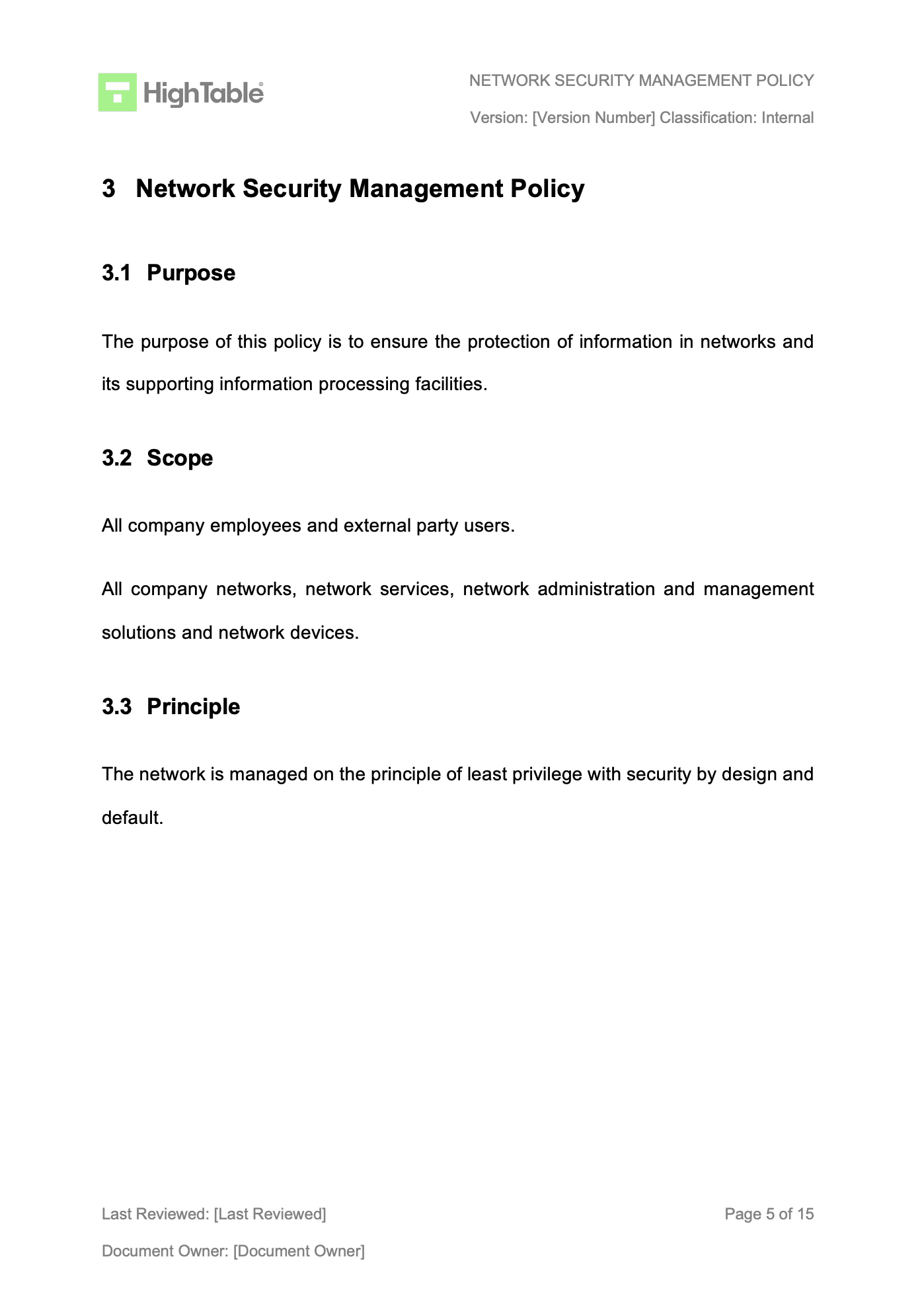
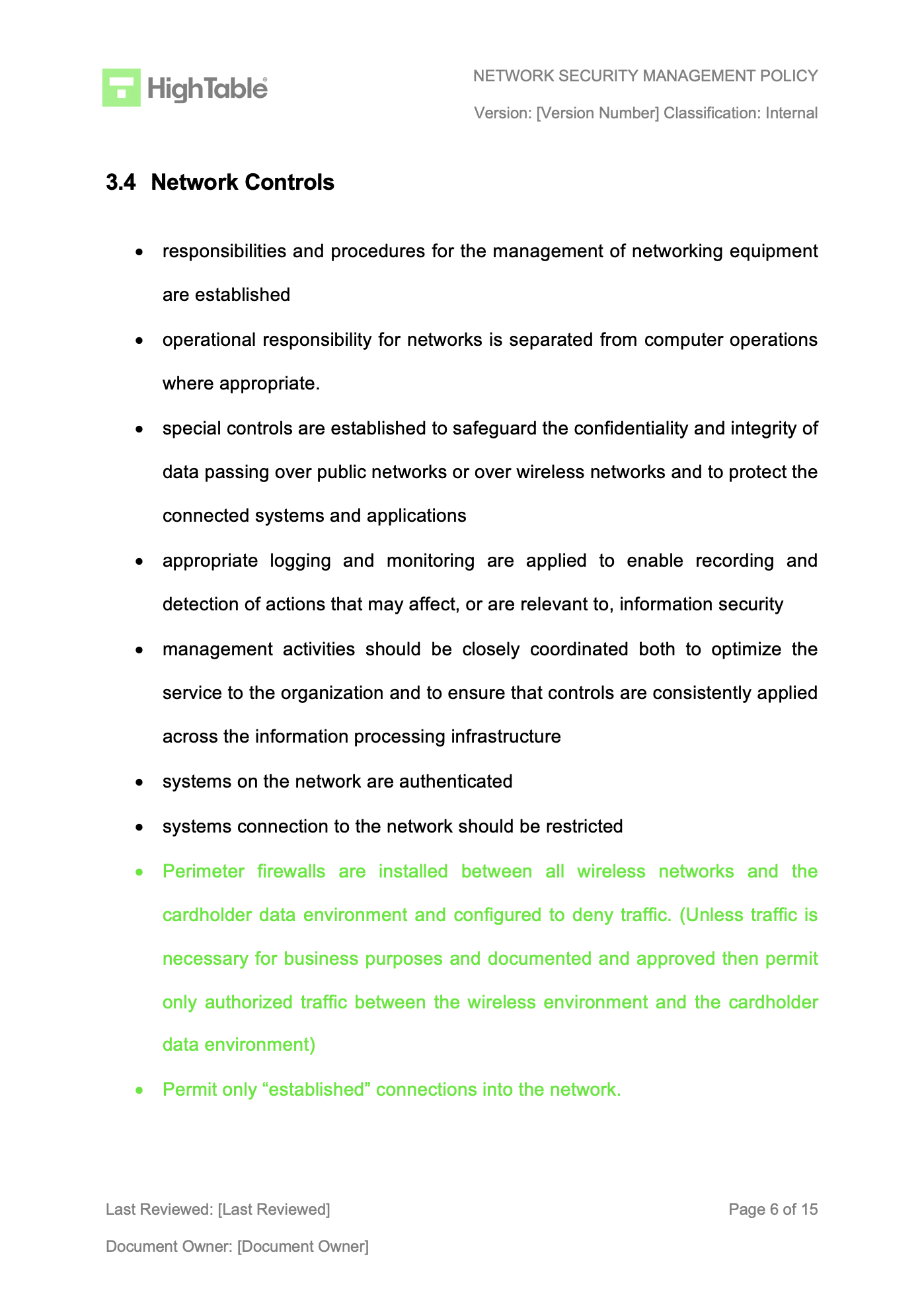
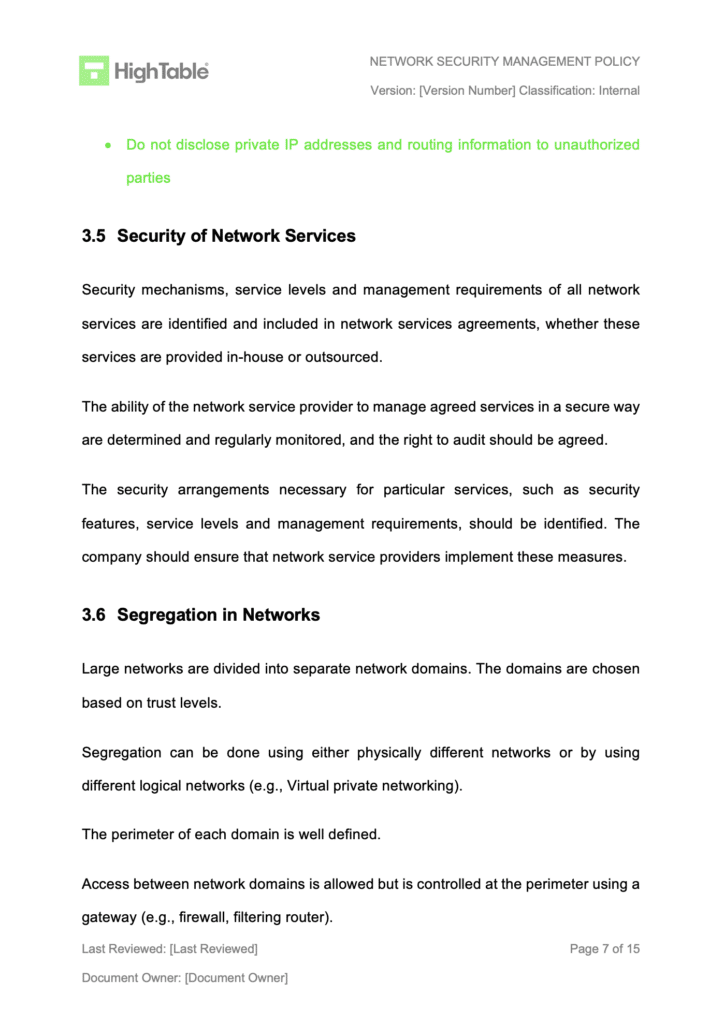
Network Security Policy Template
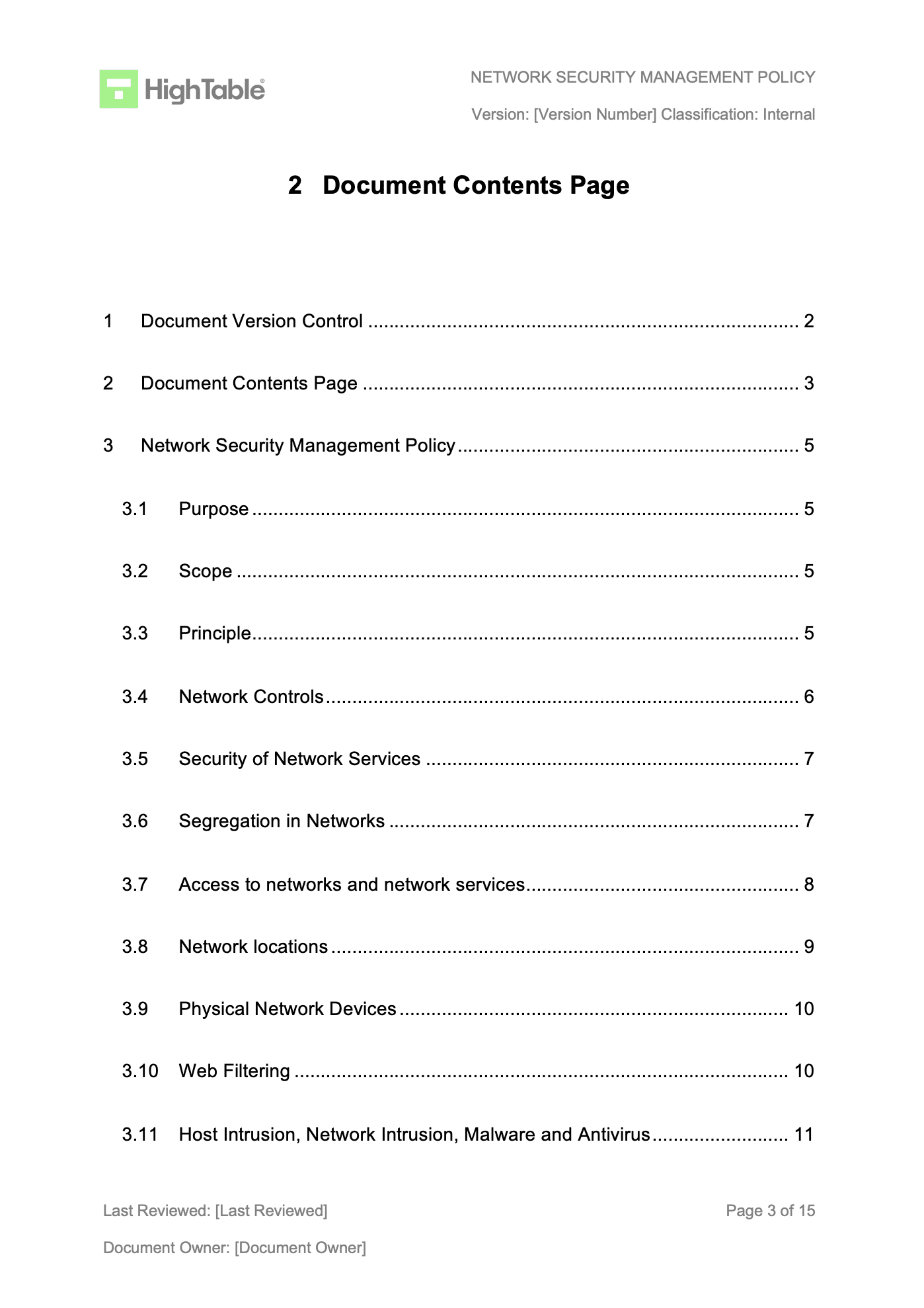
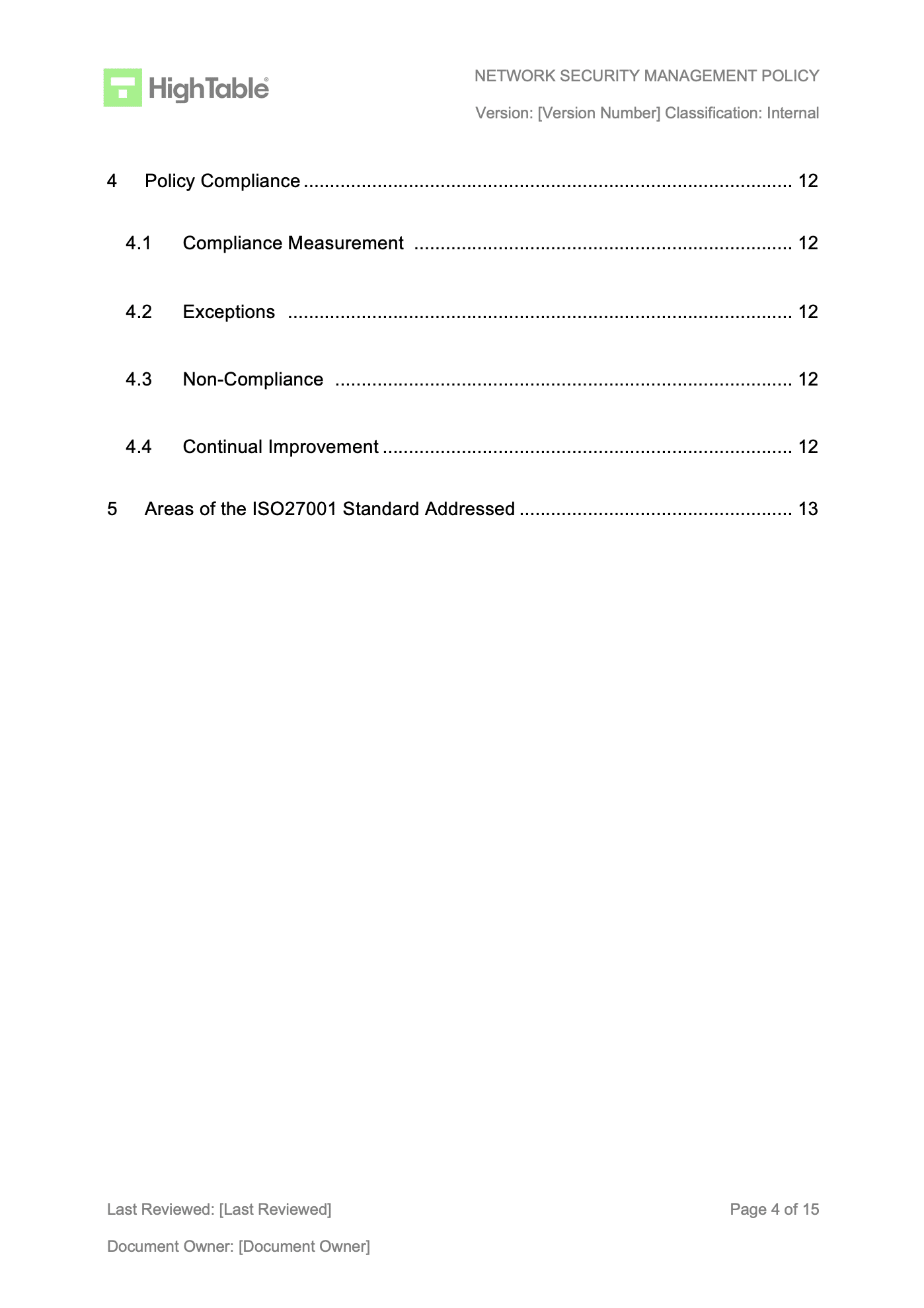
The network security policy sets out the approach to security of network services.
Network Security Policy Example
An example of the ISO 27001 Network Security Policy.
How to implement ISO 27001 Annex A 8.21
Securing network services is a vital requirement for ensuring the confidentiality and availability of data as it traverses both internal and external infrastructures. By following these technical steps, your organisation can effectively manage third-party service providers and internal network configurations to satisfy the rigorous standards of ISO 27001 Annex A 8.21.
1. Formalise Service Level Agreements and Security Requirements
- Document all security requirements within Service Level Agreements (SLAs) for every network service provider, including uptime guarantees and data protection obligations.
- Establish a “Rules of Engagement” (ROE) document that defines the technical boundaries and permissible actions for external service management.
- Result: Legally binding security baselines that ensure third-party providers adhere to your organisation’s internal risk posture.
2. Provision Secure Authentication and Encrypted Management Paths
- Mandate the use of Multi-Factor Authentication (MFA) for all administrative access to network service consoles and management interfaces.
- Enforce encrypted protocols such as SSHv2, SNMPv3, or TLS 1.3 for all remote management traffic to prevent credential sniffing and man-in-the-middle attacks.
- Result: Hardened administrative access that protects the integrity of network service configurations.
3. Restrict Service Access via Granular IAM Roles
- Implement the Principle of Least Privilege by assigning specific Identity and Access Management (IAM) roles to users and automated services based on their functional needs.
- Revoke generic or shared administrative credentials, ensuring all actions taken within network services are attributable to a specific verified identity.
- Result: A reduced attack surface where unauthorised users are blocked from modifying critical network service parameters.
4. Execute Continuous Monitoring and Logging of Network Services
- Configure all network services to export telemetry and audit logs to a centralised Security Information and Event Management (SIEM) platform.
- Establish automated alerts for “Unusual Service Modification” or “High-Frequency Access Failures” to detect potential compromise in real time.
- Result: Enhanced situational awareness and a comprehensive audit trail for both compliance verification and incident investigation.
5. Validate Service Integrity through Periodic Audits
- Conduct quarterly technical reviews of network service configurations to ensure they remain aligned with the documented security requirements.
- Perform vulnerability scans and penetration testing on service endpoints to identify and remediate weaknesses before they can be exploited.
- Result: A dynamic security posture that evolves to mitigate new threats targeting network service infrastructures.
6. Implement Traffic Filtering and Protection Mechanisms
- Deploy Web Application Firewalls (WAF) and Distributed Denial of Service (DDoS) protection to shield network services from application-layer attacks.
- Configure strict Network Access Control Lists (NACLs) to permit only authorised traffic flows between the service provider and the internal network.
- Result: Resilient network services capable of maintaining availability even during active targeted attacks.
Check Your Work?
You built it yourself. Maybe with AI. But will it pass the audit?
Don’t gamble – let an ISO 27001 Lead Auditor check your work.
What will an auditor check?
The audit is going to check a number of areas. Lets go through the main ones
1. That you have documentation
What this means is that you need to show that you have documented your network, document your security implementation and put in place appropriate service levels.
2. That you have have implemented Security of Network Services appropriately
They will look at systems to seek evidence of that it is implement appropriately. They will want to see evidence of the controls that in place and that they are operating. Service levels will be expected to be in place and reviewed. Where you rely on third party attestation of the supplier then evidence of that will be expected to be shown.
3. That you have conducted internal audits
The audit will want to see that you have tested the controls and evidenced that they are operating. This is usually in the form of the required internal audits. They will check the records and outputs of those internal audits.
ISO 27001 Annex A 8.21 FAQ
Control 8.20 focuses on the technical infrastructure, whereas Control 8.21 focuses on the service delivery and management. While they are related, 8.20 handles the “plumbing” (routers, switches, firewalls), and 8.21 handles the commercial and operational “agreement” regarding how those services perform.
Annex A 8.20 (Networks Security): Securing devices, segregating networks, and managing technical configurations.
Annex A 8.21 (Security of Network Services): Managing SLAs, uptime guarantees, encryption standards, and vendor relationships.
Integration: You need 8.20 to technically secure the network that delivers the services defined in 8.21.
Compliance requires a three-step process: identification, implementation, and monitoring of service requirements. Organizations must stop treating network services as utilities and start managing them as critical security dependencies.
Identify Requirements: Define necessary encryption levels, uptime targets (e.g., 99.9%), and data separation needs.
Implement Agreements: Embed these requirements into Service Level Agreements (SLAs) or contracts.
Monitor Performance: Regularly review service reports, audit logs, and uptime statistics to verify the provider is meeting their obligations.
A robust SLA must explicitly define security responsibilities, performance metrics, and the right to audit. Relying on standard provider contracts without review is a common compliance gap.
Security Features: Specification of firewall management, DDoS protection, and encryption protocols (e.g., TLS, VPN).
Service Levels: Guaranteed availability (uptime) and maximum acceptable latency.
Incident Response: Mandatory notification windows if the provider suffers a security breach.
Data Separation: Assurance that your traffic is logically isolated from other customers.
Yes, cloud connectivity and virtual network services are significantly in scope for Annex A 8.21. Modern organizations often rely more on cloud interconnects (like AWS Direct Connect or Azure ExpressRoute) than physical lines, making these relationships critical.
Shared Responsibility: You must understand which network security controls the cloud provider handles vs. what you configure.
SLA Review: Verify the cloud provider’s availability zones and failover guarantees meet your business continuity needs.
Evidence: Download and review the provider’s SOC 2 Type II or ISO 27001 certificate as part of your monitoring process.
Auditors primarily seek evidence of governance, contract management, and ongoing monitoring. They want proof that you are actively managing your network providers rather than passively using them.
Signed Contracts/SLAs: Documents highlighting security and availability clauses.
Monitoring Records: Minutes from service review meetings or monthly uptime reports.
Network Inventory: A list of all network services (ISPs, VPNs, SD-WAN) and their owners.
Incident Logs: Records of any network outages and how the provider responded.
Network services should be reviewed at least annually or upon any significant contract renewal or architectural change. Continuous monitoring of automated reports should happen monthly.
Annual Review: comprehensive check of the SLA against current business needs and risks.
Monthly/Quarterly: Review of performance metrics (packet loss, uptime) provided by the vendor.
Trigger-Based: Immediate review following a major incident or security breach at the provider.
Related ISO 27001 Controls
ISO 27001 Templates
Further Reading
About the author
