
In this guide you will learn how to implement ISO 27001 Annex A 8.20 Networks Security and pass your audit from ISO 27001 Lead Auditor Stuart Barker – author of the ultimate ISO 27001 Toolkit.
ISO 27001 Annex A 8.20 Network Security is an ISO 27001 control that requires us to secure our networks and document that we are doing so.
Table of contents
Key Takeaways
- ISO 27001 Annex A 8.20 requires organisations to secure, manage, and control their networks and network devices.
- Its primary purpose is to protect the information within applications and systems from being compromised via the network.
- This involves a combination of up-to-date documentation, strict access controls, and technical hardening of network infrastructure.
Purpose & Definition
ISO 27001 Annex A 8.20 is a preventive control and a detective control to protect information in networks and its supporting information processing facilities from compromise via the network..
The ISO 27001 standard defines ISO 27001 Annex A 8.20 as:
Networks and network devices should be secured, managed and controlled to protect information in systems and applications.
ISO27001:2022 Annex A 8.20 Network Security

White Label
ISO 27001 for Consultants
Custom-brandable ISO 27001 documentation for consultants. Easily rebrand, reduce project time, and deliver professional, high-value security systems. Focus on delivery, not drafting.
FREE ISO 27001 Annex A 8.20 Training Video
In this free training video you will learn How to implement ISO 27001 Network Security (Annex A 8.20) and Pass Your Audit
ISO 27001 Annex A 8.20 Requirements and Guidance
This control is looking for us to have control over our networks. We are going to ensure the information security in networks and protect connected services from un authorised access. The are a few things to consider so lets go through them.
Documentation
Documentation plays a large part in the standard and that is equally true of networks. This is usually an area where organisations struggle. Keeping up to date network documentation. But it is key to this control and passing the audit.
The documentation that is expected includes network diagrams and configuration files of devices. This documentation is also expected to have the document hygiene that includes document classification and version control. Again, this can often be overlooked.
Included in the documentation would be the classification level of the data that is carried over the network. As a rule, to simplify it, all organisation networks would be classed as confidential and public access / guest networks would be classified as public.
Roles and Responsibilities
Network management is a specialist activity that requires trained and experienced professionals. As a result you would document the roles and responsibilities including recording who is performing the role. Around this would be the usual access management processes of requesting, authorising and providing access as well as the segregation of duties to remove conflicts.
Logging and Monitoring
As part of the network implementation you will include appropriate logging and monitoring for actions that are relevant to information security.
Technical Considerations
Under advisement of your technical teams you will consider technical elements such as encryption of data in transit, restrictions and filtering of connections to the network and the use of firewalls, hardening of network devices, removal of default passwords and services, disabling vulnerable network protocols, authenticating systems on the network, segregating admin channels from other network channels.
Virtual Networks
Virtual networks can add an additional layer of security and appropriate security controls should be applied. There is a standard that covers Virtual Networks and it is ISO/IEC TS 23167.
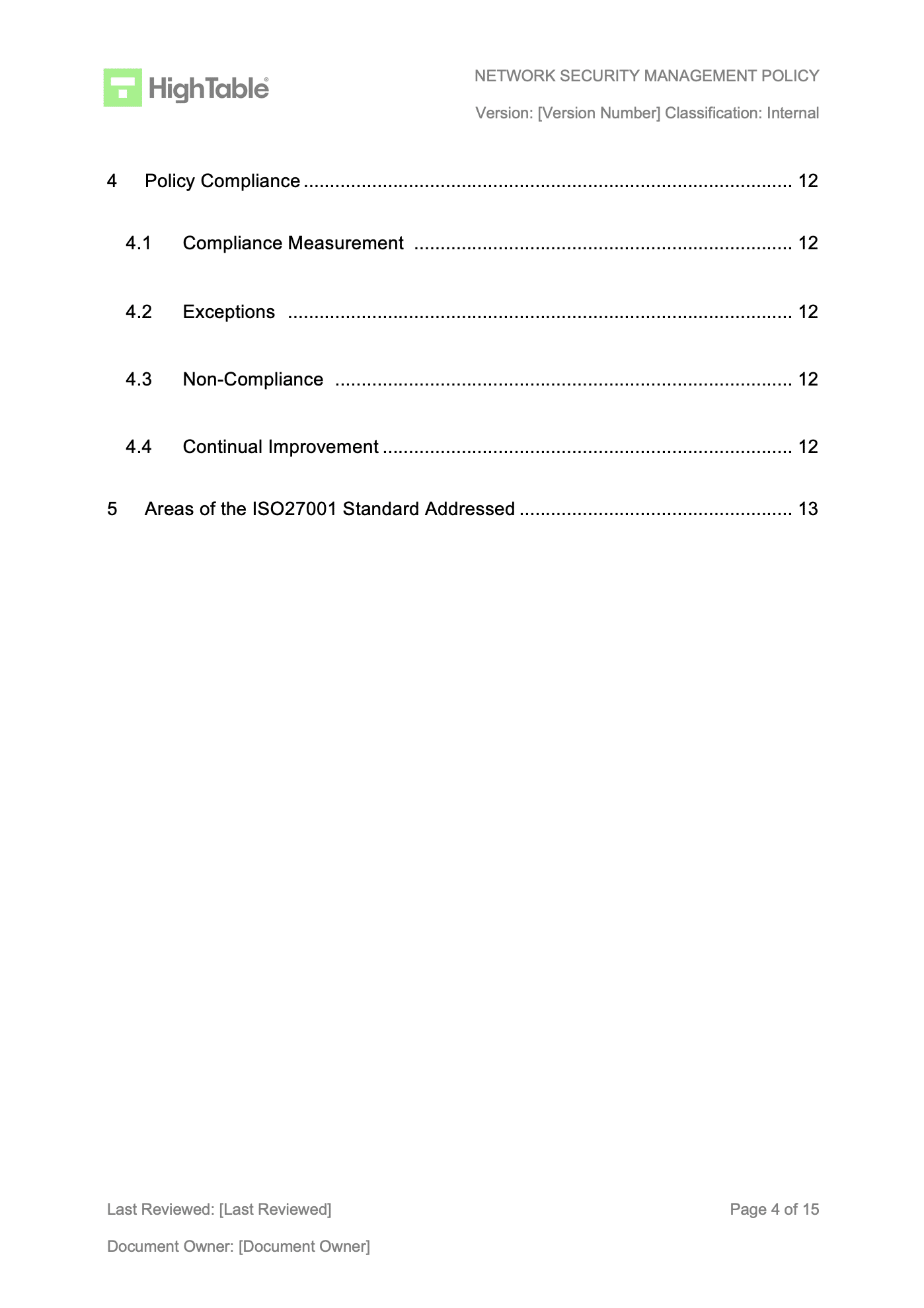
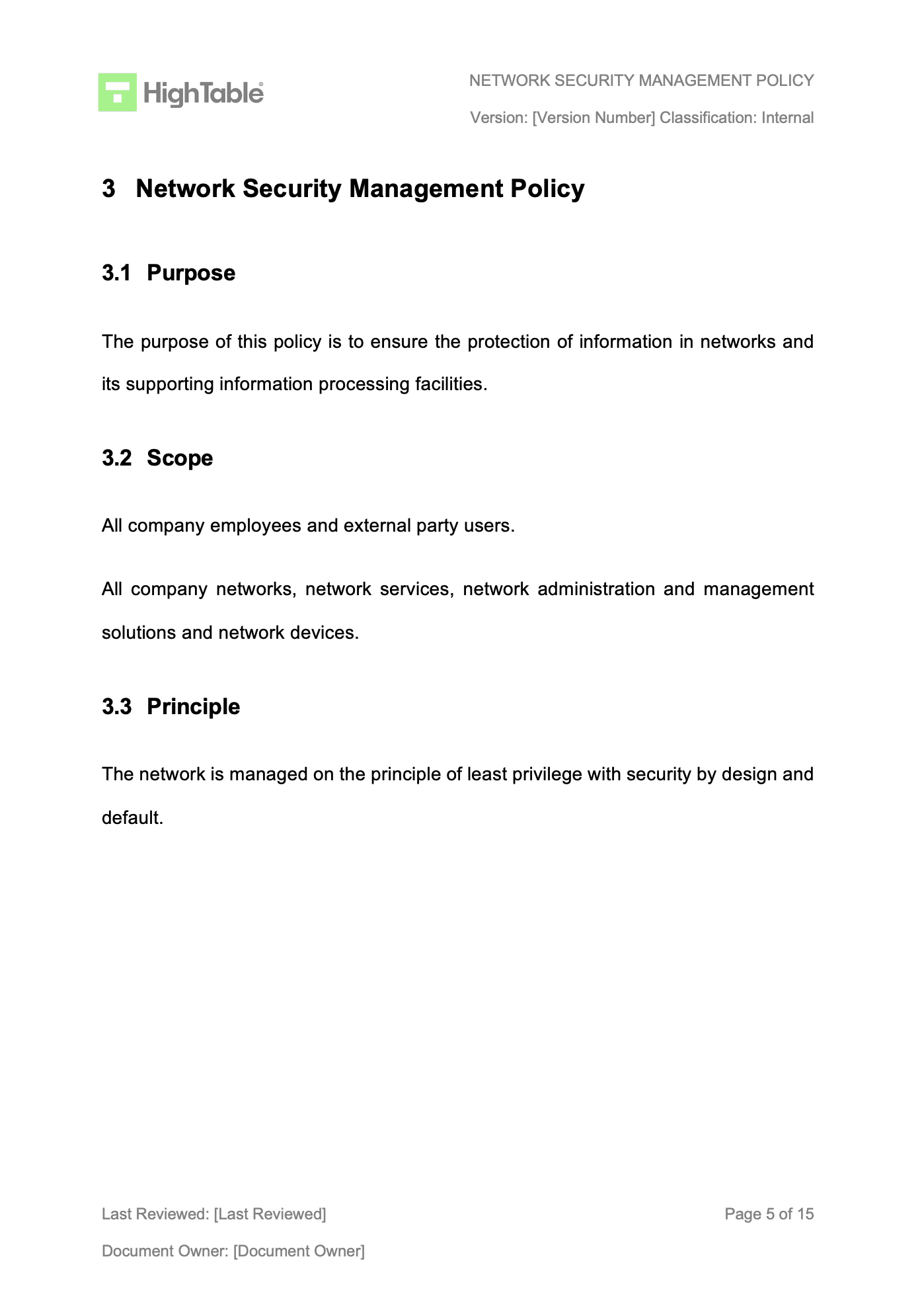
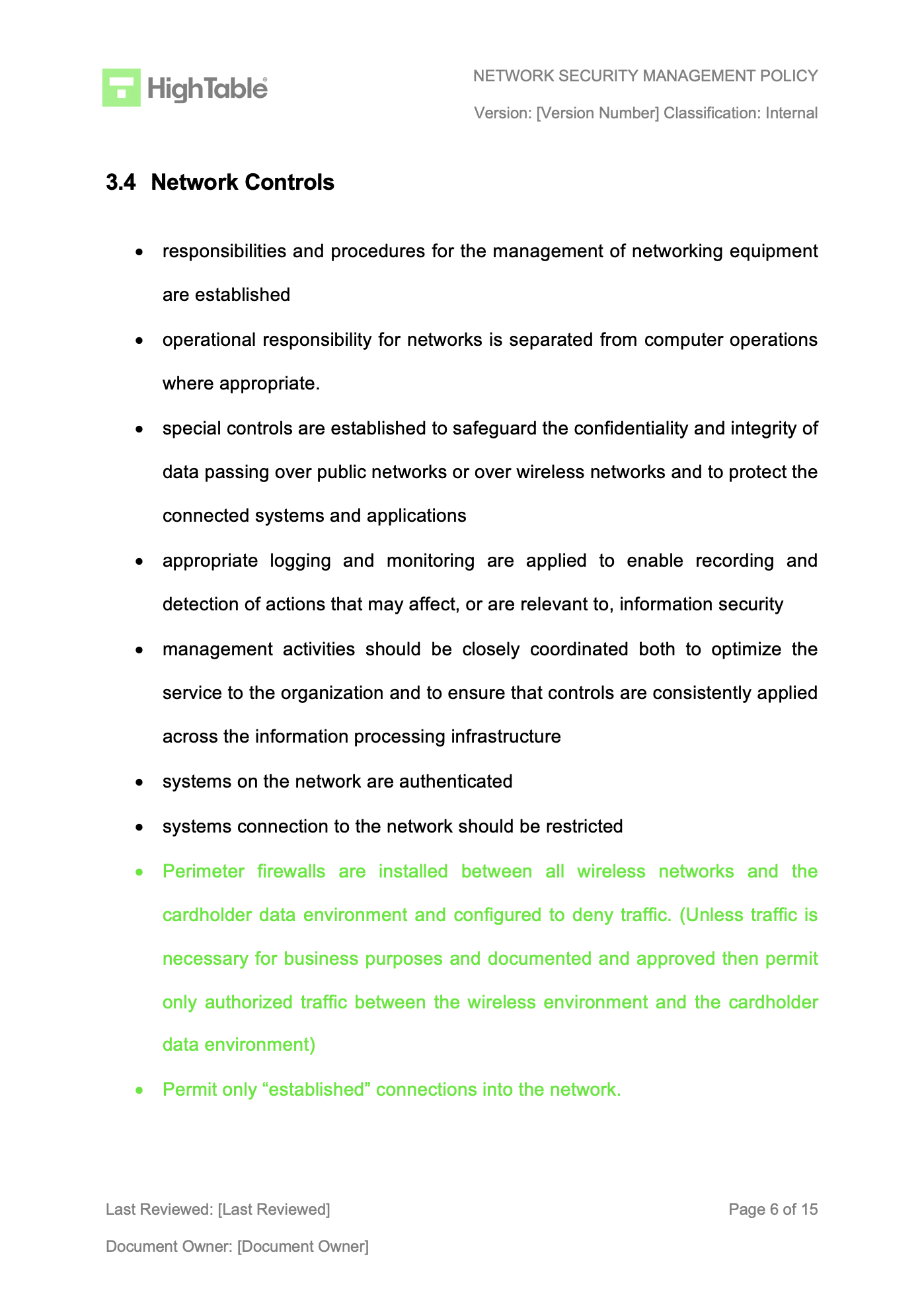
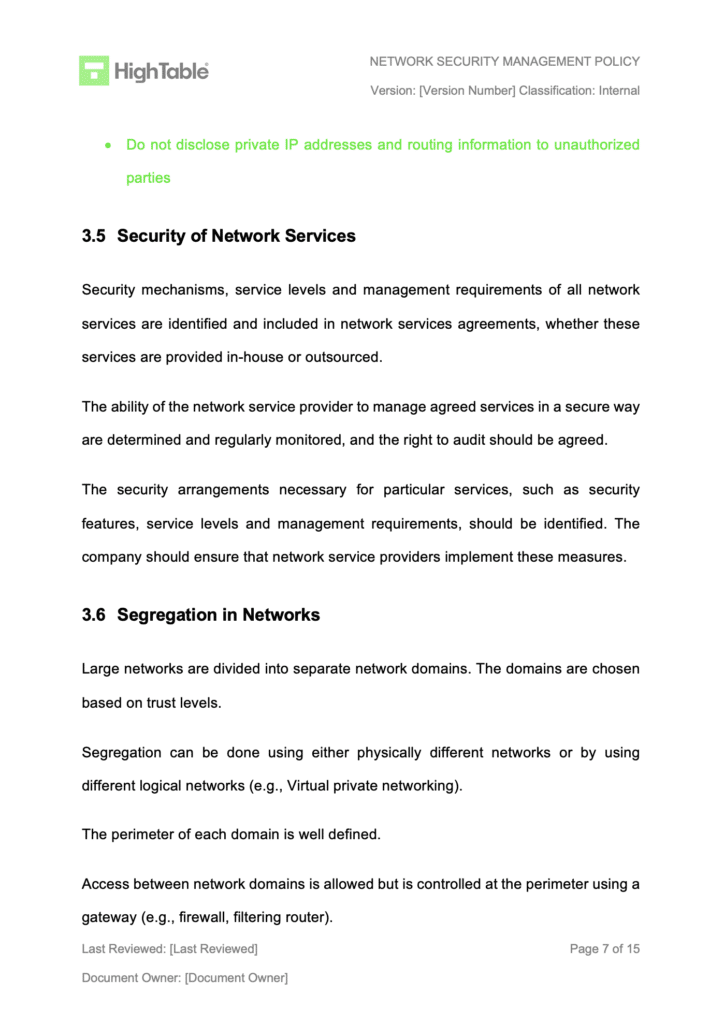
Network Security Policy Template
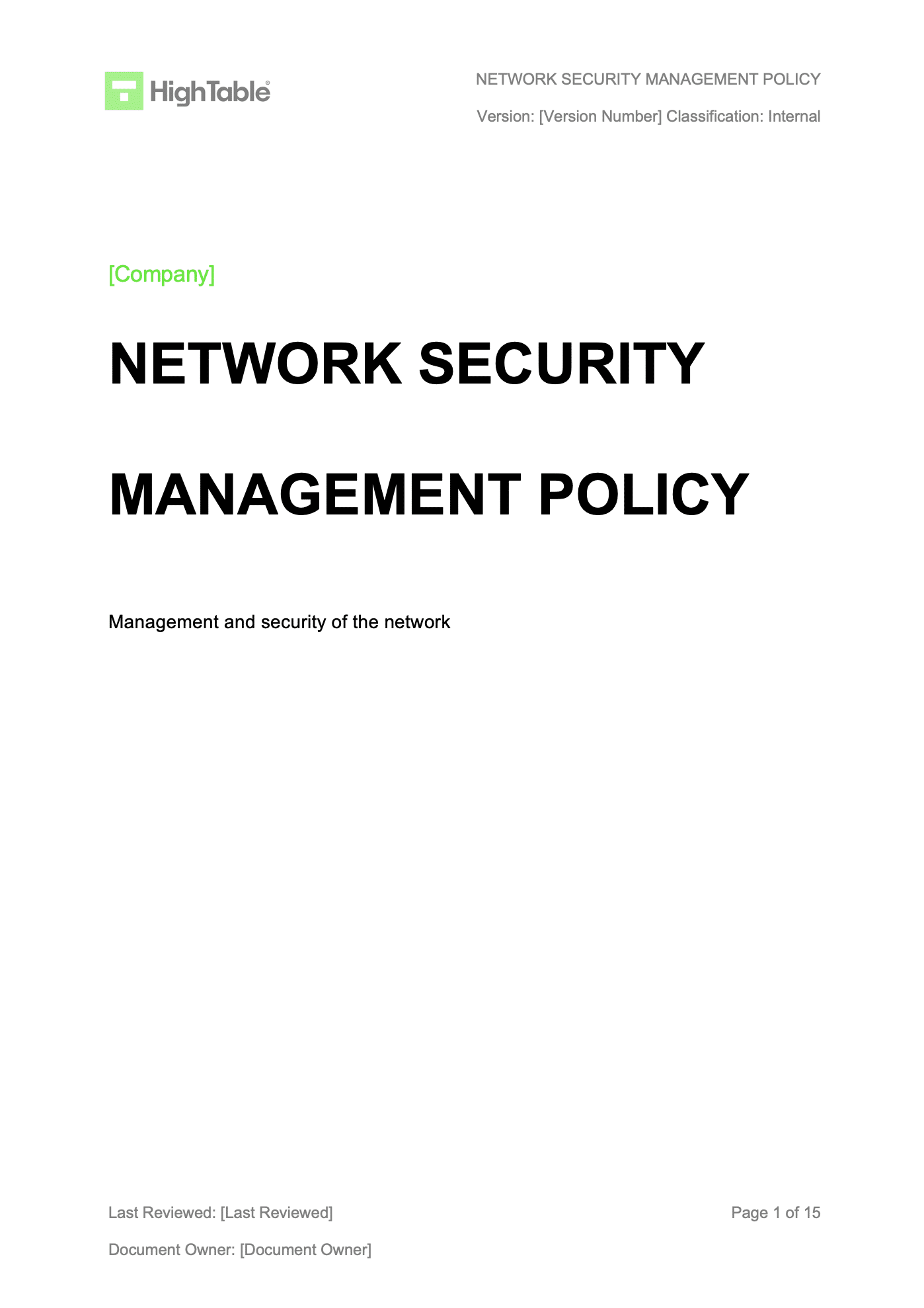
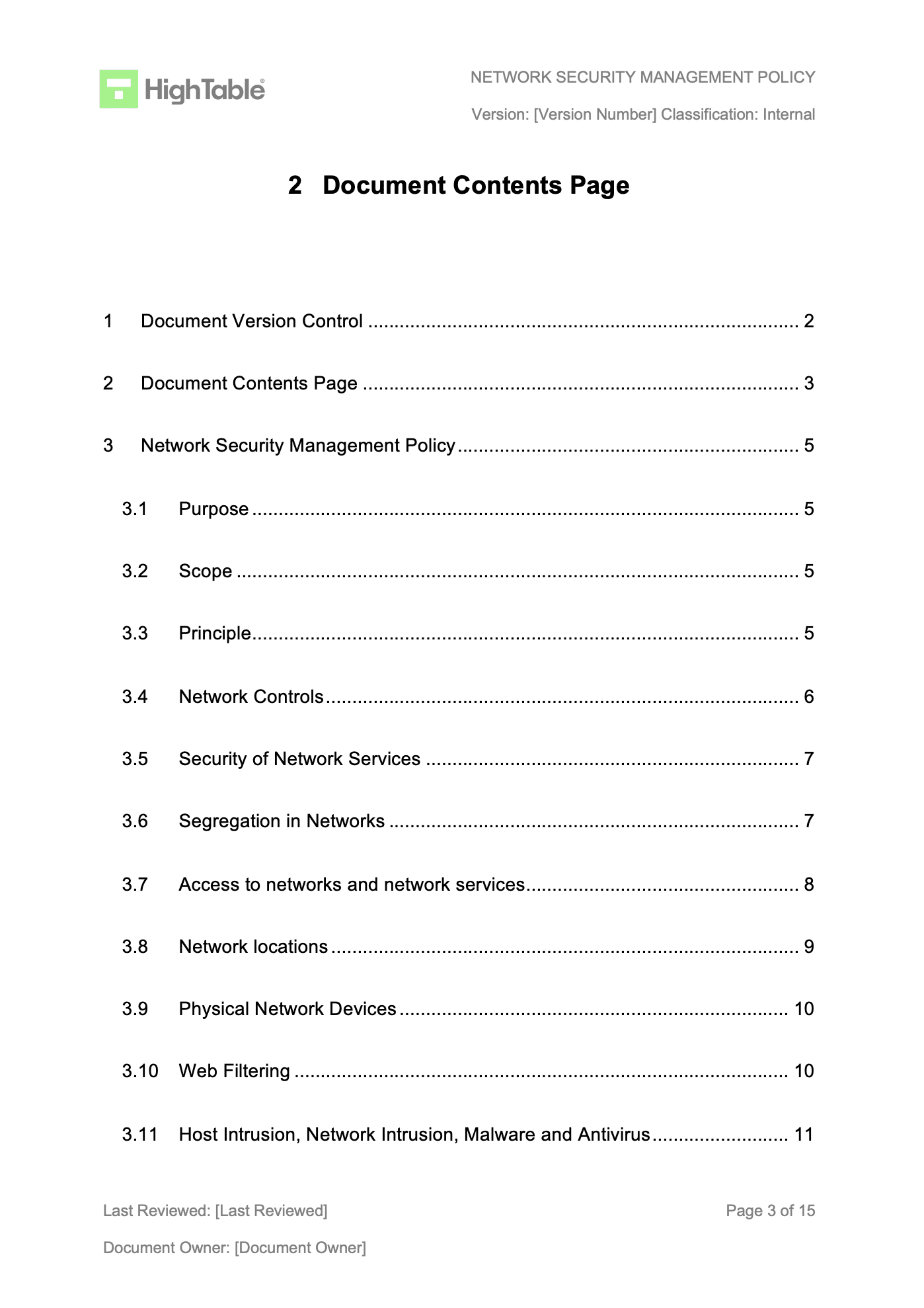
The network security policy sets out the approach to network security.
Network Security Policy Example
An example of the ISO 27001 Network Security Policy.
How to implement ISO 27001 Annex A 8.20
Establishing robust network security is a cornerstone of ISO 27001 compliance, designed to protect the confidentiality, integrity, and availability of data as it moves across your infrastructure. By following these technical implementation steps, your organisation can effectively harden network boundaries and mitigate the risk of unauthorised access or lateral movement.
1. Formalise Network Security Policies and ROE
- Draft a formal Network Security Policy that defines the baseline configurations, permitted protocols, and prohibited services across the estate.
- Establish a Rules of Engagement (ROE) document for network administrators and third-party managed service providers (MSPs) to ensure clear accountability.
- Result: A documented governance framework that serves as the legal and technical foundation for all network security controls.
2. Provision Network Segmentation and VLAN Isolation
- Utilise Virtual Local Area Networks (VLANs) and subnets to logically separate distinct business functions, such as Finance, HR, and guest traffic.
- Implement micro-segmentation for critical server environments to prevent lateral movement in the event of a single-host compromise.
- Result: A reduced blast radius that ensures a security breach in one segment cannot easily migrate to sensitive data zones.
3. Enforce Perimeter Defences and TLS Inspection
- Deploy Next-Generation Firewalls (NGFW) and Intrusion Prevention Systems (IPS) at all network entry and exit points to monitor for malicious patterns.
- Enable TLS inspection on web gateways to scan encrypted traffic for hidden malware payloads and data exfiltration attempts.
- Result: Real-time blocking of known threats and visibility into previously “blind” encrypted communication channels.
4. Restrict Administrative Access via IAM and MFA
- Configure granular Identity and Access Management (IAM) roles for network infrastructure, ensuring only authorised personnel can modify device configurations.
- Mandate Multi-Factor Authentication (MFA) for all administrative logins, particularly for remote access via VPN or cloud-based management consoles.
- Result: Elimination of risks associated with credential theft and unauthorised infrastructure tampering.
5. Execute Continuous Vulnerability Scanning and Hashing
- Schedule automated network vulnerability scans to identify open ports, insecure protocols (e.g. Telnet, FTP), and unpatched firmware.
- Use cryptographic hashing to verify the integrity of router and switch configuration files, ensuring no unauthorised changes have occurred.
- Result: Proactive identification of technical weaknesses and the ability to detect configuration drift in real time.
6. Implement Centralised Logging and SIEM Integration
- Configure all network devices to export Syslog and NetFlow data to a centralised Security Information and Event Management (SIEM) platform.
- Establish automated alerts for high-risk events, such as brute-force attempts on network gateways or unauthorised internal connection requests.
- Result: Comprehensive situational awareness and a verifiable audit trail for ISO 27001 compliance reviews and forensic investigations.
Check Your Work?
You built it yourself. Maybe with AI. But will it pass the audit?
Don’t gamble – let an ISO 27001 Lead Auditor check your work.
What will an auditor check?
The audit is going to check a number of areas. Lets go through the main ones
1. That you have documentation
What this means is that you need to show that you have documented your network. Can you show network diagrams, a list of devices and their configurations, logs of configuration changes, roles and responsibilities?
2. That you have have implemented Network Security appropriately
They will look at systems to seek evidence of network security. They will question you on the process and seek evidence that you have followed it. They want to see evidence of network security and the process in operation.
3. That you have conducted internal audits
The audit will want to see that you have tested the controls and evidenced that they are operating. This is usually in the form of the required internal audits. They will check the records and outputs of those internal audits.
ISO 27001 Annex A 8.20 FAQ
Responsibility usually lies with the IT or Network Security team, specifically those with specialist training. However, the standard requires clear segregation of duties to prevent conflicts of interest.
Network Administrators: Responsible for day-to-day configuration and maintenance.
Security Officers: Responsible for monitoring logs and auditing configurations.
Authorisation: A separate role should authorize significant changes (e.g., opening a firewall port) before implementation.
Yes, network segmentation is a critical component of securing networks under Annex A 8.20. While often detailed further in Annex A 8.22 (Segregation of Networks), control 8.20 requires you to manage and control the flow of information to prevent unauthorized access.
Guest Networks: Must be completely isolated from corporate production networks.
Admin Segregation: Management interfaces should not be accessible from the general user network.
Traffic Filtering: Use VLANs and firewalls to restrict traffic between different business units or security zones.
Auditors primarily verify compliance by examining your network documentation, configuration logs, and access control records. They will look for proof that your documented policies match the actual configuration of your live environment.
Network Diagrams: Must be current, dated, and accurately reflect physical and logical topologies.
Configuration Logs: Evidence of who changed firewall rules or device settings and when.
Access Reviews: Records showing regular reviews of who has administrative access to network gear.
Asset Inventory: A complete list of network devices (switches, routers, WAPs) and their owners.
Yes, encryption is a standard technical measure required to protect information in transit across networks. You must ensure that data moving between systems or over public networks is protected against interception.
Protocols: Use secure protocols like TLS/SSL for web traffic and IPsec for VPNs.
Management: Ensure management interfaces (e.g., SSH, HTTPS) are encrypted to protect admin credentials.
Policy: Define encryption standards in your Network Security Policy.
Related ISO 27001 Controls
ISO 27001 Templates
Further Reading
- ISO 27001 Physical and Virtual Asset Register Template
- ISO 27001 Documented Information Beginner’s Guide
About the author
