
In this guide you will learn how to implement ISO 27001 Annex A 8.30 Outsourced Development and pass your audit from ISO 27001 Lead Auditor Stuart Barker – author of the ultimate ISO 27001 Toolkit.
ISO 27001 Annex A 8.30 Outsourced Development is an ISO 27001 control that requires an organisation to make sure that outsourced developments are meeting organisational information security requirements.
Table of contents
- Key Takeaways
- Purpose & Definition
- ISO 27001 Annex A 8.30 Requirements and Guidance
- How to implement ISO 27001 Annex A 8.30
- Secure Development Policy Template
- Supplier Security Policy Template
- Supplier Register Template
- ISO 27001 Annex A 8.30 Implementation Checklist
- ISO 27001 Toolkit
- ISO 27001 Annex A 8.30 Audit Checklist
- Conclusion
- ISO 27001 Annex A 8.30 FAQ
- Related ISO 27001 Controls
- Further Reading
Key Takeaways
- ISO 27001 Annex A 8.30 requires that if you hire third-party developers (agencies, freelancers, or offshore teams) to build software for you, you must supervise their security standards.
- You cannot simply trust them to “do a good job.”
- You must define your security requirements in the contract and verify they are met before accepting the final code.
Purpose & Definition
ISO 27001 Annex A 8.26 is a preventive control and a detective control to ensure information security measures required by the organisation are implemented in outsourced system development.
ISO 27001 defines ISO 27001 Annex A 8.30 as:
The organisation should direct, monitor and review the activities related to outsourced system development.
ISO27001:2022 Annex A 8.30 Outsourced Development

White Label
ISO 27001 for Consultants
Custom-brandable ISO 27001 documentation for consultants. Easily rebrand, reduce project time, and deliver professional, high-value security systems. Focus on delivery, not drafting.
ISO 27001 Annex A 8.30 Requirements and Guidance
This is all about managing your outsourced development and making sure that it, and they, are following your requirements for information security. This will be done by telling them what you expect, getting it into agreements such as contracts and then regularly reviewing and monitoring them to ensure that it is being done.
In addition, we treat the developers as a third party for which the following will apply:
- ISO 27001 Annex A 5.19 Information Security In Supplier Relationships
- ISO 27001 Annex A 5.20 Addressing Information Security Within Supplier Agreements
- ISO 27001 Annex A 5.22 Monitor, Review And Change Management Of Supplier Services
Licensing
Getting licensing right is key. You will have documented this and who owns code and intellectual property.
The following will apply: ISO 27001 Annex A 5.32 Intellectual Property Rights
Contracts
You will have contract in place and followed the contractual requirements for secure design, coding and test.
The following will apply: ISO27001 Annex A 8.25 Secure Development Life Cycle
You will have provided them the threat model to consider.
There will be the requirement to provide evidence, and actual evidence, that sufficient testing has been conducted.
Escrow agreements where appropriate will be defined, document and evidenced.
The right to audit will be included in the contact.
Security requirements for the development environment will be in place.
The requirements of all laws and regulations will be in place.
Outsourced Development
If you outsource your development then the third party supplier controls will apply. The main thing is to ensure they meet your requirements for secure development but all relevant controls that apply to you, will apply to them.
Secure Development Policy Template
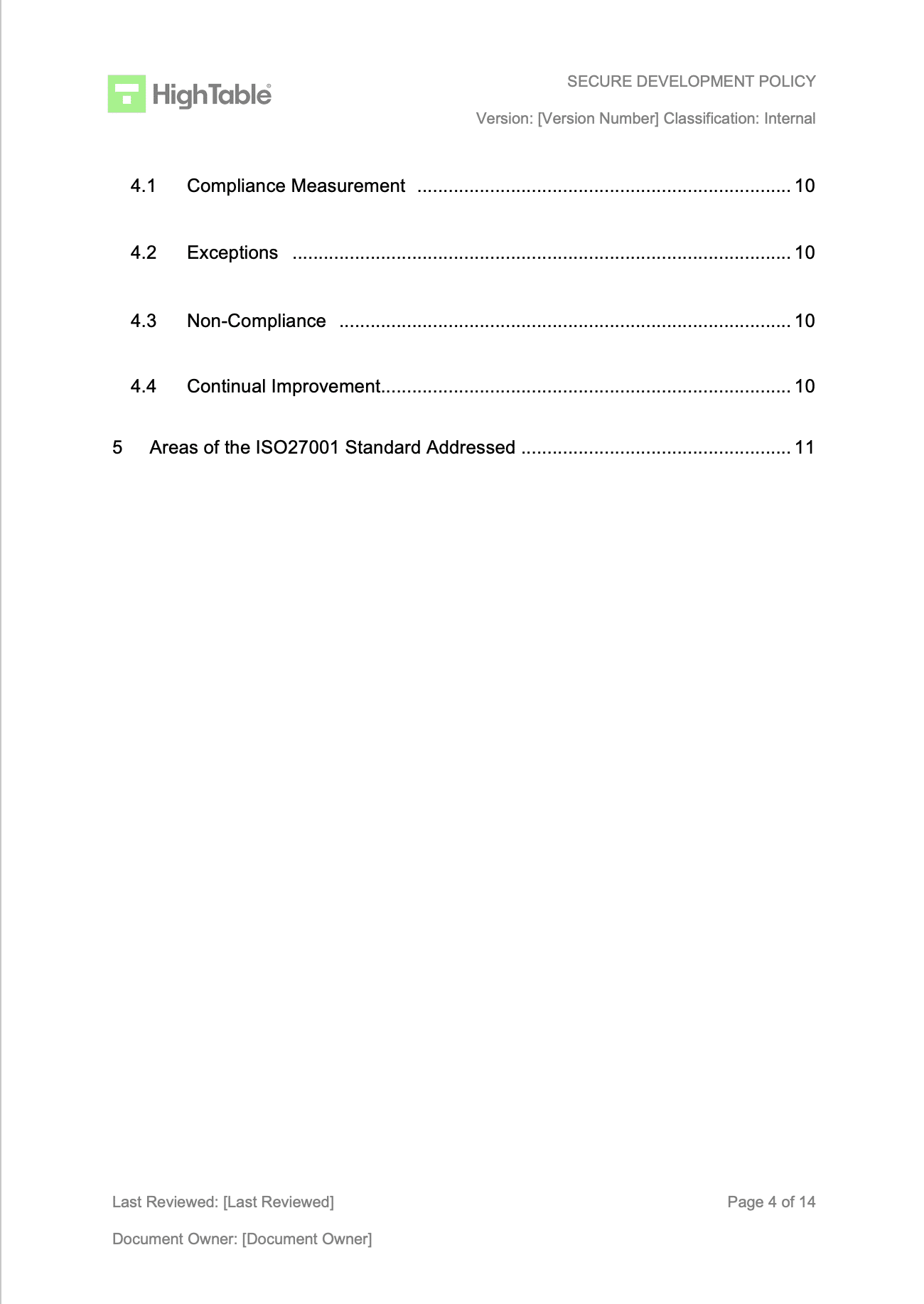
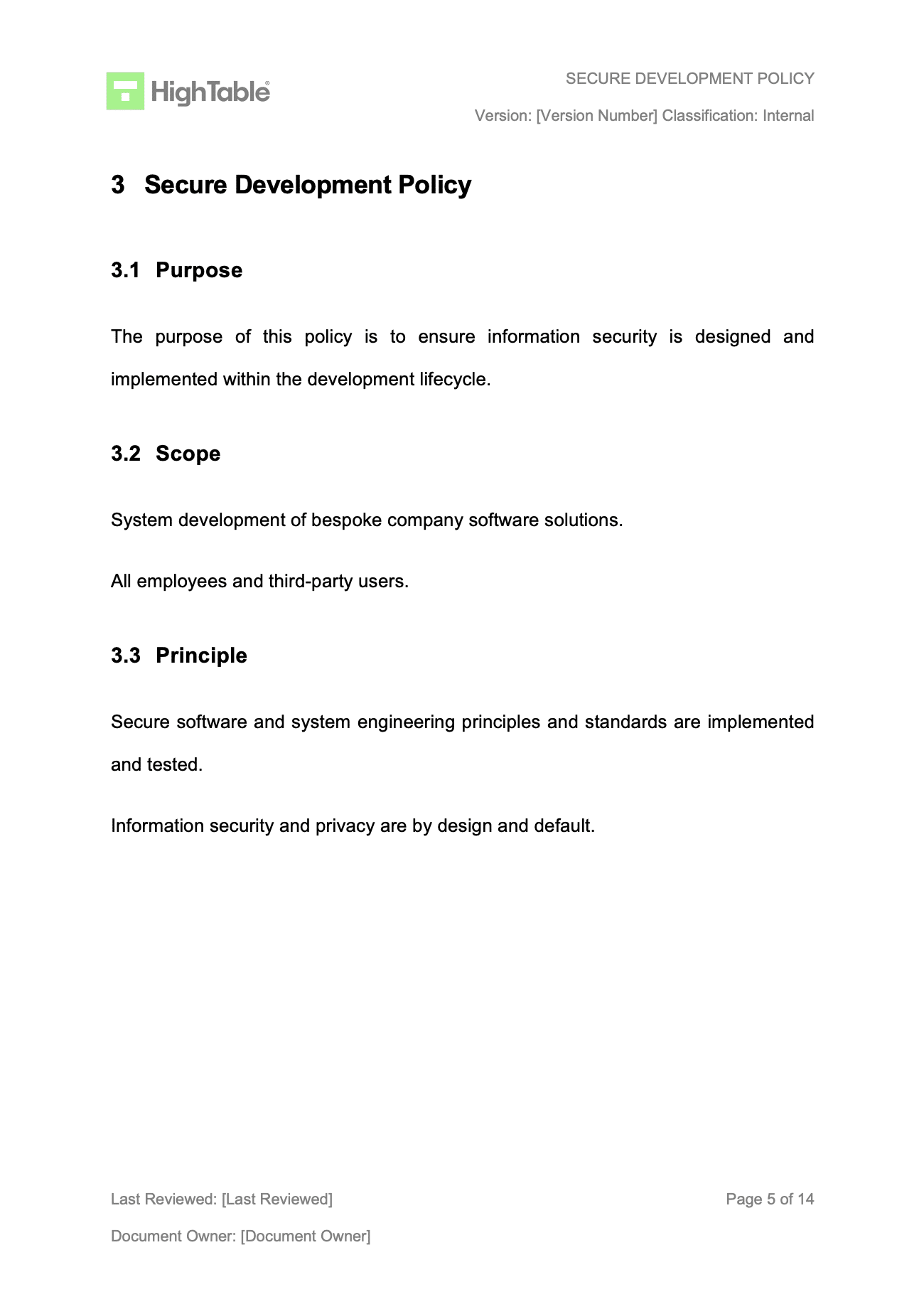
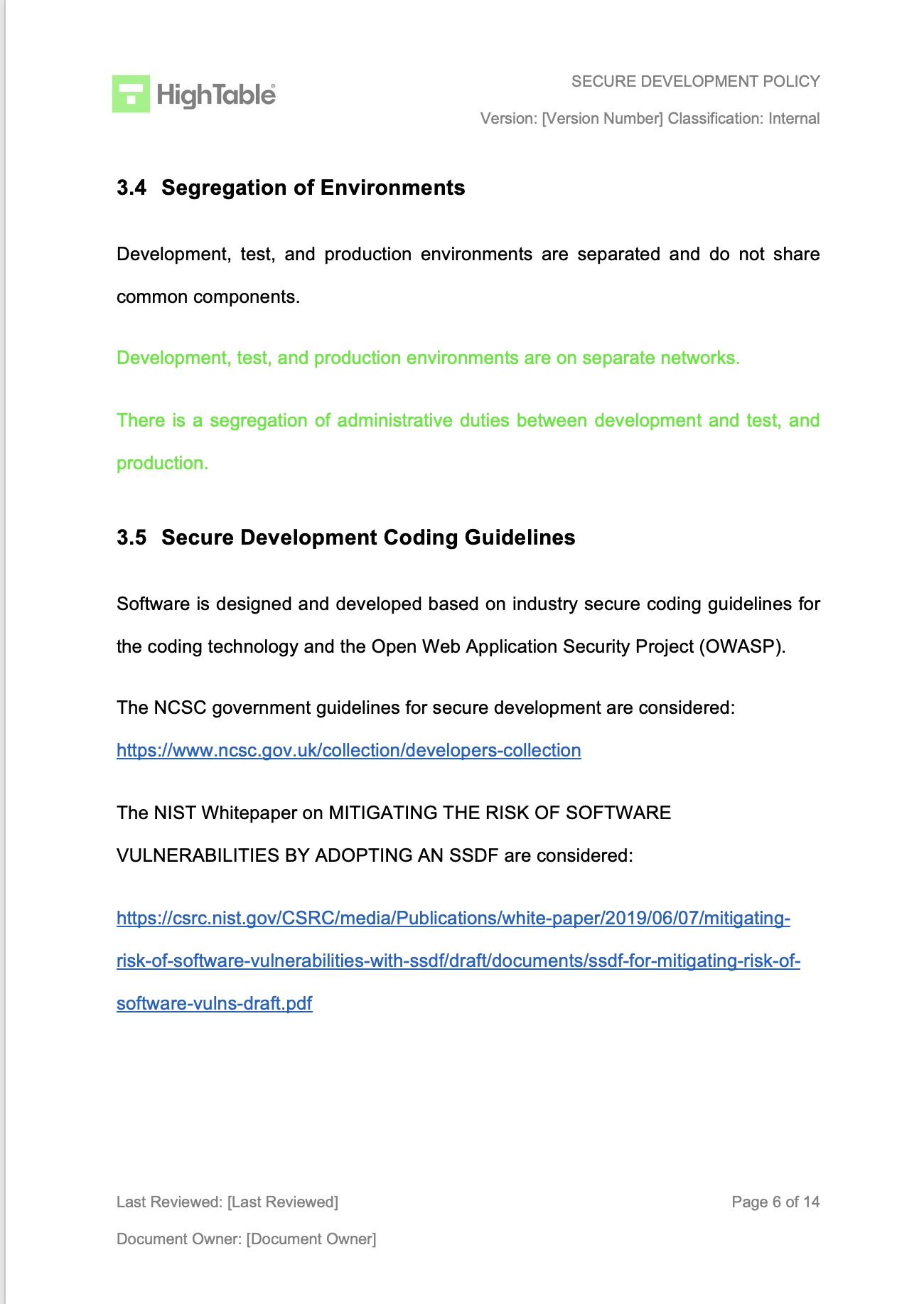
The secure development policy includes the approach to outsourced development.
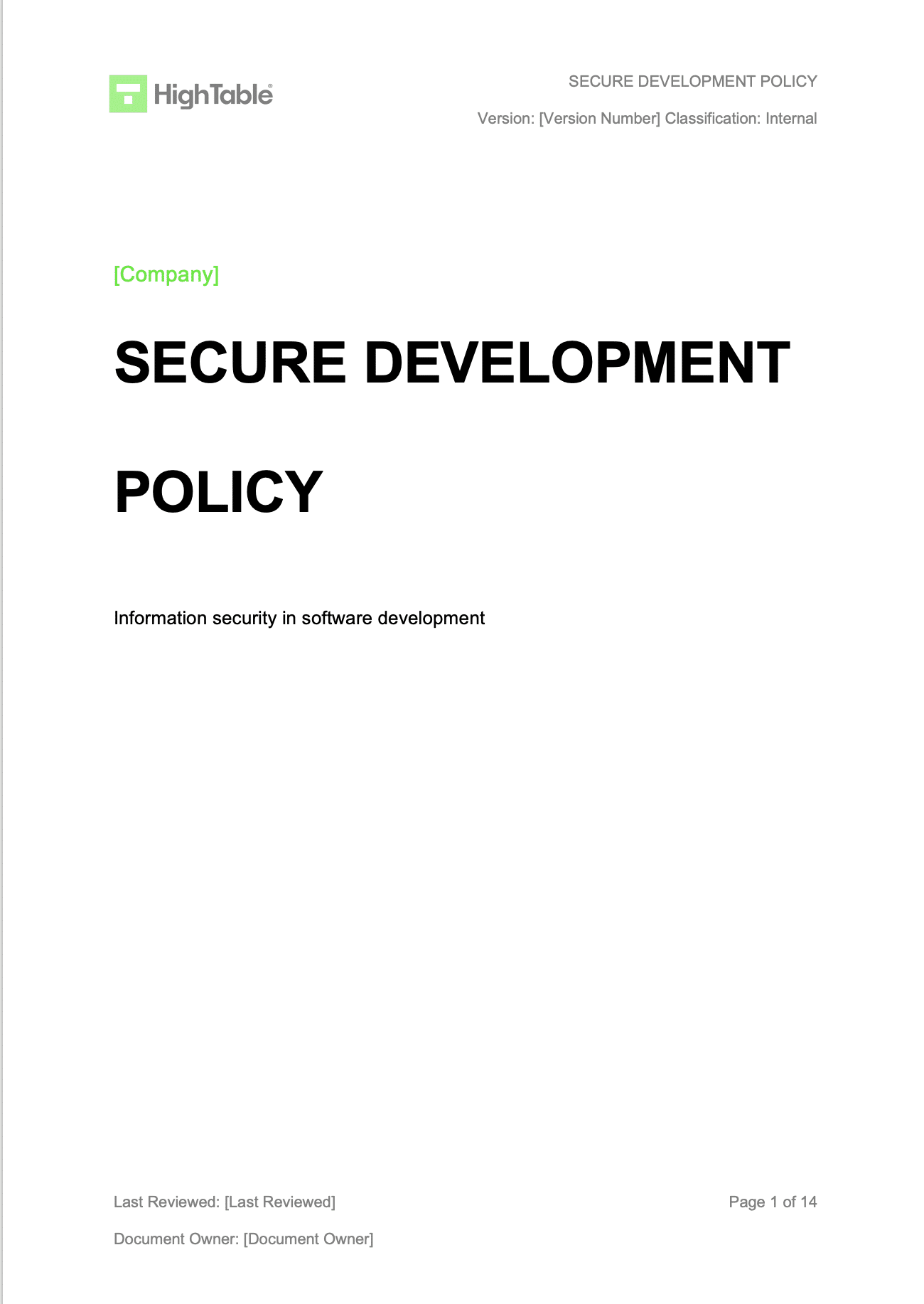
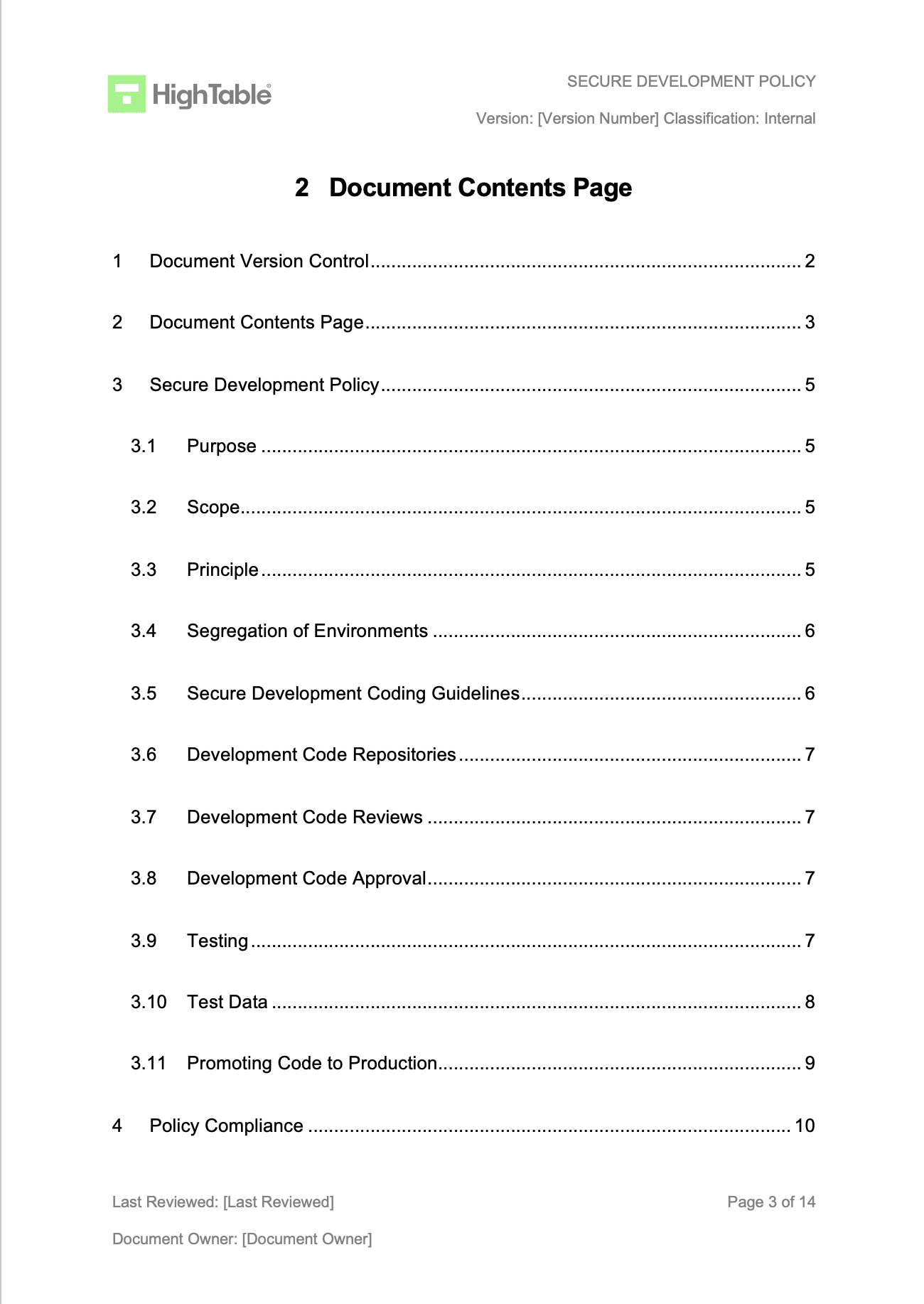
Secure Development Policy Example
An example of the ISO 27001 secure development policy.
How to implement ISO 27001 Annex A 8.30
1. Formalize Contractual Security Obligations
- Draft a Master Service Agreement (MSA) or Statement of Work (SOW) that explicitly mandates adherence to ISO 27001 secure coding standards.
- Incorporate Right-to-Audit (RTA) clauses and specific Service Level Agreements (SLAs) for vulnerability remediation timelines.
- Result: Establishing a legally binding baseline for security performance and accountability.
2. Standardize Secure Coding and SDLC Requirements
- Provide the external vendor with a documented Secure Software Development Life Cycle (SDLC) framework, including OWASP Top 10 mitigation strategies.
- Define technical requirements for input validation, cryptography, and error handling to be used throughout the development process.
- Result: Ensuring the delivered code is resilient against common web and application vulnerabilities.
3. Provision Granular Access Control via IAM and MFA
- Establish dedicated Identity and Access Management (IAM) roles for external developers with “Least Privilege” permissions.
- Enforce Multi-Factor Authentication (MFA) and utilize Zero Trust Architecture (ZTA) or encrypted VPNs for all development environment access.
- Result: Preventing unauthorized lateral movement within your infrastructure by third-party entities.
4. Validate Code Integrity via SAST and DAST
- Integrate Static Application Security Testing (SAST) and Dynamic Application Security Testing (DAST) tools into the CI/CD pipeline for all outsourced builds.
- Mandate manual peer reviews of external code by internal security architects before any merge to the main branch.
- Result: Identifying and neutralizing security flaws and “backdoors” before code enters production.
5. Execute Rigorous Acceptance Testing and Auditing
- Conduct User Acceptance Testing (UAT) in an isolated staging environment to verify that security controls function as specified.
- Perform independent penetration testing or vulnerability scans on the final deliverables prior to deployment.
- Result: Verifying that the final product meets all functional and security specifications of ISO 27001.
6. Secure Intellectual Property and Environment De-provisioning
- Implement automated scripts to revoke all vendor access tokens, SSH keys, and IAM credentials immediately upon project completion or termination.
- Ensure all intellectual property, including source code and documentation, is transferred to secure internal repositories.
- Result: Eliminating residual risk and “orphaned” accounts following the conclusion of the outsourced engagement.
If you outsource your development then the third party supplier controls will apply. The main thing is to ensure they meet your requirements for secure development but all relevant controls that apply to you, will apply to them.
Check Your Work?
You built it yourself. Maybe with AI. But will it pass the audit?
Don’t gamble – let an ISO 27001 Lead Auditor check your work.
Secure Development Policy Template
The secure development policy sets out your approach to outsourced and third party software development.
Supplier Security Policy Template
The supplier security policy sets our your approach to manage the security of third party suppliers including outsourced developers.

Supplier Register Template
The supplier register template records your third party suppliers including your outsourced developers.

ISO 27001 Annex A 8.30 Implementation Checklist
ISO 27001 Annex A 8.30 Outsourced Development Implementation Checklist:
1. Vendor Selection and Due Diligence
Conduct thorough due diligence on potential outsourced developers, assessing their information security posture, certifications (e.g., ISO 27001, SOC 2), and track record. Include security requirements in supplier selection criteria and RFPs.
Challenges: Limited vendor transparency, difficulty evaluating vendor claims.
Solutions: Third-party audits, detailed security questionnaires, reference checks.
2. Contractual Agreements
Include comprehensive security clauses in all contracts with outsourced development vendors, defining responsibilities, liabilities, and obligations related to information security.
Challenges: Negotiating strong contracts, enforcing contractual obligations.
Solutions: Legal counsel, regular contract reviews, dispute resolution mechanisms.
3. Information Sharing & Access Controls
Implementation: Establish secure procedures for sharing sensitive information with vendors, implement robust access controls, and utilise secure communication channels.
Challenges: Data breaches, insider threats.
Solutions: Data Loss Prevention (DLP) tools, security awareness training, background checks.
4. Data Protection & Privacy
Ensure compliance with relevant data protection regulations (e.g., GDPR) when sharing data with outsourced developers. Implement appropriate data protection measures, such as data masking and encryption.
Challenges: Meeting evolving data privacy regulations, ensuring vendor compliance.
Solutions: Data processing agreements, regular privacy impact assessments, ongoing supplier monitoring.
5. Incident Management
Establish clear incident reporting procedures, develop a joint incident response plan with vendors, and conduct regular incident response drills.
Challenges: Timely incident detection and response, coordination with vendors.
Solutions: Security Information and Event Management (SIEM) systems, automated incident response tools, clear communication procedures.
6. Physical and Environmental Security
Ensure that vendors maintain adequate physical and environmental security measures, including secure facilities, access controls, and environmental controls.
Challenges: Assessing and verifying vendor physical security measures.
Solutions: On-site audits, remote monitoring of security systems, third-party security assessments.
7. Human Resources Security
Ensure that vendors have robust HR security practices, including background checks, employee security training, and secure employee onboarding and off-boarding procedures.
Challenges: Ensuring compliance with vendor HR security practices.
Solutions: Contractual requirements, regular vendor assessments, third-party HR security audits.
8. System and Application Security
Ensure that vendors have robust systems and application security controls, including secure development practices, vulnerability management, and regular security testing.
Challenges: Assessing the security of complex systems and applications.
Solutions: Penetration testing, vulnerability assessments, code reviews, secure development lifecycle (SDLC) processes.
9. Business Continuity and Disaster Recovery
Ensure that vendors have business continuity and disaster recovery plans in place to minimise the impact of disruptions on outsourced services.
Challenges: Verifying the effectiveness of vendor BCP/DR plans.
Solutions: Business impact analysis, disaster recovery drills, regular review and updates of BCP/DR plans.
10. Continuous Monitoring & Improvement
Conduct regular security audits and assessments of outsourced development activities, monitor vendor performance against agreed-upon security controls and KPIs, and continuously improve security processes.
Challenges: Maintaining visibility into vendor security practices, resource constraints.
Solutions: Third-party audits, automated monitoring tools, regular review and improvement of security controls.
ISO 27001 Toolkit
Everything a business needs to do ISO 27001 and get ISO 27001 certified in the ISO 27001 Toolkit: Business Edition
ISO 27001 Annex A 8.30 Audit Checklist
ISO 27001 Annex A 8.30 Outsourced Development Audit Checklist
1. Outsourced Developer Management
Evidence that the guidance in the following was followed:
- ISO 27001 Annex A 5.19 Information Security In Supplier Relationships
- ISO 27001 Annex A 5.20 Addressing Information Security Within Supplier Agreements
- ISO 27001 Annex A 5.22 Monitor, Review And Change Management Of Supplier Services
2. Vendor Selection and Due Diligence
- Assess the process for selection the outsourced developer
- Review the due diligence that was carried out.
- Seek evidence of vendor security certifications and / or audits and / or questionnaires.
- Review a sample of supplier references.
3. Contractual Agreements
Check contracts in place and that they cover
- the products and services the organisation has aquired
- clauses for information security
Assess if contracts were reviewed and approved by legal counsel
Ensure that regular contractual reviews are in place and evidenced.
4. Information Sharing & Access Controls
Have secure procedures for sharing sensitive information with been establised.
Are access controls and user access lifecycle management in place.
5. Data Protection & Privacy
Ensure compliance with relevant data protection regulations (e.g., GDPR) when sharing data with outsourced developers is in place.
Walkthrough the processes and procedures.
6. Incident Management
Assess the incident management process and communication channels with the outsourced developer.
7. Physical and Environmental Security
Audit to ensure that the outsourced developers maintain adequate physical and environmental security measures, including secure facilities, access controls, and environmental controls.
8. Human Resources Security
With your HR team review if vendors have robust HR security practices, including background checks, employee training, and secure employee onboarding and off-boarding procedures.
Assess contracts for requirements.
9. System and Application Security
Walkthrough and asses that vendors have robust systems and application security controls, including secure development practices, vulnerability management, and regular security testing.
Seek evidence of penetration testing, vulnerability assessments, code reviews, secure development lifecycle (SDLC) processes.
10. Business Continuity and Disaster Recovery
Review the business continuity and disaster recovery plans and check that they minimise the impact of disruptions on outsourced services.
Assess the outsourced developers business impact analysis, disaster recovery plans, regular review and updates of BCP/DR plans.
11. Continuous Monitoring & Improvement
Check any security audits and assessments of outsourced development activities.
Review if there is a monitor of supplier performance against agreed-upon security controls and KPIs, and if they continuously improve security processes.
Conclusion
Many if not all of the controls that apply to this control are covered elsewhere. Be it the experience, licensing, technical controls but consider them in the context of this clause and be able to evidence them as they apply to outsourced development.
ISO 27001 Annex A 8.30 FAQ
Contracts must go beyond functionality and explicitly define security obligations and the right to audit. To comply with Control 8.30, your agreement should specify:
Secure Coding Standards: The vendor must follow specific guidelines (e.g., OWASP Top 10) to prevent vulnerabilities.
Testing Requirements: Mandating Static (SAST) and Dynamic (DAST) application security testing prior to delivery.
Right to Audit: Your organization’s right to review their code, architecture, or security logs.
Intellectual Property: Clarity on who owns the code and who is responsible for fixing security bugs discovered post-launch.
Monitoring must be active and evidence-based, occurring at milestones rather than just at final delivery. Effective supervision methods include:
Regular Code Reviews: Requesting access to the repository to spot-check code quality and security practices.
vCISO / Security Reviews: Having your security team review the proposed architecture before coding begins (Security by Design).
Testing Evidence: Requiring the vendor to submit reports from their vulnerability scans before you accept the software.
It applies strictly to custom development (outsourced coding), regardless of whether it is a freelancer or a large agency.
Freelancers/Agencies: Yes. If they are writing code specifically for you, Control 8.30 applies.
COTS (Commercial Off-The-Shelf): Generally No. Buying standard software (like Microsoft Office) falls under Supplier Relationships (5.19), specifically “Information security in supplier relationships,” rather than outsourced development.
Auditors will look for evidence that you managed the security risk, rather than just the timeline or budget. Expect questions such as:
“Show me the contract where you defined the security requirements for this project.”
“How did you verify the developer followed your secure coding guidelines?”
“Did you scan the delivered code for malware or vulnerabilities before deploying it to production?”
“Show me the acceptance criteria you used to sign off on the security of this release.”
Control 8.30 is specific to the creation of software, while Control 5.19 covers the general business relationship.
Annex A 5.19 (Supplier Relationships): Focuses on the contract, access management, and general service delivery (e.g., “Do they have ISO 27001 certification?”).
Annex A 8.30 (Outsourced Development): Focuses on the product being built (e.g., “Did they sanitize inputs to prevent SQL injection?” or “Did they remove hardcoded passwords?”).
Related ISO 27001 Controls
- ISO 27001 Monitoring, Measurement, Analysis, Evaluation: Clause 9.1
- ISO 27001 Secure Systems Architecture and Engineering Principles: Annex A 8.27
- ISO 27001 Security Testing in Development and Acceptance: Annex A 8.29
Further Reading
- ISO 27001 Supplier Register Beginner’s Guide
- ISO 27001 Secure Development Policy Template
- ISO 27001 Patch Management Policy Beginner’s Guide
About the author