
In this guide you will learn how to implement ISO 27001 Annex A 8.16 Monitoring Activities and pass your audit from ISO 27001 Lead Auditor Stuart Barker – author of the ultimate ISO 27001 Toolkit.
ISO 27001 Annex A 8.16 Monitoring is an ISO 27001 control that requires to check for inappropriate actions on networks, systems, applications and premises. It is about checking before the bad things happen to try to catch them.
Table of contents
Key Takeaways
- ISO 27001 Annex A 8.16 mandates that organisations monitor their networks, systems, and applications for “anomalous behaviour.”
- Unlike passive logging, monitoring is an active process designed to detect potential security incidents in real-time.
- The goal is to catch unauthorised actions or system failures before they result in a full-scale data breach.
Purpose & Definition
ISO 27001 Annex A 8.16 is a detective control and corrective control to detect anomalous behaviour and potential information security incidents..
The ISO 27001 standard defines ISO 27001 Annex A 8.16 as:
Networks, systems and applications should be monitored for anomalous behaviour and appropriate actions taken to evaluate potential information security incidents.

White Label
ISO 27001 for Consultants
Custom-brandable ISO 27001 documentation for consultants. Easily rebrand, reduce project time, and deliver professional, high-value security systems. Focus on delivery, not drafting.
FREE ISO 27001 Annex A 8.16 Training Video
In this free training video you will learn How to implement ISO 27001 Monitoring Activities (Annex A 8.16) and Pass Your Audit
ISO 27001 Annex A 8.16 Requirements and Guidance
Identify Requirements
Identify what requirements you have for monitoring so that you can understand what you need to implement.
This is going to be based on the risk assessments that you have conduct and the needs of the business and your clients.
Consider that we use monitoring to catch things either before or as they are happening and to support investigations if things do happen.
Logging and Monitoring Policy Template
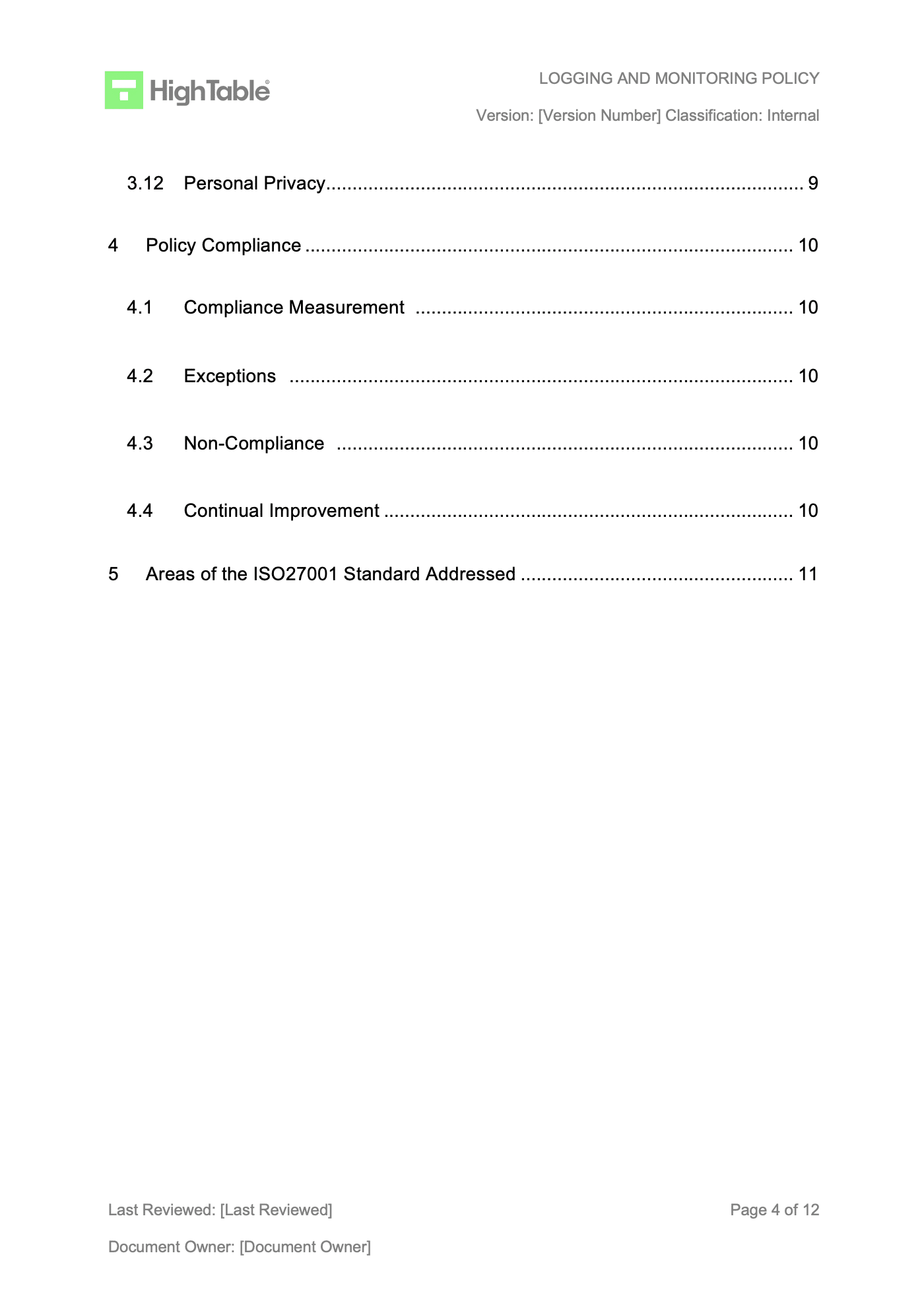
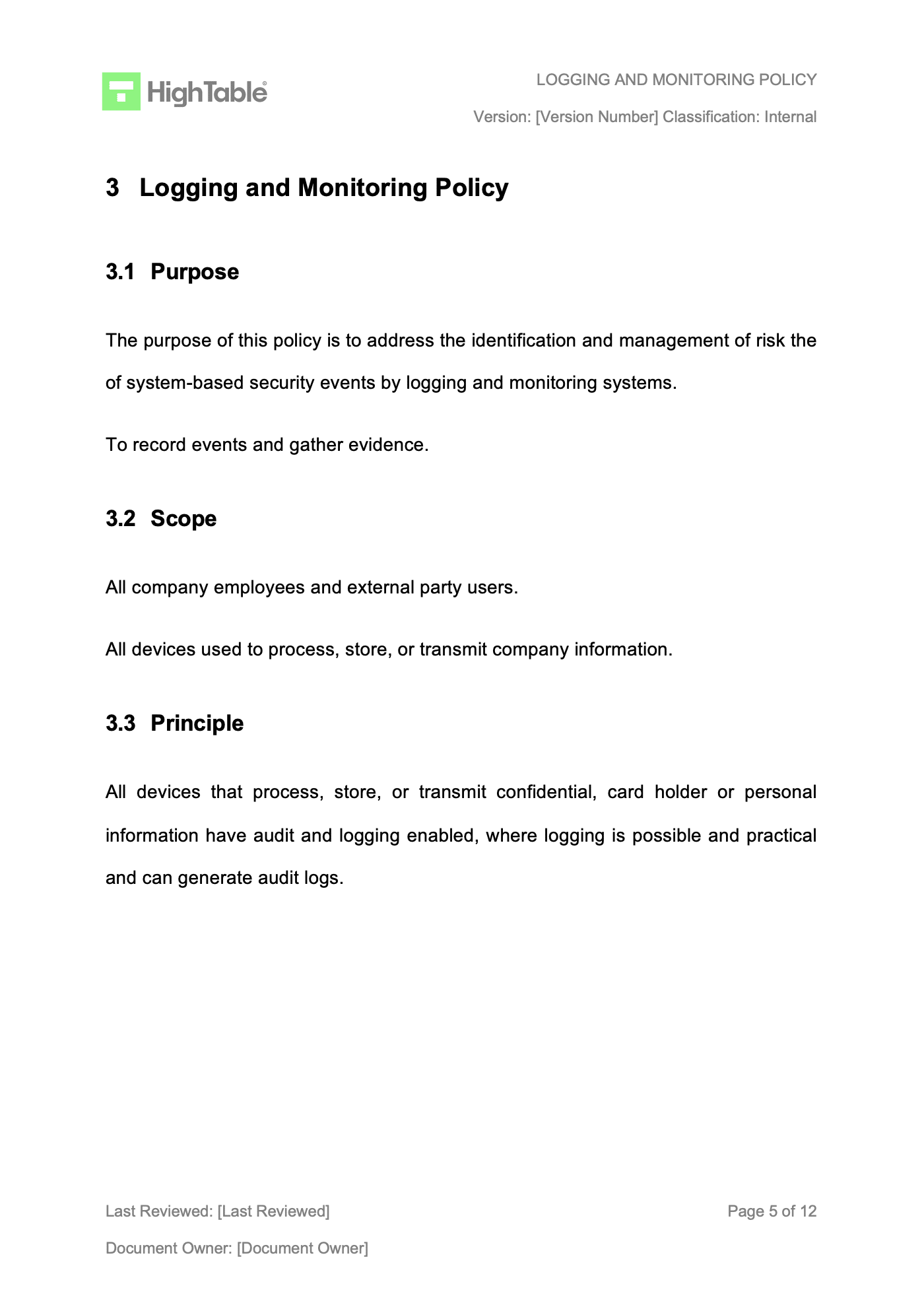
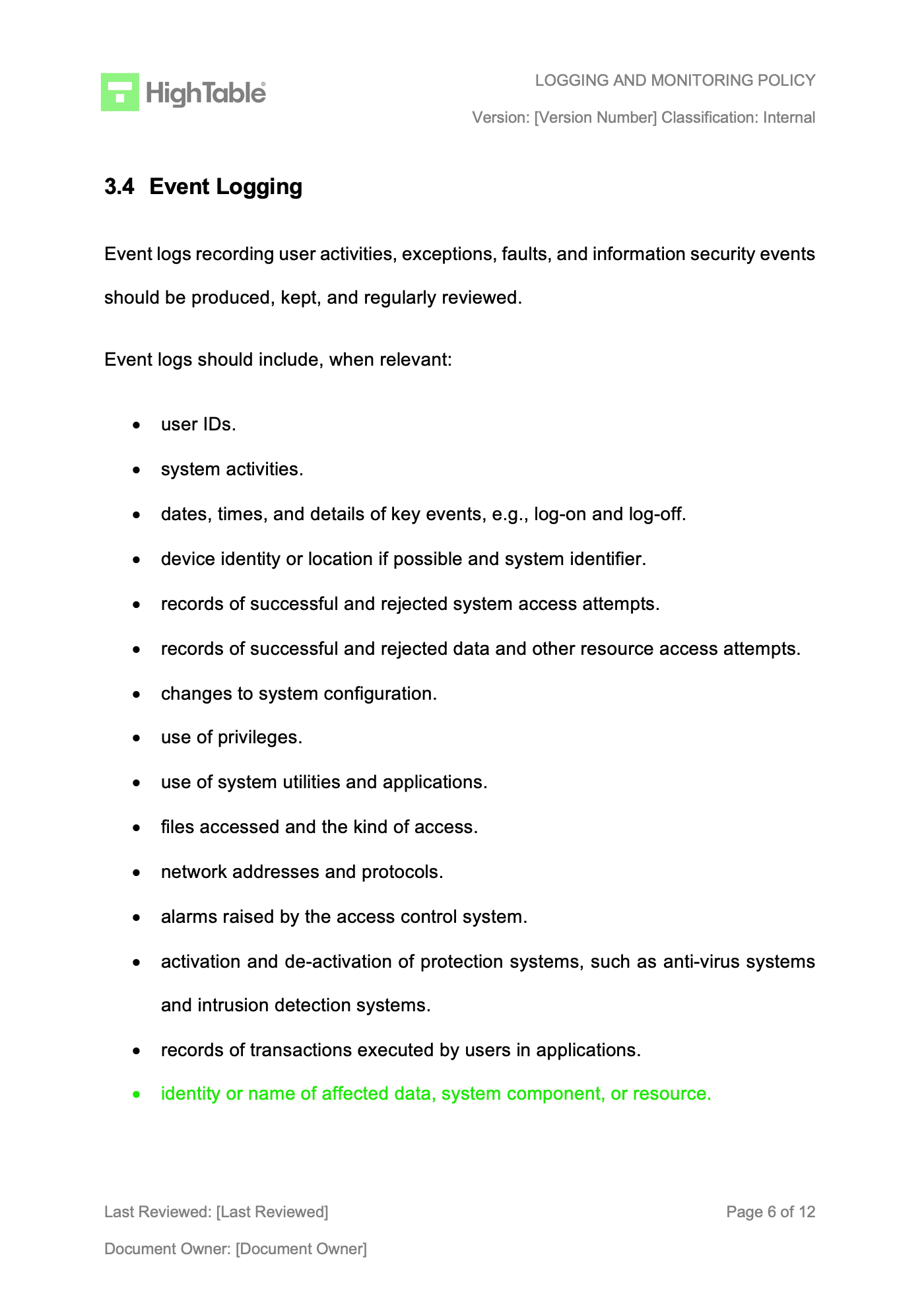
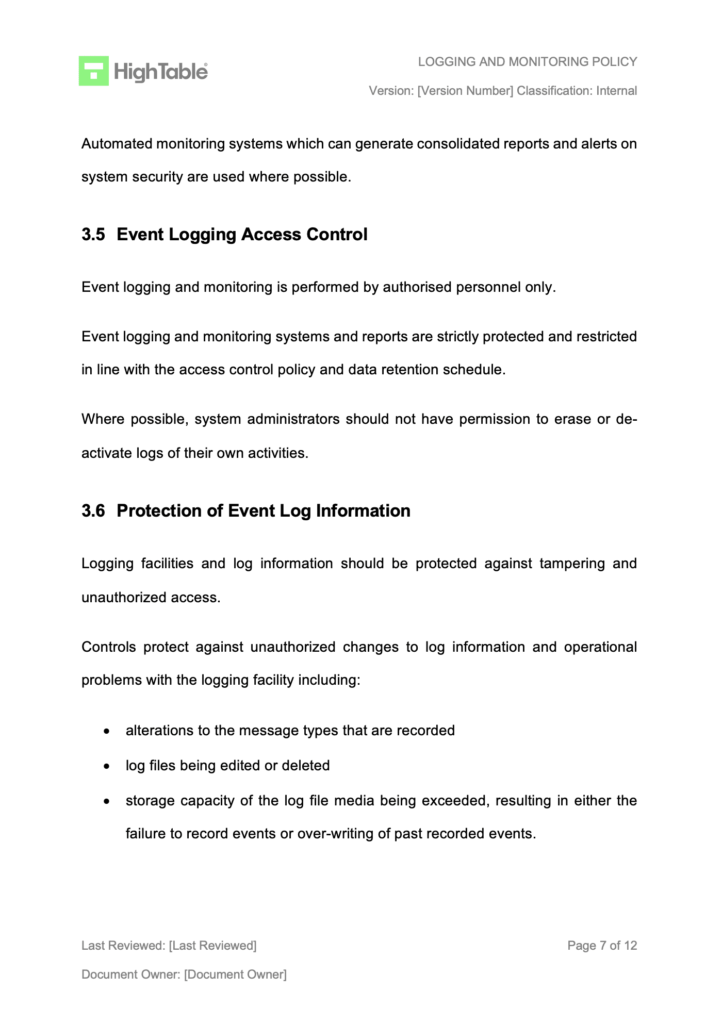
You will have a topic specific policy, the ISO 27001 Logging and Monitoring Policy that sets out what you do for logging and monitoring.
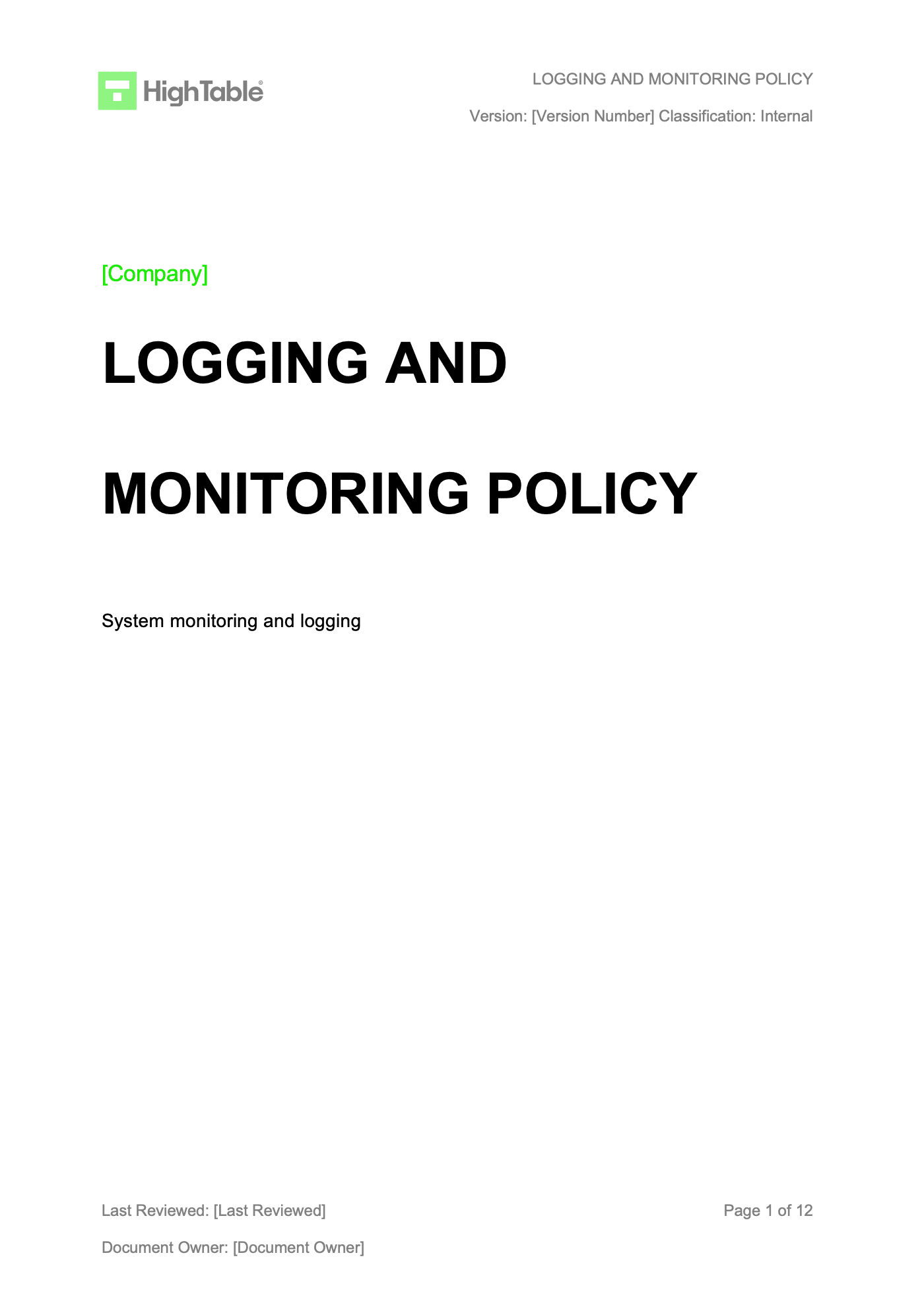
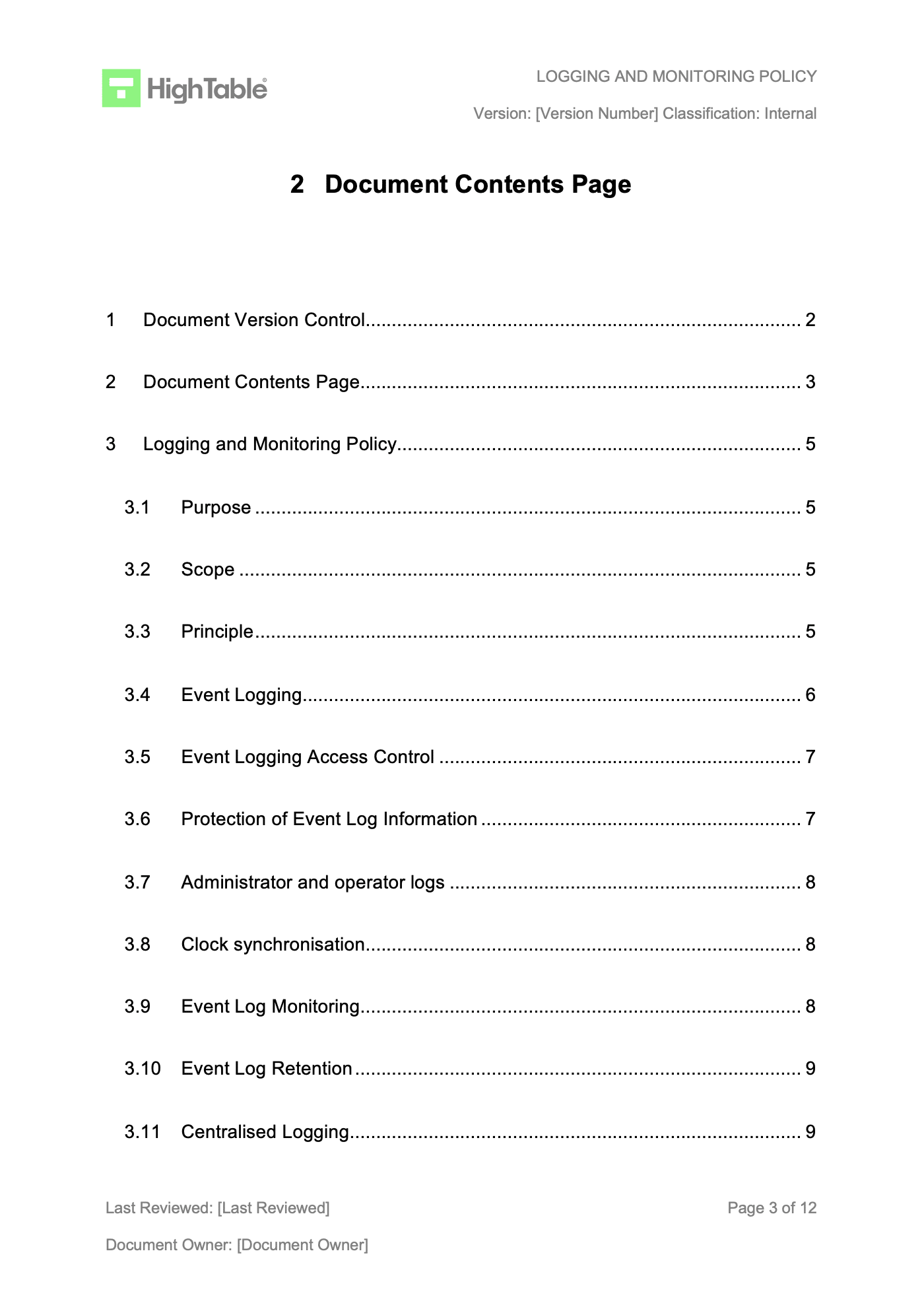
Logging and Monitoring Policy Example
An example of the ISO 27001 Logging and Monitoring Policy.
Monitoring Records
As with all logs and data you will need to define a data retention schedule for your monitoring records and put in place appropriate safeguards, protections and information security controls, as with any other data.
What to monitor
What you monitor is down to you and your identification of requirements but the standard provides some guidance on typical things that can be monitored being:
- Traffic that is inbound and outbound
- Access to resources
- Critical configuration files
- Security Tools Logs
- Event Logs
- Use of resource
Anomalous behaviour
Our monitoring is looking for behaviour outside the norm. Examples include:
- Processes or applications that just stop, or restart
- Malware traffic
- Unusual system behaviour
- Bottlenecks or spikes in resource usage
- Unauthorised scans of systems and networks
- Access attempts on restricted resources
Ensure You Meet the Law
Monitoring is potentially dangerous when it comes to law and regulation, in that it can contain information and data protected by data protection laws and others. It is important to ensure that what you have and what you do complies. This is includes all steps of the process and lifecycle. It is recommended to get the advice of legal and data protection professionals in terms of your particular deployment.
Monitoring Tools
The use of monitoring tools is clearly recommended. Some of these are built into to systems and operating systems and some are off the shelf, dedicated solutions. It maybe that you have a hybrid of tools. They need to be able to handle large volumes of information and include real time notifications. Alerts should be configured and implemented and set against pre defined thresholds.
Monitoring is usually done be specialist software with examples being Host Intrusion Detection Systems (HIDS) or Network Intrusion Detection Systems (NIDS).
Staff
Staff will be trained to be able to use tools and interpret the information and appropriately respond. This can include the management of false positives, which do happen.
Continuous Monitoring
The standard advocates for continuous monitoring, in real time or at periodic intervals.
Key Monitoring Triggers
| Event Type | Priority | Why Monitor? |
| Failed Logins | High | Brute force attack indicator. |
| Privilege Escalation | Critical | User suddenly becoming Admin. |
| Malware Detection | Critical | Anti-virus actually catching something. |
| After-Hours Access | Medium | Login at 3 AM (could be compromised account). |
Check Your Work?
You built it yourself. Maybe with AI. But will it pass the audit?
Don’t gamble – let an ISO 27001 Lead Auditor check your work.
How to implement ISO 27001 Annex A 8.16
Establishing a robust monitoring framework is essential for detecting security anomalies, verifying system performance, and ensuring the continuous integrity of information assets. By following these technical implementation steps, your organisation can align with ISO 27001 Annex A 8.16 requirements to create a proactive and auditable security posture.
1. Formalise a Monitoring Strategy and Rules of Engagement
- Document a formal monitoring policy that defines the scope of activities, including system logs, user access patterns, and network traffic anomalies.
- Establish a Rules of Engagement (ROE) document that outlines the legal and privacy boundaries for monitoring employee activities to ensure compliance with the UK GDPR.
- Result: A legally sound governance framework that dictates exactly what, when, and how systems are monitored within the organisation.
2. Provision a Centralised SIEM and Logging Infrastructure
- Deploy a centralised Security Information and Event Management (SIEM) platform to aggregate logs from applications, servers, and network devices.
- Configure log ingestion pipelines to capture critical events, such as failed authentication attempts, privilege elevations, and changes to system configurations.
- Result: A unified “single pane of glass” view that enables the correlation of disparate events to identify complex multi-stage attacks.
3. Restrict Log Access via Granular IAM Roles and MFA
- Implement the Principle of Least Privilege by assigning specific Identity and Access Management (IAM) roles to security analysts and system auditors.
- Mandate Multi-Factor Authentication (MFA) for accessing monitoring consoles and log repositories to prevent unauthorised tampering or deletion of evidence.
- Result: Assurance that log data remains immutable and accessible only to verified personnel, maintaining the integrity of the audit trail.
4. Execute Real-Time Alerting and Baseline Configuration
- Establish baseline “normal” activity patterns for network traffic and system performance to facilitate the detection of statistically significant deviations.
- Provision automated alerting rules within the SIEM to notify the Security Operations Centre (SOC) immediately upon the detection of high-risk indicators of compromise (IoCs).
- Result: Reduced Mean Time to Detect (MTTD) by ensuring that critical security incidents are flagged for human review in real time.
5. Implement Cryptographic Hashing for Log Integrity
- Utilise cryptographic hashing (e.g. SHA-256) and digital signatures on log files to detect any unauthorised modifications at rest.
- Store logs on write-once-read-many (WORM) storage media or in an isolated “Security Account” in the cloud to prevent log wiping by advanced persistent threats.
- Result: A forensically sound record of system activities that remains admissible in legal proceedings or regulatory audits.
6. Perform Periodic Monitoring Reviews and Capability Audits
- Conduct quarterly technical reviews of monitoring rules and alert thresholds to ensure they remain effective against evolving threat landscapes.
- Revoke or update monitoring access for personnel whose roles have changed, ensuring that the “four-eyes” principle is maintained for sensitive data access.
- Result: A dynamic monitoring environment that evolves alongside organisational changes and new security vulnerabilities.
ISO 27001 Templates

How to pass the ISO 27001 Annex A 8.16 audit
To comply with ISO 27001 Annex A 8.16 you are going to implement the ‘how’ to the ‘what’ the control is expecting. In short measure you are going to:
- Understand and record the legal, regulatory and contractual requirements you have for data
- Conduct a risk assessment
- Based on the legal, regulatory, contractual requirements and the risk assessment you will implement a monitoring solution
- Implement a topic specific policy, the ISO 27001 Logging and Monitoring Policy
- Document and implement your processes and technical implementations for monitoring
- Check that the controls are working by conducting internal audits
What will an auditor check?
The audit is going to check a number of areas. Lets go through the main ones
1. That you have documentation
What this means is that you need to show that you have documented your legal, regulatory and contractual requirements for information and that you have taken this into account when building your monitoring solution. Where data protection laws exist that you have documented what those laws are and what those requirements are. That you have an information classification scheme and a topic specific policy for access control and that you have documented your monitoring taking all of this into account.
2. That you have have implemented monitoring appropriately
They will look at systems to seek evidence of monitoring. They want to see evidence of monitoring and the process in operation that includes the analysis of the monitoring data and what you do as a result of that analysis. In addition the use of cloud services and the cloud providers monitoring and monitoring capabilities will be reviewed.
3. That you have conducted internal audits
The audit will want to see that you have tested the controls and evidenced that they are operating. This is usually in the form of the required internal audits. They will check the records and outputs of those internal audits.
Top 3 mistakes and how to avoid them
In my experience, the top 3 mistakes people make for ISO 27001 Annex A 8.16 monitoring are
1. You collect too much
Collecting too much data and logging everything is a common mistake we see. That in conjunction with storing all logs for ever. It is easy to be overwhelmed with information so it is important to work out what you are going to log and why. Then to be sure that the information is valuable, can be analysed and that analysis is actionable.
2. You don’t know your legal obligations
This is a massive mistake that we see, where people assume ISO 27001 is just information security and forget that it also checks that appropriate laws are being followed, and in particular data protection laws. Cost saving by not having a data protection expert or ignoring data protection law entirely is a common mistake we see people make when cutting corners and saving costs. Monitoring and in particular personal information, can get you in a lot of hot water depending how you implement it.
3. Your document and version control is wrong
Keeping your document version control up to date, making sure that version numbers match where used, having a review evidenced in the last 12 months, having documents that have no comments in are all good practices.
ISO 27001 Annex A 8.16 FAQ
Logging is the passive collection of data, while Monitoring is the active review and analysis of that data.
Many organizations confuse these two controls. You cannot have effective monitoring without logging, but you can have logging without monitoring (which is useless for immediate defense).
Annex A 8.15 (Logging): Records history. Example: A security camera recording to a hard drive in a basement.
Annex A 8.16 (Monitoring): Analyzes the present. Example: A security guard watching the live camera feed to spot an intruder.
You should monitor high-risk activities that deviate from your established baselines, focusing on the “Red Flags” of digital security.
It is impossible and counter-productive to monitor everything. Focus your alerts on indicators of compromise (IoCs) and critical system health metrics.
Inbound/Outbound Traffic: Large data transfers (potential exfiltration) or connections to known malicious IP addresses.
Access Control: Failed login attempts, after-hours access, or access to sensitive files by unauthorized personnel.
System Integrity: Unexpected modification of critical configuration files or installation of unauthorized software.
Resource Usage: Sudden spikes in CPU or memory usage that could indicate malware or crypto-jacking.
No, ISO 27001 does not mandate specific expensive tools; it mandates effective processes suitable for your risk level.
While a Security Information and Event Management (SIEM) tool is excellent for large enterprises, smaller organizations can achieve compliance using built-in cloud tools (like AWS CloudWatch or Azure Monitor) or open-source solutions, provided the review process is rigorous.
Small Business: Native logs from firewalls/antivirus + daily manual review + automated email alerts for critical errors.
Enterprise: Centralised SIEM with automated correlation, machine learning, and 24/7 SOC monitoring.
Key Requirement: Proof that alerts are generated, reviewed, and acted upon.
Auditors will look for evidence of “Actionable Analysis”—they want to see that you actually noticed and responded to an alert.
Having terabytes of logs is irrelevant if nobody looks at them. The auditor will ask for a “paper trail” from trigger to resolution.
The Trigger: Can you show an alert that fired in the last 3 months?
The Response: Is there a ticket or log entry showing who investigated it and what they did?
The Tuning: Have you adjusted your thresholds to reduce false positives?
Ownership typically lies with the Head of IT or the Security Operations Center (SOC) team, but the responsibility is shared.
System Administrators: Responsible for configuring the tools to generate the right logs.
Security Analysts: Responsible for interpreting the alerts and investigating anomalies.
Management: Responsible for defining the risk appetite (e.g., “We need to know immediately if X happens”).
Related ISO 27001 Controls
Further Reading
- Business Continuity Incident Action Log Template
- ISO 27001 Logging and Monitoring Policy Beginner’s Guide
- ISO 27001 Incident and Corrective Action Log Template
About the author
