
In this guide you will learn how to implement ISO 27001 Annex A 8.13 Information Backup and pass your audit from ISO 27001 Lead Auditor Stuart Barker – author of the ultimate ISO 27001 Toolkit.
ISO 27001 Annex A 8.13 Information Backup is an ISO 27001 control that requires an organisation to create and test backups of data, software and systems.
Table of contents
Key Takeaways
- ISO 27001 Annex A 8.13 requires organizstions to maintain backup copies of information, software, and systems and to test them regularly.
- Its primary purpose is to ensure you can recover from data loss, system failure, or a ransomware attack.
- Backups are your ultimate “Safety Net,” but the standard emphasises that a backup you haven’t tested is not a backup at all.
Purpose & Definition
ISO 27001 Annex A 8.13 is corrective control that is to enable recovery from loss of data or systems.
The ISO 27001 standard defines ISO 27001 Annex A 8.13 as:
Backup copies of information, software and systems should be maintained and regularly tested in accordance with the agreed topic-specific policy on backup. – ISO 27001:2022 Annex A 8.13 Information Backup

White Label
ISO 27001 for Consultants
Custom-brandable ISO 27001 documentation for consultants. Easily rebrand, reduce project time, and deliver professional, high-value security systems. Focus on delivery, not drafting.
FREE ISO 27001 Annex A 8.13 Training Video
In this free training video you will learn How to implement ISO 27001 Information Backup (Annex A 8.13) and Pass Your Audit.
ISO 27001 Annex A 8.13 Requirements and Guidance
You are going to have to ensure that you:
- Implement a topic specific policy for information backup
- Identify the information that you want to protect
- Classify the information that you want to protect
- Implement controls to protect the information based on risk, classification and business need
- keep records
- Test the controls that you have to make sure they are working
There are several approaches to information backup and the most common is to implement a backup tool.
Backup Policy
The backup policy is a specific document that is covered in detail in the Beginner’s Guide to the ISO 27001 Backup Policy.
In summary it sets out the organisations approach to backups and ensures that adequate processes and procedures are in place as well as regular testing of the backup so that we can be sure that when the time comes and if we need it, we can recover it.
ISO 27001 Backup Policy Template
The ISO 27001 Back Up Policy Template is designed to fast track your implementation and give you an exclusive, industry best practice policy template that is pre written and ready to go. It is included in the ISO 27001 toolkit.
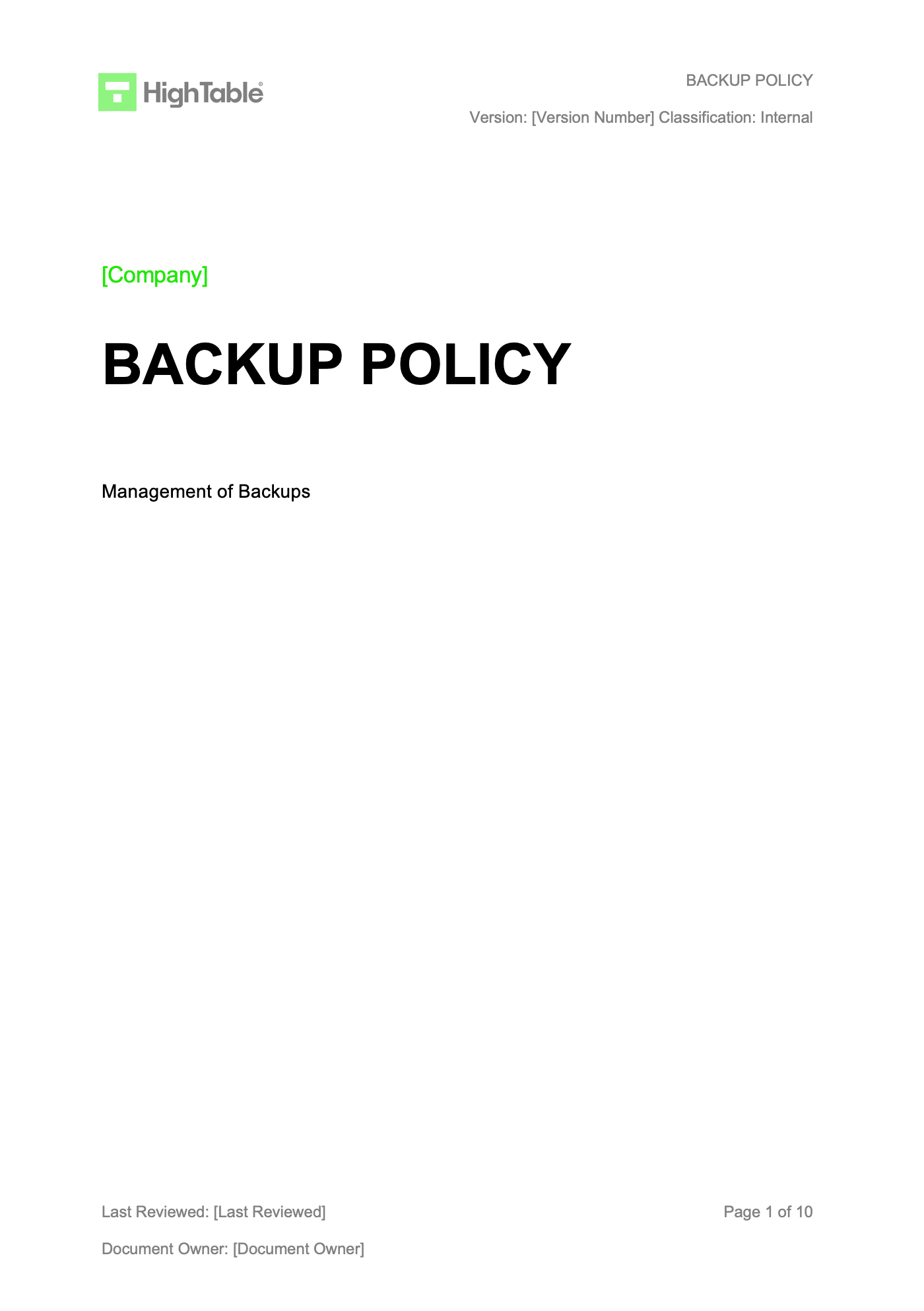
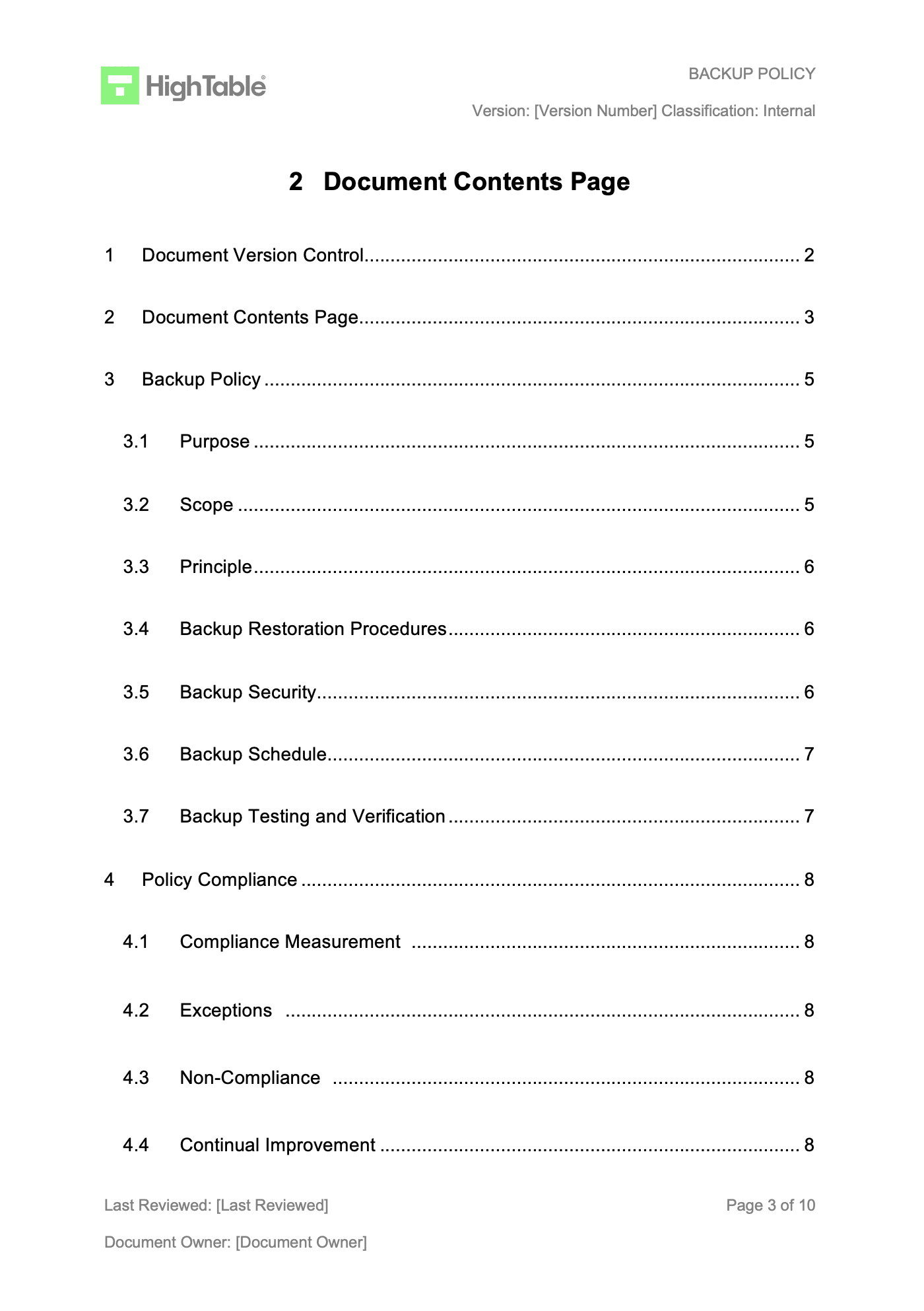
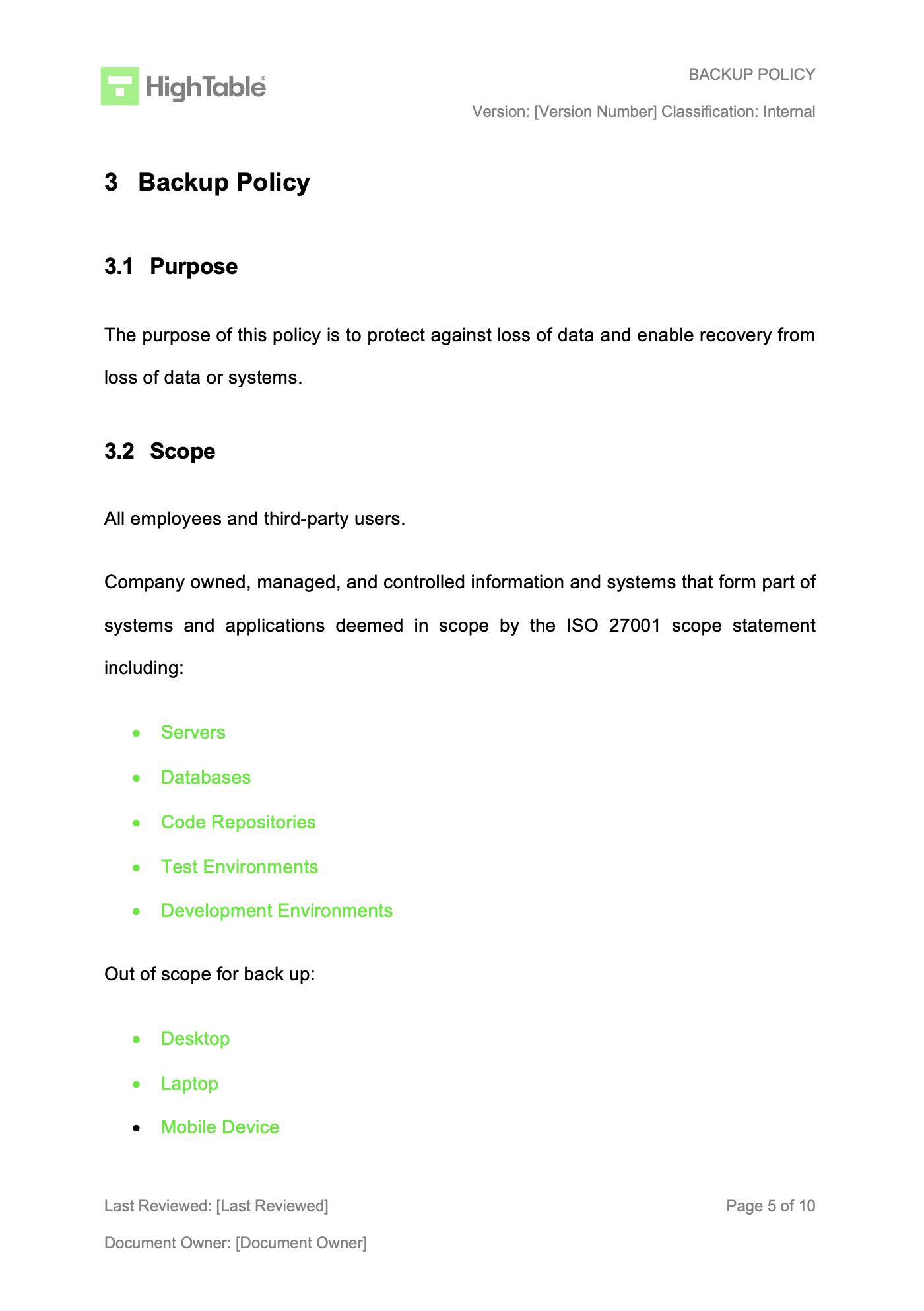
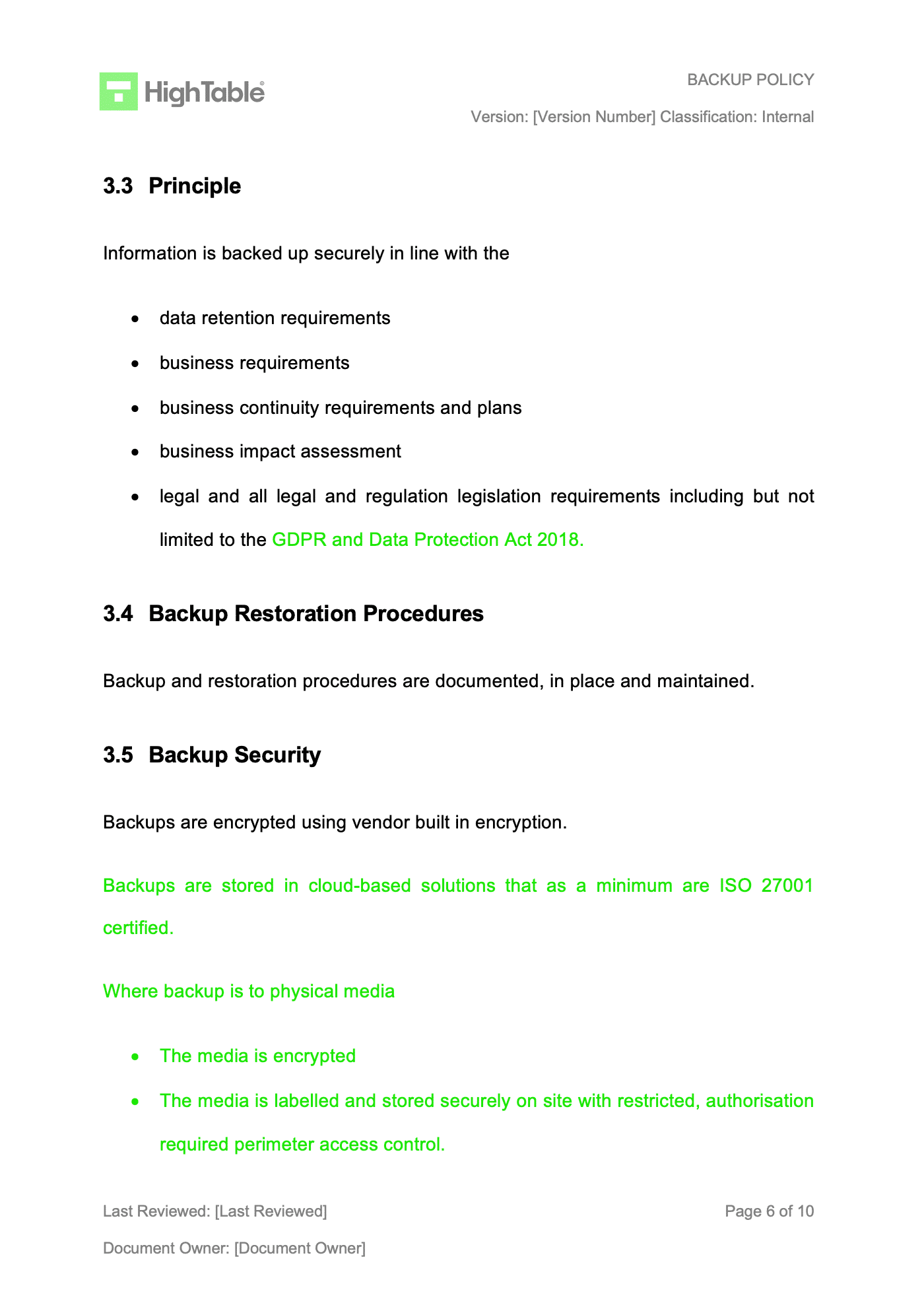
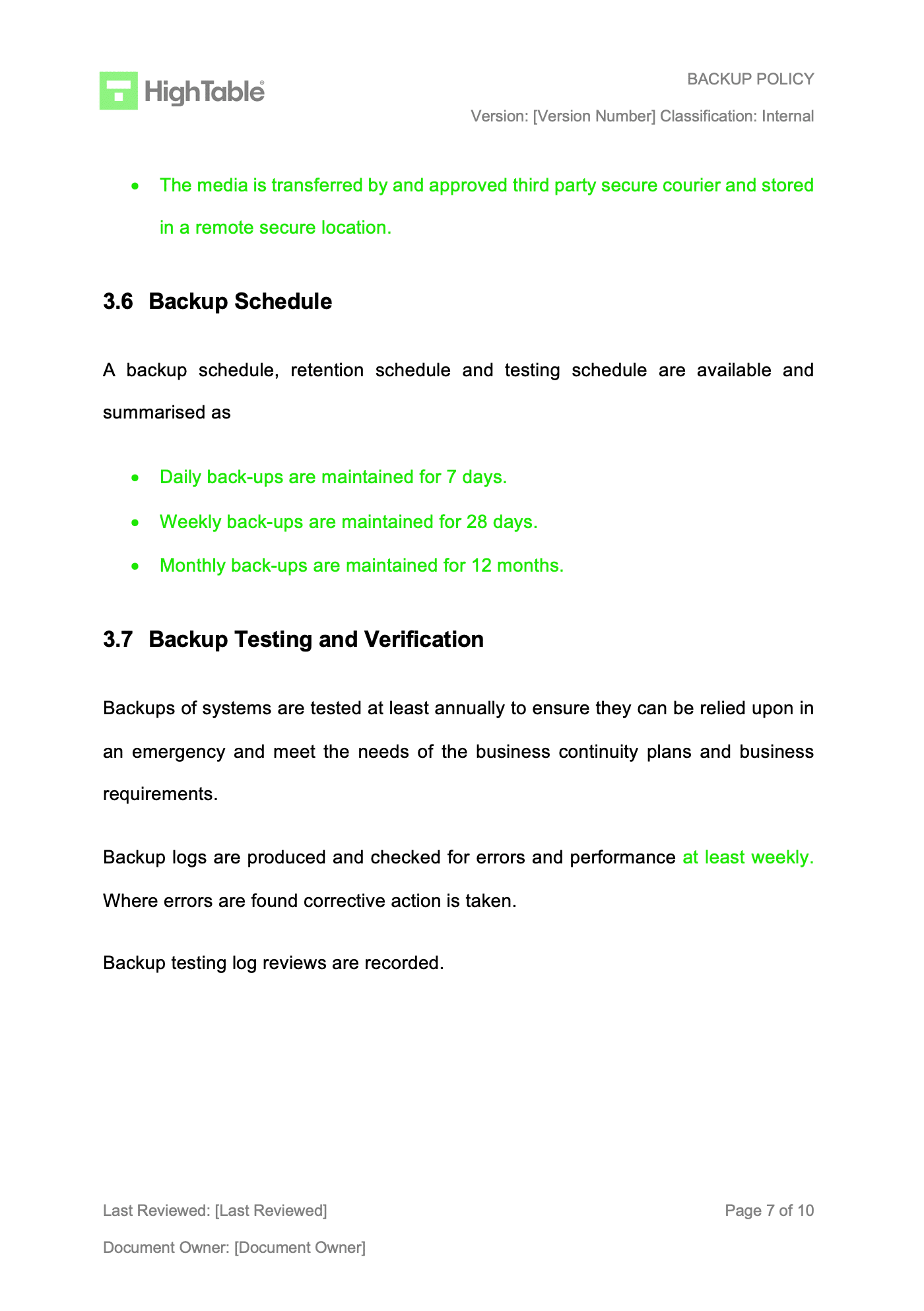
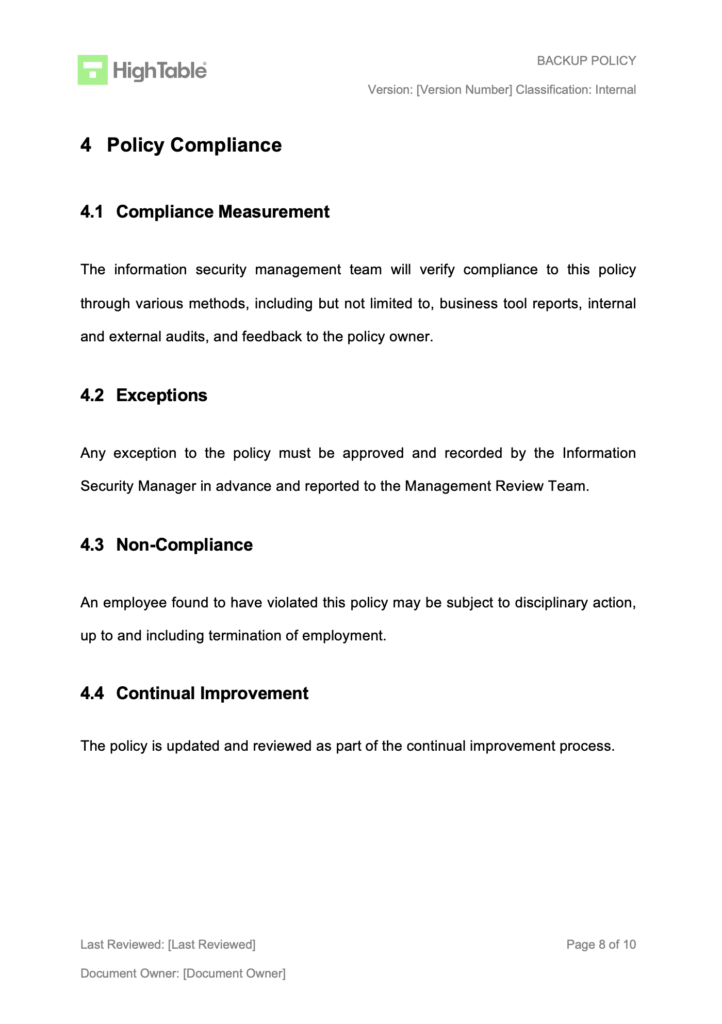
Backup Policy Example
An example of the ISO 27001 Backup Policy.
Identify Backup Requirements
The best way to identify the backup requirements is to conduct a business impact assessment (BIA). The BIA will identify and prioritise your critical systems and data and will provide you with time scales for how quickly they should be recovered. This in turn will inform your approach to backups and the scheduling of backups.
Implement Backup Technology
There are many types of backup technology and you should implement the one that is appropriate to you. The standard is hung up on old fashioned tapes and storing them in remote locations but any technology solution can work, especially with the prevalence of cloud based storage. The things to consider here are both the encryption of the backup and the legal and regulatory requirements placed on data.
Encrypt backups
Backups should always be encrypted and is often built into any off the shelf backup solution.
Backups and the law
This is an area where you are going to need some legal advice. The main issues here come around data protection and in particular the GDPR and relate directly to the right to be forgotten and information deletion. Backups are one area that can get you in hot water if you are unable to meet the demands and requirements of the laws and regulations.
Set Backup Retention Schedules
The backup retention schedules are driven by the needs of the business and the laws and regulations that apply to it. Using the business impact assessment (BIA) is a good starting point for working out the schedule as is reverting to client contracts and client requirements.
Test Backups
The backups that you make should be tested. It is pointless to back things up securely and when the time comes to recover the data find out that you cannot, in fact, recover the data. Have a process of regular backup testing that gives you the confidence that you can recover from backup should the need arise.
Business Continuity Templates
The business continuity templates include the approach for, and use of, backups.
Common Log Retention Schedule
| Log Type | Retention Period | Primary Reason |
| Firewall / Network Logs | 12 Months | Forensic history & industry standards (PCI-DSS). |
| User Access / Login Logs | 12 Months | Investigating unauthorized access attempts. |
| Antivirus / Security Alerts | 12 Months | Identifying recurring malware trends. |
| System Error Logs | 3 Months | Technical troubleshooting (lower security risk). |
How to implement ISO 27001 Annex A 8.13
Implementing a robust information backup framework is vital for ensuring data resilience and enabling rapid recovery following a security incident or system failure. By following these technical steps, your organisation can align with ISO 27001 Annex A 8.13 requirements to protect the availability and integrity of critical information assets.
1. Formalise a Backup Policy and Retention Schedule
- Identify and categorise all critical data sets, specifying the required frequency of backups based on business impact and data volatility.
- Define clear retention periods that comply with legal obligations, such as the UK GDPR, and document the “Rules of Engagement” (ROE) for data restoration.
- Result: A documented governance baseline that ensures consistent protection across all physical and cloud-based environments.
2. Provision Immutable and Off-site Storage Solutions
- Deploy the “3-2-1” backup strategy by maintaining three copies of data on two different media types, with at least one copy stored off-site or in an isolated cloud region.
- Utilise “Immutable Storage” or Object Lock features to prevent backup files from being modified or deleted by ransomware and malicious insiders.
- Result: Increased resilience against catastrophic events and targeted data destruction attacks.
3. Restrict Backup Access via Granular IAM and MFA
- Enforce the Principle of Least Privilege by assigning specific Identity and Access Management (IAM) roles to backup administrators, separating them from standard system admins.
- Mandate Multi-Factor Authentication (MFA) for all access to backup consoles and storage APIs to mitigate the risk of account takeover.
- Result: A hardened backup infrastructure where unauthorised users are blocked from compromising the last line of defence.
4. Execute End-to-End Cryptographic Protection
- Provision AES-256 bit encryption for all backup data at rest and ensure that TLS 1.3 is utilised for all data in transit to storage repositories.
- Establish a secure key management process to ensure that decryption keys are stored separately from the backup data they protect.
- Result: Assurance that backup media remains unreadable and secure even if physically or logically intercepted.
5. Automate Continuous Monitoring and Success Verification
- Configure automated alerts and reporting to notify the technical team of any backup failures or partial completions in real time.
- Integrate backup telemetry with a centralised SIEM platform to detect anomalies, such as unexpected spikes in data volume which may indicate ransomware activity.
- Result: Immediate visibility into backup health, allowing for the rapid remediation of gaps in data protection coverage.
6. Perform Periodic Restoration Testing and Audits
- Conduct scheduled restoration tests for every critical data set to verify that backups are functional and meet defined Recovery Time Objectives (RTO).
- Revoke access for any outdated backup accounts discovered during quarterly technical audits to maintain environment hygiene.
- Result: Verifiable proof for ISO 27001 auditors that the recovery process is effective and the organisation is prepared for a real-world disaster.
Check Your Work?
You built it yourself. Maybe with AI. But will it pass the audit?
Don’t gamble – let an ISO 27001 Lead Auditor check your work.
How to comply
To comply with ISO 27001 Annex A 8.13 you are going to implement the ‘how’ to the ‘what’ the control is expecting. In short measure you are going to:
- Understand and record the legal, regulatory and contractual requirements you have for data
- Conduct a risk assessment
- Based on the legal, regulatory, contractual requirements and the risk assessment you will implement an information backup scheme
- Implement and communicate your topic specific policy on backup
- Document and implement your processes and technical implementations for data backup
- Check that the controls are working by conducting internal audits
How to pass the ISO 27001 Annex A 8.13 audit
To pass an audit of ISO 27001 Annex A 8.13 Information backup you are going to make sure that you have followed the steps above in how to comply.
You are going to do that by first conducting an internal audit, following the How to Conduct an ISO 27001 Internal Audit Guide.
What will an auditor check?
The audit is going to check a number of areas. Lets go through the main ones
- That you have documentation: What this means is that you need to show that you have documented your legal, regulatory and contractual requirements for information backup. Where data protection laws exist that you have documented what those laws are and what those requirements are. That you have an information classification scheme and a topic specific policy for access control and that you have documented your information backup techniques.
- That you have have implemented information backup appropriately: They will look at systems to seek evidence of information backup, testing and recovery. They want to see evidence of tests, the results of tests and any continual improvement you conducted as a result of those tests.
- That you have conducted internal audits: The audit will want to see that you have tested the controls and evidenced that they are operating. This is usually in the form of the required internal audits. They will check the records and outputs of those internal audits.
ISO 27001 Templates

Top 3 mistakes and how to avoid them
In my experience, the top 3 mistakes people make for ISO 27001 Annex A 8.13 Information Backup are
- You have not tested the backup: This is a common mistake we see. That you have not tested that you can recover from backups. Sometimes you did a recovery test but it was a long time ago, or it was a partial recovery and therefore you have no actual evidence that your backups can be recovered to a point the organisation is operational again within the time frames and to the point in time that was agreed.
- You don’t know your legal obligations: This is a massive mistake that we see, where people assume ISO 27001 is just information security and forget that it also checks that appropriate laws are being followed, and in particular data protection laws. Cost saving by not having a data protection expert or ignoring data protection law entirely is a common mistake we see people make when cutting corners and saving costs. Backups where information, in particular personal information, cannot be deleted selectively can get you in a lot of hot water.
- Your document and version control is wrong: Keeping your document version control up to date, making sure that version numbers match where used, having a review evidenced in the last 12 months, having documents that have no comments in are all good practices.
ISO 27001 Annex A 8.13 FAQ
The standard requires you to establish a topic-specific backup policy that aligns with your business requirements and risk assessment. To achieve compliance, your backup strategy must demonstrate:
Scope: Identification of all critical data, software, and system configurations requiring backup.
Frequency: Backup intervals that meet your Recovery Point Objectives (RPO).
Separation: Storage of backups at a remote location (offsite or separate cloud region) to mitigate physical risks.
Encryption: Encryption of backup media in transit and at rest.
Regular restoration testing is mandatory, though the specific frequency is determined by your risk assessment. Auditors generally expect to see evidence of successful restoration tests at least annually or semi-annually. Best practices include:
Testing critical systems quarterly.
Performing ad-hoc tests after significant system changes.
Documenting the test results, including the time taken to restore (verifying RTO) and the integrity of the data.
RPO and RTO are critical metrics that define your backup strategy’s success criteria. You must define these for all critical assets in your Business Impact Assessment (BIA):
Recovery Point Objective (RPO): The maximum amount of data (measured in time) you can afford to lose. (e.g., “We can lose up to 4 hours of data,” requiring backups every 4 hours).
Recovery Time Objective (RTO): The maximum amount of time your systems can be offline before significant business harm occurs. (e.g., “We must be operational within 2 hours of a crash”).
Yes, backups must be stored at a location physically separate from the production site. This requirement protects against site-specific disasters such as fire, flood, or theft. Compliance typically follows the “3-2-1 Rule”:
3 copies of data (Production + 2 Backups).
2 different media types (e.g., Disk and Cloud).
1 copy stored offsite (e.g., a different AWS region or a physical vault).
The responsibility typically lies with the IT Manager or Systems Administrator, while accountability rests with Senior Management. Auditors look for clear role definitions:
Operational Responsibility: IT staff who configure schedules, monitor logs, and perform restoration tests.
Accountability: Leadership who approves the Backup Policy and accepts the risks associated with the defined RPO/RTO.
Asset Owners: Department heads who identify which data is critical and needs backing up.
Yes, a topic-specific Information Backup Policy is required. While it can be part of a broader Operations Security policy, it is cleaner and more audit-friendly to have a standalone document that outlines:
Retention schedules (how long backups are kept).
Encryption standards for backup media.
Testing procedures and logging requirements.
Legal and regulatory obligations (e.g., GDPR right to deletion).
Related ISO 27001 Controls
- ISO 27001 Clause 7.5.3 Control of Documented Information
- ISO 27001 Annex A 8.34 Protection of Information Systems During Audit Testing
- ISO 27001 Annex A 8.29 Security Testing in Development and Acceptance
About the author
